

















Research Finder
Find by Keyword
Agentic AI Is Not a Silver Bullet — But It’s a Service Enabler

Agentic AI, emerging as a powerful enterprise tool, delivers real value when embedded programmatically into broader IT platforms and solutions—don’t rush to indiscriminately connect large language models to workflows. Instead, integrate agentic AI instances to augment your existing workflows first, and later evolve them to multi-agent solutions.
Key Highlights
- Platform integration represents the bulk of effort in agentic AI solutions.
- Vertical expertise and platform alignment are vital vendor selection criteria.
- Full solution vendors offer crucial expertise in complex integrations:Cognigy exemplifies a vendor bridging pre-LLM and LLM-based solutions.
Analyst Take
As enterprise IT leaders begin to monetize the capabilities of generative AI (GenAI), a new paradigm is emerging: the rise of Agentic AI. These AI systems—autonomous, goal-driven agents capable of carrying out complex tasks—are no panacea for all problems, but must be seen as powerful service enablers when embedded into comprehensive solutions. The real value of Agentic AI lies not in its novelty, but in its programmatic, embedded application within enterprise platforms. Realizing that value, however, requires far more than simply connecting a large language model (LLM) like ChatGPT or Claude to a customer-facing workflow.
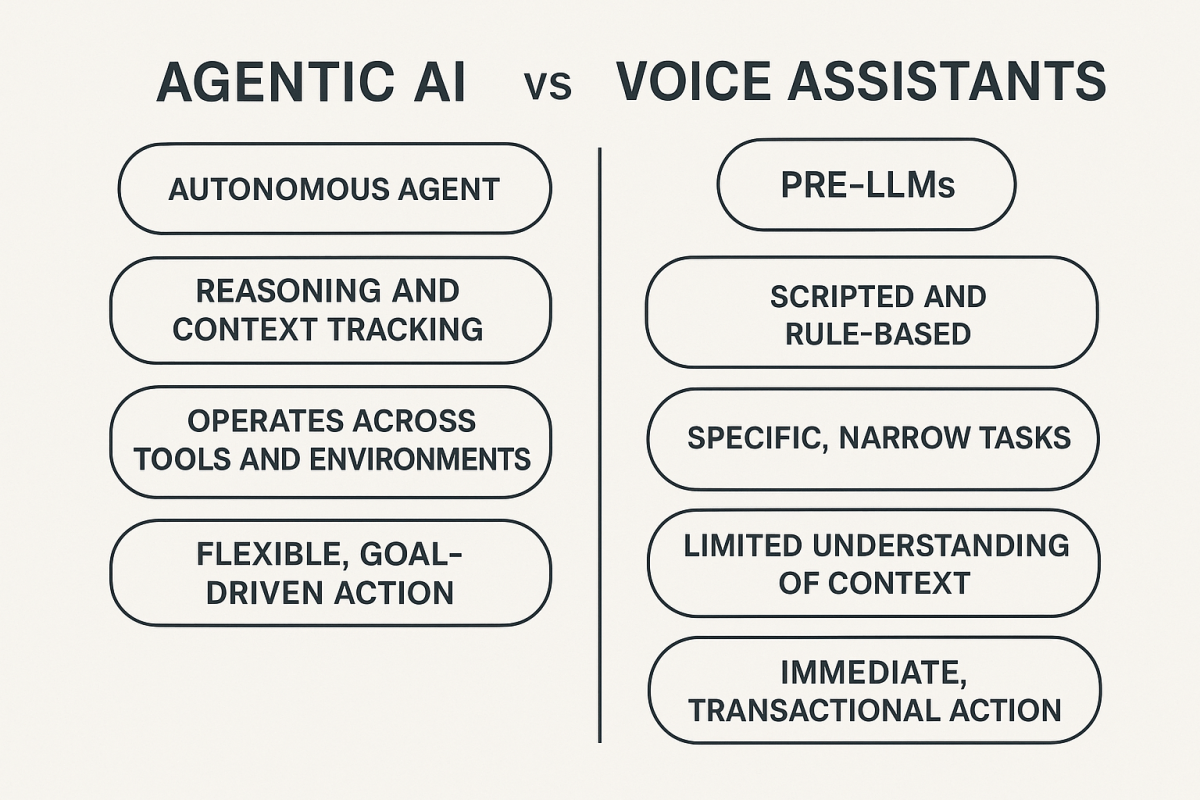
The primary challenge for most enterprises is not instantiating the AI model itself, but rather the integration, orchestration, and governance that surround it. Informal industry data show that as much as 75 to 80 percent of the development effort in Agentic AI projects stems from the infrastructure and process work—far beyond the foundational AI layer. This includes connecting the agent to legacy systems and platforms, ensuring regulatory compliance, and designing workflows that are robust, secure, and context-aware. As such, recently emerging GenAI-native vendors of agentic AI solutions rarely meet these enterprise needs. What’s required instead are solution partners with deep pre-LLM experience who understand the nuances of enterprise deployment. Those who can build a system that can implement rules-based Interactive Voice Response (IVR) systems as well as prompt-based interactions.
This point is underscored by a recent comment from a banking IT leader who noted that while the market is saturated with voice agents, what’s missing is domain-specific expertise, contextual continuity, and implementation maturity. The implication is clear: enterprises don’t need more tools—they need smarter, more connected tools, and trusted partners who can deliver integrated solutions quickly and reliably.
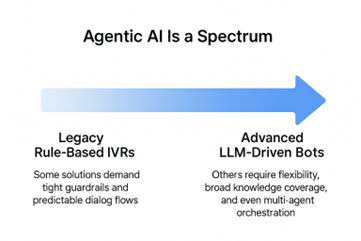
Agentic AI solutions exist along a spectrum. On one end there are traditional, rules-based interactive voice response (IVR) systems that prioritize predictability and guardrails. On the other end there are fully generative, adaptive agents capable of handling ambiguous inputs and dynamically escalating to other systems or human operators. Most real-world enterprise use cases sit somewhere between these extremes, requiring systems that combine the structured decision logic of older technologies with the flexible intelligence of modern LLMs. Vendors must be equipped to support the full range of this spectrum in order to deliver meaningful, scalable results.
Unfortunately, many enterprises mistakenly assume that GenAI-native solutions and prompt-based applications can function out-of-the-box, as standalone customer service systems. In practice, unlocking the full value of Agentic AI requires deeply embedding it into dialog flows, enriching it with industry-specific (synthetic) data, integrating it securely into enterprise tech stacks, and governing it with the same rigor applied to any mission-critical system. That level of sophistication cannot be achieved without experienced vendors who bring not only technical capabilities but also real-world operational knowledge.
Companies like Cognigy, Openstream, Boost.ai, and Kore.ai stand out in this regard. These vendors have long histories of building enterprise-grade dialog systems, know when and how to escalate issues to human or specialized agents, and offer well-tested APIs and orchestration tools. They excel at navigating the complexities of enterprise IT environments, including hybrid deployments, compliance frameworks, and third-party integrations. These companies do not simply deploy an LLM—they aim to deliver a full-stack solution tailored to enterprise realities.
Choosing the right vendor requires a multidimensional evaluation. Enterprises should consider a partner’s vertical expertise, the extent of their out-of-the-box capabilities, their platform's alignment with existing infrastructure, and their readiness to integrate with external datasets and APIs. Additional factors include their support for global service integrators (GSIs), compatibility with multi-agent systems, and the robustness of their governance and compliance tooling. Most importantly, enterprises must determine where their solution sits on the Agentic spectrum—and ensure their vendor has the capacity to deliver across that full range.
Cognigy serves as a compelling case study. As a leader in enterprise conversational AI, it combines foundational models with orchestration layers that support multichannel deployment across sectors like telecom, banking, and healthcare. Cognigy’s solutions are enterprise-ready, offering secure deployment in private data centers or public cloud environments, backed by a strong reputation validated through both analyst recognition and customer feedback. Its 4.8/5 rating on Gartner Peer Insights and inclusion in Gartner’s Magic Quadrant for Enterprise Conversational AI Platforms highlight its strength as a mature, scalable solution partner.
Looking Ahead
The evolutionary path for Agentic AI solutions already has the next obstacle mapped out: how will future multi-agent systems interoperate, and how can conversation-specific details be seamlessly handed off between agents? Such multi-agent systems will have to manage and coordinate multiple, simultaneous contexts. Large Language Models (LLMs) are stateless — they typically operate on a single conversation thread or context window. But real-world use cases require:
- Handling multiple threads of conversation at once
- Maintaining long-term memory across sessions, apps, or workflows.
- Managing different tools or environments (e.g. browsing the web while summarizing documents and using APIs).
- Interacting with multiple users or goals simultaneously, each needing isolated and persistent context.
In our next Research Brief, we will propose and discuss a proposed standard called model context protocol (MCP) that will allow you to encode conversational context details in JSON or YAML.

Werner Goertz | Analyst In Residence
Werner brings a wealth of expertise as a former Gartner analyst, where he spearheaded groundbreaking research into the early adoption of Natural Language Generation (NLG) in enterprise settings, illuminating its transformative potential. This foresight led to his appointment as Principal Evangelist for Alexa for Business at AWS in 2020, where he championed innovative AI-driven solutions. Most recently, he guided a team of Analyst Relations professionals, shaping strategic narratives for IT infrastructure for IBM.