
















Research Finder
Find by Keyword
IBM Gives A Timeline for Quantum, And It’s Sooner Than You Think
IBM's ambitious push for a fault-tolerant quantum future, leveraging a new dedicated data center and advanced error correction, aims to unlock new computational paradigms.

Key Highlights
- IBM announced its commitment to build the world's first large-scale, fault-tolerant quantum computer, marking a significant step towards practical quantum computation.
- This initiative is anchored by a new IBM Quantum Data Center, designed to house and operate these advanced quantum systems with stringent environmental controls.
- The focus is on delivering true fault tolerance, which is critical for executing complex algorithms without debilitating errors.
- IBM aims to deliver solutions for computational challenges currently intractable for even the most powerful classical supercomputers.
- This move signals a strategic deepening of IBM's long-term commitment to advancing quantum technology from theoretical promise to practical application.
The News
IBM today announced its plan to build the world's first large-scale, fault-tolerant quantum computer. This ambitious project will be housed in a new, purpose-built IBM Quantum Data Center, signaling a focused effort to accelerate the development and deployment of robust quantum systems. The initiative is a direct response to the industry's need for quantum machines capable of sustained, error-free computation, moving beyond the current noisy intermediate-scale quantum (NISQ) era. This represents a substantial investment in the infrastructure and research required to achieve truly useful quantum computation. Find out more by clicking here to read the press release.
Analyst Take
The challenge with Quantum computing is not the complexity of the technology or that the use cases aren’t obvious; the challenge is that it's perpetually a five-year-out technology. IBM has upended that narrative.
IBM's announcement to construct the world's first large-scale, fault-tolerant quantum computer, coupled with the establishment of a dedicated IBM Quantum Data Center, represents a substantial pivot in the quantum computing landscape. The fact that this facility is 15 miles from my house also happens to be impactful for me.
For years, the conversation around quantum computing has been dominated by the incremental increase in qubit counts and the ongoing struggle with quantum decoherence and error. This announcement, however, shifts the focus squarely onto fault tolerance, which I believe is the true linchpin for unlocking the transformative potential of quantum computation. Without robust error correction, even a machine with thousands of qubits remains a research curiosity rather than a practical tool.
The quantum computing industry has been in a phase of rapid experimentation, often characterized by the "noisy intermediate-scale quantum" (NISQ) era. While NISQ devices have demonstrated quantum phenomena and allowed for the exploration of basic algorithms, their inherent susceptibility to errors significantly limits the complexity and duration of computations they can reliably perform. This has created a gap between the theoretical promise of quantum computing and its practical applicability. IBM's move is a direct address to this gap, indicating a mature understanding that raw qubit count alone is insufficient. The emphasis on fault tolerance suggests a strategic long-term vision, recognizing that the next major hurdle is not just building more qubits, but building better qubits and architectures that can sustain computation reliably.
This initiative is not merely about building a bigger quantum computer; it is about building a reliable one. Fault tolerance in quantum computing is a profoundly complex engineering and theoretical challenge. It requires sophisticated quantum error correction codes, which themselves demand a significant overhead in physical qubits for each logical qubit. This means that a "large-scale" fault-tolerant machine will likely require thousands, if not millions, of physical qubits to encode a much smaller number of error-corrected logical qubits. The commitment to a dedicated data center underscores the immense infrastructure requirements: maintaining extremely low temperatures, shielding from environmental noise, and managing the intricate control systems necessary for such a complex quantum system. This is not a project that can be undertaken in a standard lab environment; it necessitates a specialized facility architected to meet the unique demands of large-scale quantum processors.
When I look at the broader market, I see many players working on various quantum computing technologies, from superconducting qubits to trapped ions, photonic, and topological approaches. Each has its strengths and weaknesses in the journey towards fault tolerance. What sets IBM's announcement apart is the explicit commitment to "large-scale" and "fault-tolerant" in conjunction with a dedicated facility. This is a clear signal that IBM is moving beyond incremental improvements in their superconducting qubit technology and is now putting serious resources behind the significant engineering challenge of scaling error correction. This is an expensive and difficult endeavor, but if successful, it could put IBM in a leading position for the next wave of quantum applications. The implications for industries like drug discovery, materials science, financial modeling, and optimization are profound if these machines can deliver on their promise.
What was Announced
IBM officially announced its plan to build the world's first large-scale, fault-tolerant quantum computer, signifying a major leap in quantum computing development. This ambitious endeavor is architected to tackle complex computational problems that remain beyond the reach of even the most powerful classical supercomputers.
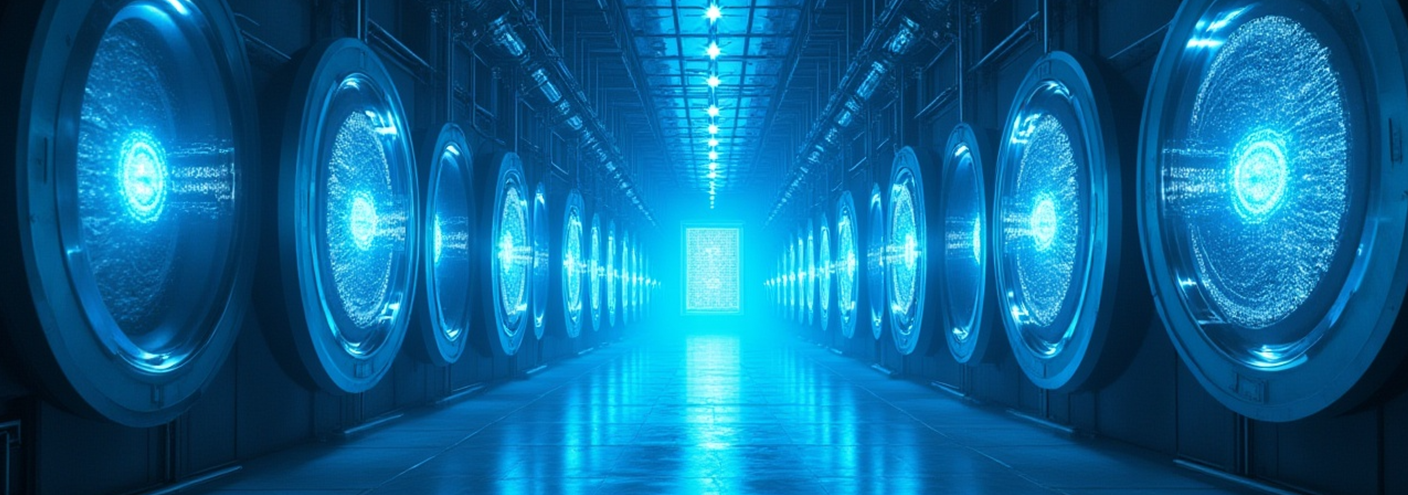
The core of this initiative is the establishment of a new, purpose-built IBM Quantum Data Center. This facility is designed to house the advanced quantum systems necessary for fault-tolerant operation, ensuring optimal environmental conditions such as extreme cryogenic temperatures and robust electromagnetic shielding. The data center aims to provide the stable infrastructure essential for the delicate nature of quantum computations and the intricate control systems required for error correction.
Key to the fault-tolerant approach is the deployment of advanced quantum error correction (QEC) techniques. IBM's quantum computing architecture is being evolved to implement these QEC protocols, which are crucial for detecting and correcting errors that inevitably arise due to environmental noise and qubit imperfections. The system is designed to encode fragile quantum information into a larger number of physical qubits, thereby creating more stable "logical" qubits that are resistant to errors. This process significantly increases the reliability and coherence time of quantum computations, allowing for the execution of deeper and more complex algorithms.
While specific qubit counts for the fault-tolerant machine were not detailed in the press release, the term "large-scale" suggests a system that will require a substantial increase in physical qubits beyond current generations, with a significant portion dedicated to redundancy for error correction. The system is also architected to integrate advanced control electronics and sophisticated software layers designed to manage the complexities of QEC in real-time, aiming to ensure seamless operation and efficient utilization of the quantum resources. The overall system is expected to deliver a platform capable of achieving computational tasks that demand very low error rates, moving quantum computing from experimental demonstrations to practical, impactful applications.
Looking Ahead
Based on what I am observing, IBM's decisive move towards large-scale, fault-tolerant quantum computing is a significant inflection point for the entire quantum industry. For years, the conversation has centered on the "NISQ" era, where devices with increasing qubit counts struggled with fundamental error rates. This announcement is a clear statement that the path to true quantum utility lies in conquering error, not just accumulating more physical qubits. The strategic investment in a dedicated quantum data center underscores the immense engineering challenge ahead. It’s not just about chip design; it’s about a complete ecosystem for cryogenic operations, control electronics, and sophisticated software stacks that can manage error correction overhead. This commitment to infrastructure indicates a long-term vision, moving beyond lab-scale demonstrations to a more industrialized approach.
The key trend that I am going to be looking out for is the actual realization of practical logical qubits. The theoretical frameworks for quantum error correction are well-established, but translating them into a physical architecture with sufficient performance is an entirely different matter. Competitors, particularly those pursuing trapped-ion or photonic approaches, often highlight different scaling pathways and error characteristics. While superconducting qubits, IBM's chosen modality, have shown impressive scaling in raw qubit numbers, achieving fault tolerance in this medium presents unique challenges due to crosstalk and connectivity. Based on my analysis of the market, my perspective is that the next few years will be a race not just for qubit counts, but for demonstrating the stability and functionality of error-corrected logical qubits on a large scale.
Going forward, I am going to be closely monitoring how IBM performs on its stated goal of building this fault-tolerant machine, and hopefully touring this facility again some time soon. Specific metrics will include the number of stable logical qubits achieved, their coherence times, and the demonstrated error rates for complex algorithms running on these error-corrected systems. When you look at the market as a whole, the announcement today sets a new benchmark for ambition. It forces other players to articulate their own roadmaps for fault tolerance with greater clarity. HyperFRAME will be tracking how the company does on its ambitious timeline and the scientific breakthroughs required to meet its goals in future quarters, as this will ultimately determine if the quantum computing market truly shifts from foundational research to broad commercial applicability. It's also going to be fun to track this facility bolster the tech sector in the Hudson Valley.

Steven Dickens | CEO HyperFRAME Research
Regarded as a luminary at the intersection of technology and business transformation, Steven Dickens is the CEO and Principal Analyst at HyperFRAME Research.
Ranked consistently among the Top 10 Analysts by AR Insights and a contributor to Forbes, Steven's expert perspectives are sought after by tier one media outlets such as The Wall Street Journal and CNBC, and he is a regular on TV networks including the Schwab Network and Bloomberg.