













Research Finder
Find by Keyword
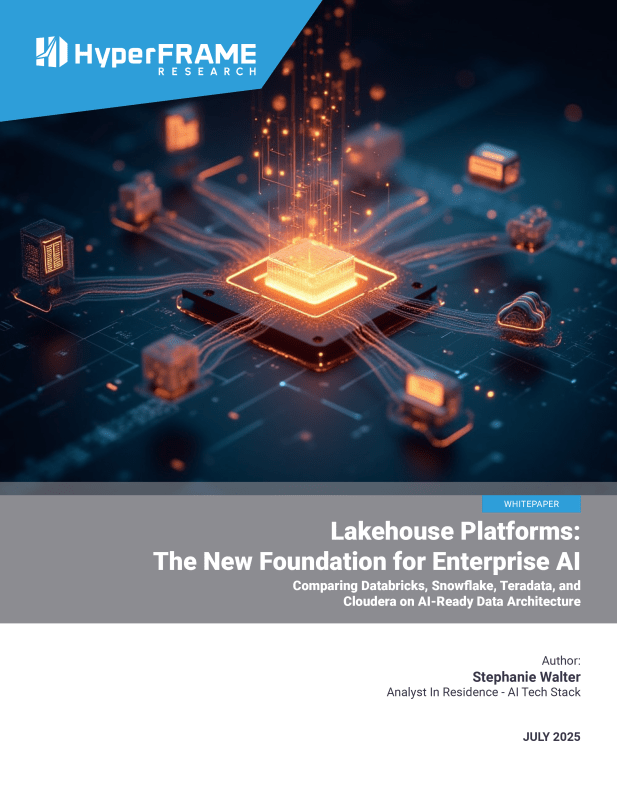
Lakehouse Platforms: The New Foundation
for Enterprise AI
Comparing Databricks, Snowflake, Teradata, and Cloudera
on AI-Ready Data Architecture

As AI transforms enterprises, the foundational data architectures supporting it are more critical than ever. The convergence of data warehousing and data lakes has evolved into the lakehouse architecture, positioning it as a cornerstone for enterprise AI. This paper analyzes how key vendors - Databricks, Snowflake, Teradata, and Cloudera - are shaping the future of AI by enabling unified, scalable, and governed data platforms. These companies are aiming to address the critical need for an AI-ready lakehouse to manage diverse data types, support real-time data streams, and integrate seamlessly with AI model development and deployment. The paper will also provide strategic insight into how these vendors differ in their approach and what enterprise architects should consider when designing for AI readiness.
Key Takeaways
- Lakehouse as AI Foundation: Lakehouses have moved beyond emerging architecture to become a strategic foundation for AI-driven enterprises, unifying diverse data types and supporting both analytical and AI workloads with strong data quality and governance.
- Defining AI-Ready: A truly AI-ready lakehouse goes beyond basic data handling; it supports real-time streaming, integrates with the full AI model lifecycle, enables cross-functional collaboration, and is increasingly crucial for agentic AI patterns and multimodal processing with vector databases.
- Vendor Landscape: Leading vendors like Databricks, Snowflake, Teradata, and Cloudera are each evolving their platforms to meet AI demands. They offer distinct strengths in areas such as open-source commitment, managed services simplicity, hybrid deployment, and specialized AI features like agent orchestration and enterprise vector stores.
- Strategic Adoption: Enterprise architects must consider factors beyond technical features, including the trade-offs between open-source flexibility and managed services, robust governance for sensitive AI data, support for hybrid and multi-cloud scenarios, and a vendor's AI roadmap to ensure long-term scalability and relevance.

Stephanie Walter | Practice Leader, AI Stack
Stephanie Walter is a results-driven technology executive and analyst in residence with over 20 years leading innovation in Cloud, SaaS, Middleware, Data, and AI. She has guided product life cycles from concept to go-to-market in both senior roles at IBM and fractional executive capacities, blending engineering expertise with business strategy and market insights. From software engineering and architecture to executive product management, Stephanie has driven large-scale transformations, developed technical talent, and solved complex challenges across startup, growth-stage, and enterprise environments.