


















Research Finder
Find by Keyword
Lenovo Is Innovating But Is The AI Software Keeping Up?
Lenovo’s push for a full AI portfolio raises questions about practical application, market differentiation, and the race for on-device intelligence.

Key Highlights
- Lenovo is positioning itself as a leader in the AI PC space with a new, comprehensive portfolio of AI-powered devices across consumer, business, and mobile segments.
- The company is betting on a "Smarter AI for All" vision, integrating generative AI and hybrid intelligence into various form factors, from PCs and workstations to tablets and Motorola smartphones.
- New AI-driven features like the ThinkBook VertiFlex Concept and on-device AI assistants signal a strategic move to define new use cases for AI-ready hardware.
- The announcement emphasizes a hybrid AI approach, balancing on-device processing with cloud-based services for data protection and real-time responsiveness.
- Lenovo's focus on a services-led model, like the AI Fast Start program, indicates a shift toward helping businesses deploy and scale AI solutions quickly, beyond just selling hardware.
The News
Lenovo has unveiled a new portfolio of AI-powered devices and experiences spanning its consumer, business, and mobile product lines. This launch is aimed at delivering what the company calls "Smarter AI for All" by embedding generative and hybrid AI features directly into everyday products. This includes new PCs, workstations, tablets, and Motorola smartphones, all designed to enhance productivity, creativity, and user protection. find out more by clicking here to read the press release: https://news.lenovo.com/pressroom/press-releases/ai-powered-devices-experiences-consumer-business-mobile/

Analyst Take
Lenovo's latest announcement, timed with what appears to be an Innovation World event, confirms what many of us have been observing: the AI PC is not a single product but a new category of computing. The company is trying to move beyond being just a PC vendor and into a full-stack AI solutions provider, from the pocket to the data center. This move makes sense given the impending market shift, with IDC projecting that AI-capable PCs will represent a significant majority of shipments within the next couple of years.
The messaging here is less about a single revolutionary device and more about a strategic re-architecture of the entire portfolio around AI. Lenovo is clearly aiming to be a one-stop shop for businesses and consumers looking to adopt AI, whether that's through new hardware, software, or services. This is a subtle but important pivot. It's an acknowledgment that for AI to matter, it needs to be integrated everywhere, not just on a high-end laptop. I am a little puzzled, however, by the seeming lack of a "killer app" to justify this massive architectural shift.
The company's "Smarter AI for All" vision is a nice soundbite, but it raises questions about how truly differentiated their approach is. We are seeing every major OEM, from HP to Dell to Acer, making similar announcements. The real battle is not who has an AI PC, but who has the most compelling on-device AI applications. For now, much of what is being shown seems to be incremental improvements on existing features. While a faster, more intelligent photo editor is welcome, it isn't going to drive mass-market excitement. The real value will be in what applications the ecosystem partners create and how seamless the on-device AI makes the user's life.
Lenovo's focus on a hybrid AI model—combining on-device NPUs with cloud intelligence—is the right approach. It addresses the privacy concerns of sensitive data while still allowing for the power of large-scale models when needed. I am particularly interested in their services-led strategy. The AI Fast Start program, which leverages Intel's AI Assistant Builder to help organizations quickly deploy tailored on-device AI assistants, is a shrewd business move. It takes the abstract concept of the AI PC and turns it into a concrete, revenue-generating service. This is where Lenovo can truly differentiate itself from the pack of competitors who are just selling hardware.
What was Announced
The announcement detailed a range of products and concepts designed to embed AI across Lenovo’s portfolio. The new ThinkPad P16 Gen 3 mobile workstation, for instance, is designed to support demanding AI development with its latest Intel Core Ultra 200HX series processors and integrated NPU. For creative professionals, the new Yoga Tab aims to deliver on-device hybrid AI features, including advanced sketch-to-image functionality with the Lenovo Tab Pen Pro.
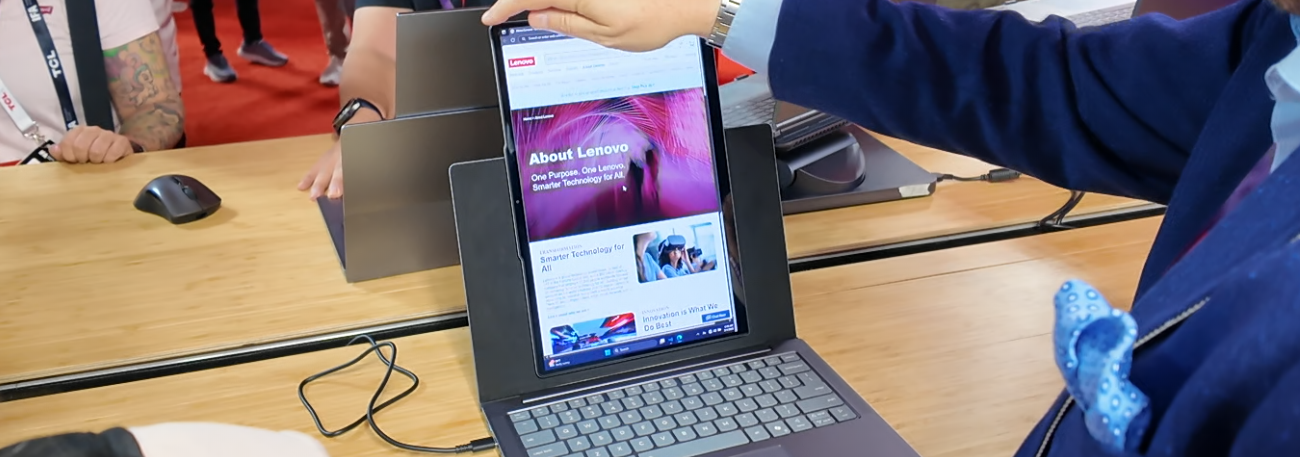
On the concept side, the ThinkBook VertiFlex Concept is architected to showcase a rotatable 14-inch screen with an AI-adaptive UI for seamless switching between horizontal and vertical modes. The Lenovo Smart Motion Concept aims to deliver a multi-directional laptop stand with gesture control and voice commands. In the consumer space, the new Yoga and IdeaPad devices now come with AI features like FlickLift, a smart image editing overlay that uses AI to remove backgrounds and streamline cross-app image work. The latest Motorola phones and tablets are also designed with AI-powered camera systems, with features like Circle to Search with Google.
Lenovo also announced the ThinkVision P40WD-40, a 39.7-inch curved ultrawide monitor designed to support multitasking with its 5120x2160 resolution and Thunderbolt 4 one-cable docking. All of these products aim to bring AI acceleration to a variety of use cases, from professional workflows to creative pursuits and gaming, without relying solely on the cloud.

Looking Ahead
Based on what I am observing, the real story here is not the hardware itself, which is largely an expected refresh with more powerful processors and integrated NPUs. The key trend I am going to be looking out for is the shift from "AI-enabled" hardware to "AI-driven" experiences. Lenovo is putting a lot of weight on the latter, and that is where the true competitive advantage will be built or lost. The company's emphasis on services like AI Fast Start is a fascinating strategic move that could pay significant dividends. It allows them to become a trusted advisor and implementation partner, not just a hardware box-pusher. This is a very different business model, one that moves up the value chain.
When you look at the market as a whole, this announcement today is a significant signal that the race is on to own the "last mile" of AI—the on-device experience. The competition from Dell, HP, and even Apple and Samsung is fierce. My perspective is that the success of Lenovo’s strategy will hinge on how effectively they can partner with software developers to create truly unique and indispensable applications that leverage the on-device NPU. It's one thing to have the hardware capability, but another entirely to have compelling reasons for customers to use it. I will be closely monitoring how the company performs in terms of real-world application adoption and how their services model scales in future quarters.

Steven Dickens | CEO HyperFRAME Research
Regarded as a luminary at the intersection of technology and business transformation, Steven Dickens is the CEO and Principal Analyst at HyperFRAME Research.
Ranked consistently among the Top 10 Analysts by AR Insights and a contributor to Forbes, Steven's expert perspectives are sought after by tier one media outlets such as The Wall Street Journal and CNBC, and he is a regular on TV networks including the Schwab Network and Bloomberg.