














Research Finder
Find by Keyword
Is NVIDIA Positioning AI As America’s Next Apollo Launchpad?
AI factories, physical AI, and the politics of industrial re-acceleration (domestic and global) take center stage at GTC DC.
Key Highlights:
- Jensen Huang framed AI as America’s “next Apollo moment,” blending industrial ambition with national mission.
- NVIDIA’s “AI Factory” architecture reframes data centers as production systems for intelligence and cost per token.
- Physical AI - robots, factories, and vehicles that act in the real world - anchors the next growth wave.
- ARC for AI-native 6G with Nokia, and NVQLink for quantum-GPU coupling, aim to reset telecom and science roadmaps.
- Omniverse DSX, BlueField-4, and Spectrum-X form a blueprint for gigascale AI factories.
- Open models and enterprise tie-ups with CrowdStrike and Palantir signal an agentic, secure enterprise stack.
- Autonomous mobility gets a scale plan with Uber and DRIVE AGX Hyperion 10, targeting 2027 deployment.
- U.S. manufacturing and energy posture moved from backdrop to strategy.
Analysis
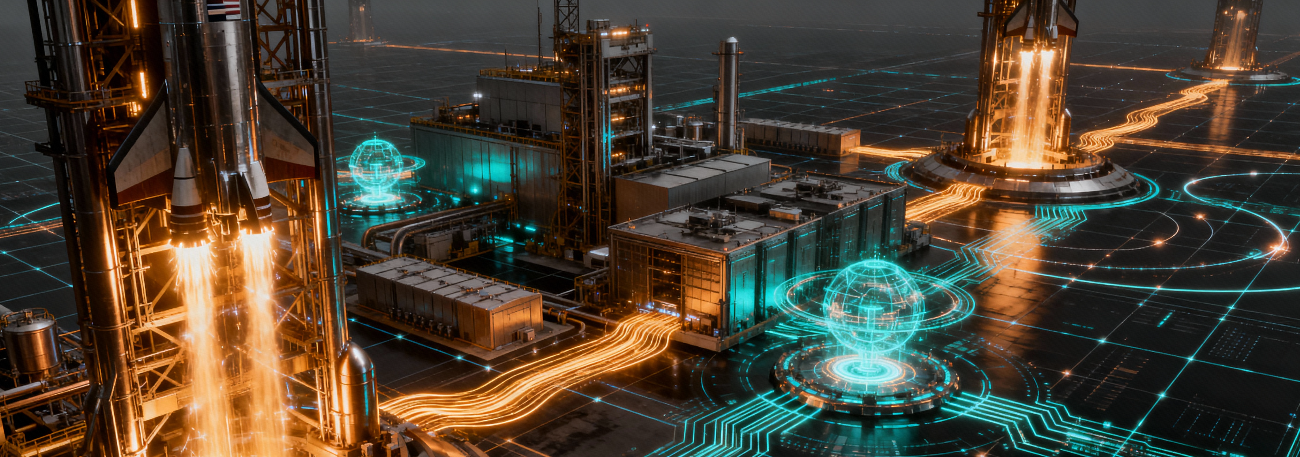
I live twenty miles from the launchpad that sent Apollo to the moon. Growing up under that legacy, I learned that national ambition is realized first in speeches, then in factories and foundries around the country. Standing on that foundation, Jensen Huang came to Washington, D.C., and used GTC DC to announce something larger than a product line. He framed AI itself as America’s next Apollo project - a call to rebuild the industrial stack for a new kind of mission.
GTC DC wasn’t a product show as much as a declaration of industrial intent from a company dominant in just about every part of the AI landscape. It was the equivalent of Boeing or Rockwell taking the stage in 1964 talking about the path to the moon. The message to policymakers and executives was that computing is in a rapid stage of evolution - drawing power, producing hardware, and shaping economics at a planetary scale. In this telling, the age of software abstraction yields to the age of energy, silicon, and embodied intelligence.
And Huang had a lot to cover, as always.
From data centers to AI factories
The keynote’s core metaphor - and arguably the most impactful to enterprise strategy - is the AI factory. Traditional data centers are universal machines, computational swiss army knives running many tools. AI factories are production systems, singly switchblade-focused on producing one product: tokens, the digital atoms of intelligence across language, vision, biology, motion, and more. These mammoth AI factories are measured on one thing: cost per token. Cost per thought.
NVIDIA’s answer to evolving challenges - not least that it's taking more compute than ever to address the ravenous AI market - is extreme codesign across chips, systems, interconnects, libraries, and models. Grace Blackwell plus NVLink-72 aims to act as a single virtual GPU at rack scale, then Spectrum-X scales out the factory across rows and sites. The motivating concept is to raise tokens per second and push down cost per token. Thus, keeping the adoption flywheel spinning as AI companies seek revenue to justify massive investments.
Physical AI and the return of the real
Beyond the virtual, Physical AI takes center stage. The pattern is a three-hop loop:
- Grace Blackwell supercomputers for training and reasoning
- Omniverse simulation systems are building digital-twins for reduced-risk learning
- Jetson Thor robotics computers for deployment at the edge, where latency is life or death
Factories, hospitals, vehicles, and robots are increasingly the endpoints. Foxconn’s Houston site was held up as a living example, the entire flow designed and validated through digital twinning, allowing robots to be trained through simulation before touching anything real. Disney’s “Blue” robot showed the expressive side of embodied AI - beyond the ‘uncanny valley.’ Johnson & Johnson MedTech demonstrated the practical use on the clinical side by pairing Isaac for Healthcare, Omniverse, and Cosmos - codesigning and rehearsing procedures virtually, well ahead of the operating theatre.
Blending corporate strategy and U.S. national renewal
Holding GTC in Washington was a deliberate flex. The resulting narrative enmeshes energy supply, U.S. manufacturing, and scientific leadership. An example, DOE partnerships for seven new AI supercomputers were highlighted, with two named anchors:
- Solstice at Argonne National Labs built up from one hundred thousand Blackwell GPUs into a public research agentic AI platform
- Equinox with ten thousand Blackwell GPUs and a stated up to 2,200 exaflops of AI performance yielding exascale science and open research
NVIDIA’s made-in-America manufacturing storyline spanned wafers and stacks through Arizona, Indiana, Texas, and California. It is a necessary narrative for the company in the geopolitical moment; with resurgent domestic competitors and global competitors all advancing their U.S. domestic storylines. The implication is clear: AI infrastructure is U.S. industrial policy, catching up to how the rest of the world sees it.
AI-native 6G: ARC with Nokia
Telecom was showcased as the lifeblood for both economy and national security - and in the U.S. today it is too dependent on foreign stacks. The Company introduced NVIDIA ARC, built on the Aerial platform, as a U.S. anchored, AI-native wireless compute fabric. For the non-telecom initiated, RAN means Radio Access Network, the portion of a telecommunications system connecting individual devices (phones, sensors, vehicles, etc.) to the broader network core. Nokia will integrate NVIDIA ARC in future base stations, pointing to two opportunities executives should note:
- AI for RAN to improve spectral efficiency and energy productivity
- AI on RAN to host edge AI workloads at base stations where data centers do not exist
If ARC ships as described, RAN simultaneously evolves as a radio and an edge cloud.
NVIDIA also disclosed their $1B strategic investment in Nokia, thus highlighting the company’s intent to anchor an AI-native RAN stack embedded into the U.S. ecosystem.
Quantum becomes hybrid by design: NVQLink
Quantum progress was presented as real but fragile - no surprises there. The absolutely essential error correction advances require fast classical feedback loops. NVQLink serves to connect QPUs to GPUs for real-time CUDA Q calls with latencies as low as ~4 microseconds. This brings quantum forward from the lab into a hybrid quantum GPU model. The company listed seventeen quantum companies and multiple DOE labs in support. For executives, the takeaway is that evaluating quantum readiness now necessitates planning for GPU adjacency and software orchestration. This advances beyond the previous bet-the-farm hardware choices.
Control plane for the AI factory: BlueField-4 and DSX
Two control pieces rounded out the factory picture:
- BlueField-4 DPU with a 64-core Grace CPU complex and ConnectX-9 will run the operating system of the AI factory. This pairing offloads and accelerates networking, storage, security, and context memory flows such as KV caching for long conversations and agent memory
- Omniverse DSX provides enterprises and hyperscalers with the blueprint to design and operate 100 megawatt to multi-gigawatt AI factories to be validated at an AI Factory Research Center in Manassas, Virginia. Including three modules executives can drive based on forward requirements:
- DSX Flex to manage AI factory to grid collaboration for better energy cost and reliability control
- DSX Boost optimizing performance per watt, resulting in higher throughput, lower OPEX
- DSX Exchange to integrate IT and OT systems for unified operations and predictive control
Read this as a full lifecycle and controls suite: site, build, commission, operate, optimize.
Open models and enterprise security
NVIDIA placed open models at the center of its startup and research story, naming Nemotron for agentic and reasoning AI, Cosmos for synthetic data and physical AI, Isaac GR00T for robotics skills, and Clara for biomedical pipelines. Two enterprise focal points stood out as clear templates for NVIDIA:
- CrowdStrike to push “speed of light” cyber defense using Nemotron models and NeMo tooling from cloud to edge
- Palantir to integrate accelerated computing, CUDA X, and Nemotron models into Palantir Ontology for higher scale and speed
This fast-moving area sets agentic AI inside defense and decision loops - with the domain experts driving the codevelopment.
Autonomous mobility gets a scale plan
NVIDIA and Uber are collaborating on autonomous mobility, aiming at about 100,000 autonomous vehicles, with scaling beginning in 2027. DRIVE AGX Hyperion 10 provides the level 4 reference architecture, and Lucid, Mercedes-Benz, and Stellantis were all named as adopters on the road to level 4 readiness. The operating logic matches the AI factory narrative: reference hardware, unified sensor suites, common software rails, partner ecosystems. Repeatable and effective at scale.
Beyond the core - Sector spotlights
NVIDIA keynotes are such a grab bag of announcements that other sectors can get ‘lost in between the cracks’. Two that stood out:
- Financial services highlights fresh STAC records from Grace Hopper and H200 NVL configurations running LSTM and LLM inference workloads. These highlight the practical latency and energy gains that are creating microstructure advantages in trading and risk
- Healthcare and science see new Clara open models, including CodonFM for RNA, La Proteina for atom-by-atom protein structures, and Reason for explainable radiology, with NIH and Kitware integrations mentioned
Competition without borders
NVIDIA’s stack touches everything from telco to quantum, from robots to cyber, from enterprise software to mobility fleets. That means it competes with everyone, including customers and partners.
- Hyperscaler clouds rely on the stack even as they design/build/deploy their own silicon.
- OEMs assemble systems even as they consider alternate fabrics, both vertical and in cross-company collaborations.
- Software vendors embed CUDA X even as they nurture their own agents, attempting niche ecosystem plays, peeling away parts of CUDA's dominance.
That said, NVIDIA's strategic moat is obvious: annual cadence, full-stack integration, and new categories such as ARC, NVQLink, DSX, and Hyperion that reset the playing field, or make it irrelevant.
The broader implication for executives
The subtext for leaders is compelling every time there is a GTC. Thought leaders are seeing compute capacity as an industrial input instead of endlessly arguing it as IT OPEX budget line. Companies in every industry that model tokens per second, cost per token, energy per token, and time to safe deployment will outperform peers in this new moonshot era. AI factories may start out virtual, but the operating metrics are industrial as the map becomes the territory.
Looking Ahead
Based on what I am observing, the most durable theme from NVIDIA GTC DC is the continuing progression of AI into the material economy, and the company’s place at the center of it all. Factories of intelligence now require site selection, grid collaboration, cooling strategy, and an operating system for the data hall - the factory floor of the AI age. The key trend that I am going to be tracking is how these coalescing technologies (e.g. DSX plus BlueField plus Spectrum-X) migrate from hyperscalers into asset-heavy sectors such as automotive, energy, healthcare, aerospace, and public infrastructure. Places where physical AI has the potential of converting digital tokens into real productivity and safety.
The relationships matter to NVIDIA. ARC with Nokia points to a world where base stations additionally become edge AI nodes. NVQLink points to quantum as a hybrid extension of GPU estates, giving it an operational context outside the lab. Uber with Hyperion suggests an evolution of autonomy scaling via reference designs and network effects - going beyond bespoke pilots. CrowdStrike and Palantir integrations indicate that agentic AI is already moving to the top of enterprise decision and defense systems.
Based on my analysis of the market, my perspective is that NVIDIA is using its dominant role and relationships to position past parts and products into operating doctrines for the AI era infrastructure. Going forward, I am going to be tracking how the company performs on three fronts:
- Convert the DSX blueprints into repeatable, gigascale builds with publicly quantifiable cost per token declines
- Turn ARC from demos into upgrades that actually lift spectral efficiency and enable AI on RAN
- Sustain open model cadences, empowering enterprises to mix proprietary and open safely in regulated environments
Considering the market as a whole, the GTC DC announcements read like mission architecture for the next Apollo program. The next bold advance that changes everything. HyperFRAME will be tracking how NVIDIA and its partners translate that architecture into steady manufacturing output, energy discipline, and cross-sector productivity in future quarters.

Stephen Sopko | Analyst-in-Residence – Semiconductors & Deep Tech
Stephen Sopko is an Analyst-in-Residence specializing in semiconductors and the deep technologies powering today’s innovation ecosystem. With decades of executive experience spanning Fortune 100, government, and startups, he provides actionable insights by connecting market trends and cutting-edge technologies to business outcomes.
Stephen’s expertise in analyzing the entire buyer’s journey, from technology acquisition to implementation, was refined during his tenure as co-founder and COO of Palisade Compliance, where he helped Fortune 500 clients optimize technology investments. His ability to identify opportunities at the intersection of semiconductors, emerging technologies, and enterprise needs makes him a sought-after advisor to stakeholders navigating complex decisions.