












Research Finder
Find by Keyword
Dell Infrastructure Updates Demonstrate Steady Progress Toward Its AI Factory Vision
Dell connects storage engine performance, tighter NVIDIA integration, and earlier AI Data Platform commitments into an actionable path for enterprise AI adoption.
Key Highlights:
Dell announced AI Data Platform enhancements with new storage engine capabilities that accelerate inference and agentic AI workloads using PowerScale and ObjectScale.
Dell reports roughly one-second TTFT at a 131K token context window for LLaMA 3.3 70B using PowerScale/ObjectScale with vLLM, LMCache, and NVIDIA NIXL, or 19x faster than its baseline vLLM configuration.
PowerScale will add Parallel NFS (pNFS) with flexible file layout, enabling parallel IO and near-linear throughput scaling for GPU-intensive training and inference.
The updates build on earlier 2025 milestones including the unstructured data engine, S3 over RDMA for ObjectScale, and integrations for vector search and hybrid retrieval.
Dell also expanded its NVIDIA portfolio with new GPU-dense PowerEdge XE7740 and XE7745 systems that complete the validated end-to-end reference architecture.
The News
At Supercomputing 2025 in St. Louis, Dell extended its AI Data Platform strategy with a set of storage and compute enhancements designed to improve throughput, responsiveness, and scalability across enterprise AI workloads. The centerpiece is a validated configuration combining PowerScale and ObjectScale with vLLM, LMCache, and NVIDIA’s NIXL library, part of the NVIDIA Dynamo stack. Dell also previewed upcoming Parallel NFS (pNFS) support for PowerScale with flexible file layout, enabling clients to stripe data access across multiple nodes in a cluster. Complementing the storage engine improvements, Dell expanded the Dell AI Factory with NVIDIA system portfolio offerings. These updates extend Dell’s August and October 2025 AI Data Platform milestones. For more information, read Dell’s press release.
Analyst Take
Dell’s Supercomputing 25 updates reflect steady, meaningful progress toward the AI Data Platform it introduced earlier this year. Dell’s vision centers on integrating storage engines, data engines, and GPU-dense compute into a unified architecture that helps enterprises move from proof-of-concept AI experiments to production environments. With these updates, that architecture is beginning to show measurable, workload-relevant behavior.
The inclusion of KV cache offload is particularly noteworthy. Many vendors argue that offloading KV cache from GPU memory can reduce bottlenecks and improve inference at large context windows. Dell strengthens this case by tying its results directly to PowerScale, ObjectScale, and NVIDIA’s Dynamo stack, and by providing specific metrics that customers can use as reference points. The reported performance improvement over Dell’s own baseline indicates that storage can materially influence cost per token and model responsiveness.
This builds directly on the disaggregated, data-activation architecture we outlined in HyperFRAME Research’s October analysis. Dell is now showing how the storage engines behave under load rather than just on the roadmap.
Dell’s planned support for pNFS reinforces the shift toward storage-driven performance. While parallel IO is well-established in high-performance computing, bringing pNFS into a mainstream enterprise NAS platform provides a more accessible path for teams that want higher throughput without adopting unfamiliar parallel file systems.
These advancements also highlight how the storage layer has become a central competitive dimension in AI infrastructure. Dell’s AI Factory with NVIDIA approach competes with offerings from Pure Storage, NetApp, IBM, and VAST Data, all of whom are positioning storage as a performance-critical component of AI pipelines. We believe customers will compare Dell’s end-to-end performance, operational model, and economics against alternatives.
What Was Announced
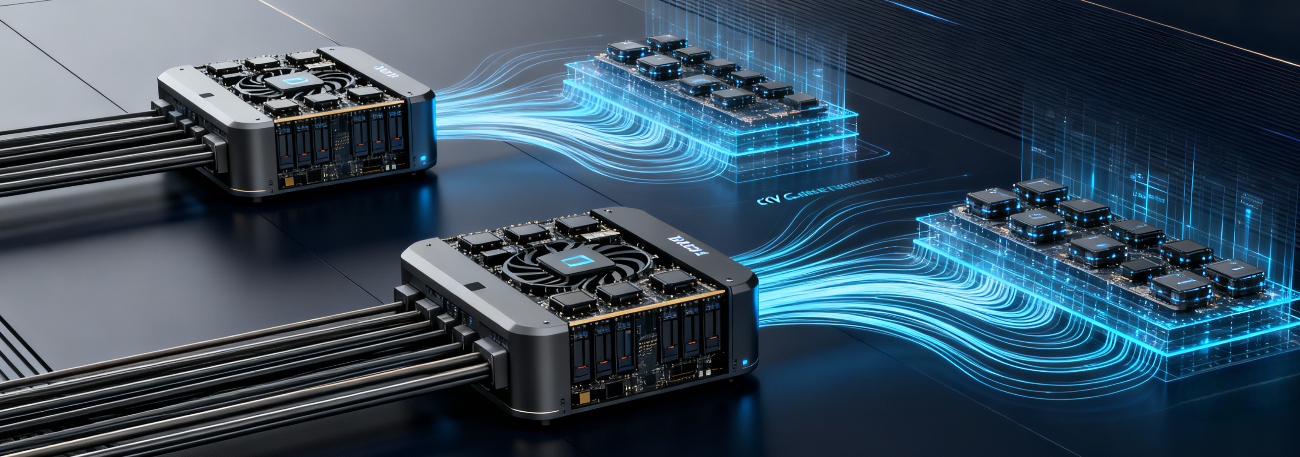
At Supercomputing 2025 in St. Louis, Dell extended its AI Data Platform strategy with a set of storage and compute enhancements designed to improve throughput, responsiveness, and scalability across enterprise AI workloads. First up, Dell is tackling the AI inference and agentic workloads bottleneck with a new KV cache offload configuration. This is built on PowerScale and ObjectScale and integrates with technologies like vLLM, LMCache, and NVIDIA NIXL.
Externalizing the KV cache can reduce pressure on the GPU's memory, making large-context inference and multi-turn conversations much faster and more responsive. According to Dell’s internal testing, this configuration achieved approximately one-second Time to First Token at the full 131K token context window of LLaMA 3.3 70B Instruct, which represents a 19x improvement over a baseline vLLM configuration that recomputes KV cache on the GPU.
Dell also introduced improvements for PowerScale with a preview of Parallel NFS (pNFS) flexible file layout support. This is designed to let clients hit multiple PowerScale nodes at the same time. For intense workloads like training and inference, organizations should expect higher, more sustained bandwidth and throughput.
The company is expanding its hardware offerings for the AI Factory by rolling out new PowerEdge XE7740 and XE7745 servers. These new systems support the latest from NVIDIA, including NVIDIA Hopper and the NVIDIA RTX Pro 6000 Blackwell Server Edition GPUs, ensuring customers have access to top-tier compute power for multimodal and agentic AI workloads.
Dell's 2025 AI Data Platform roadmap has already delivered key features like the unstructured data engine, S3 over RDMA for ObjectScale, and crucial integrations for things like vector search, hybrid retrieval, and data lifecycle management. It shows a consistent effort to build a comprehensive platform for the entire AI data pipeline.
These updates extend Dell’s August and October 2025 AI Data Platform milestones, which introduced the unstructured data engine, S3 over RDMA for ObjectScale, and integration with Elastic for semantic search and hybrid retrieval.
Looking Ahead
Dell’s announcements arrive as the pace of AI infrastructure innovation accelerates. The AI Data Platform is Dell’s response to the challenge of connecting petabyte-scale unstructured data with evolving GPU architectures and rapidly changing AI software frameworks.
Storage now plays a more active role in that architecture. KV cache offload, pNFS, and the unstructured data engine indicate a shift toward storage-driven performance, where responsiveness, throughput, and cost per token are shaped by the behavior of the data layer. If Dell can demonstrate predictable improvements across production workloads, customers will increasingly view the storage engines as strategic to their AI economics.
Dell’s integration with NVIDIA is also becoming more deliberate. The combination of NIXL, Dynamo, and validated PowerEdge platforms positions the Dell AI Factory with NVIDIA as a unified system that aims to shorten deployment time and improve lifecycle management. Customers will expect this integration to translate into clearer operational models and more consistent performance tuning.
In my opinion, these updates provide solid evidence that Dell is executing the roadmap it laid out at the start of 2025. The company should consider sharing field-validated case studies demonstrating reduced GPU spend, faster iteration cycles, or improved performance at large context windows.
For organizations evaluating AI infrastructure, the near-term recommendation is to treat Dell’s news as an indication that the platform is entering early execution. Prospective buyers should ask for detailed architectural briefings that explain how KV cache offload, pNFS, and the unstructured data engine integrate with their specific pipelines and what observability and tuning tools Dell provides.
Over the next several months, we will be watching for independent validation of Dell’s performance claims, real-world customer evidence, and stronger indications of how the company will evolve the AI Data Platform to support emerging agentic AI patterns. If Dell continues converting roadmap commitments into measurable outcomes, it will remain among the vendors shaping the next era of enterprise AI infrastructure.

Don Gentile | Analyst-in-Residence -- Storage & Data Resiliency
Don Gentile brings three decades of experience turning complex enterprise technologies into clear, differentiated narratives that drive competitive relevance and market leadership. He has helped shape iconic infrastructure platforms including IBM z16 and z17 mainframes, HPE ProLiant servers, and HPE GreenLake — guiding strategies that connect technology innovation with customer needs and fast-moving market dynamics.
His current focus spans flash storage, storage area networking, hyperconverged infrastructure (HCI), software-defined storage (SDS), hybrid cloud storage, Ceph/open source, cyber resiliency, and emerging models for integrating AI workloads across storage and compute. By applying deep knowledge of infrastructure technologies with proven skills in positioning, content strategy, and thought leadership, Don helps vendors sharpen their story, differentiate their offerings, and achieve stronger competitive standing across business, media, and technical audiences.