















Research Finder
Find by Keyword
Is HPE's New Cray GX5000 The Perfect Solution for the AI Gold Rush?
High-density liquid cooling, heterogeneous compute flexibility (Rubin/MI430X), Slingshot 400 performance, and industry-leading DAOS storage integration.
Key Highlights:
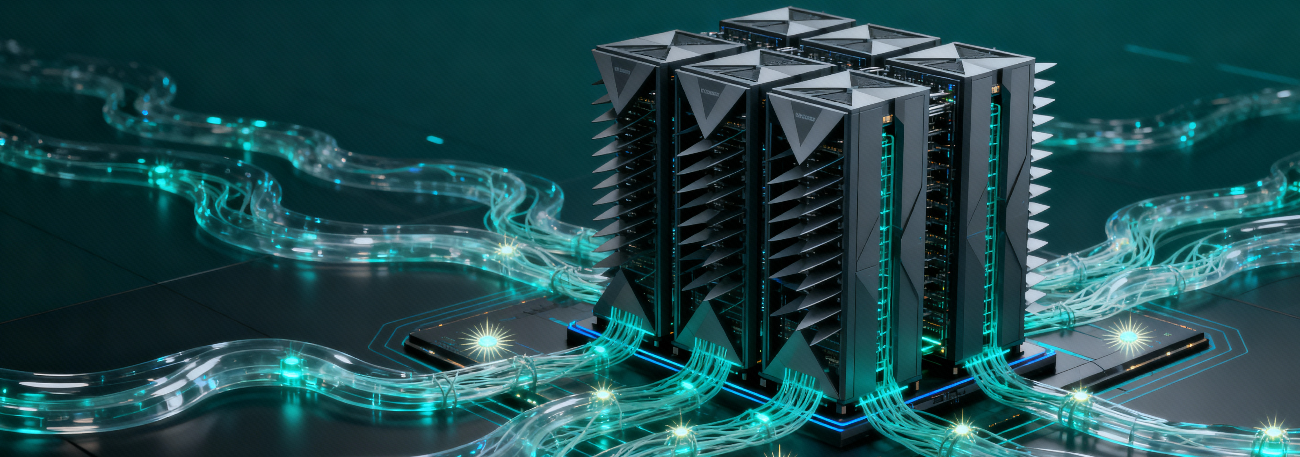
The HPE Cray GX5000 platform is architected to deliver breakthrough compute density in a smaller rack footprint.
The portfolio introduces three new direct liquid-cooled blades supporting both NVIDIA Rubin and AMD MI430X GPUs, underscoring silicon agnosticism.
HPE Slingshot 400 interconnect aims to deliver 400 Gbps networking at scale with ultra-low tail latency for demanding AI workflows.
The new Cray K3000 storage system is the first factory-built offering with embedded DAOS, substantially boosting I/O performance for AI applications.
Significant early adoption by major European and US research centers validates the platform's focus on energy efficiency and converged AI/HPC.
The News
Hewlett Packard Enterprise announced the newest additions to its next-generation HPE Cray supercomputing portfolio, centered on the GX5000 platform. The expansion features three new multi-partner, multi-workload compute blades, architected for maximum density and 100 percent direct liquid cooling. The platform refresh targets the growing demands of converged AI and high-performance computing (HPC) workloads, providing a unified architecture for scientific discovery and large-scale AI training. This news follows the platform's initial debut and rapid customer traction, including selections by major academic and national research centers. Find out more by clicking here to read the press release: HPE Press Release.
Analyst Take
This announcement affirms HPE’s calculated position in the emerging landscape where the HPC market and the AI factory market are functionally merging. The key design principle here is not raw peak performance, which is transient, but sustainable density and energy efficiency at scale. When you look at the industry today, the primary constraint on massive AI training and large-scale simulation is no longer computational throughput alone; it is power delivery and thermal management. The GX5000 portfolio is HPE’s answer to this thermal crisis, and it is a marvel of engineering optimization.
We view the 100 percent direct liquid cooling as a prerequisite for participating in the high-end market now. The thermal design - supporting up to 400 kilowatts per rack and operating with warmer water - is a necessary evolution. It enables the denser packaging of increasingly power-hungry accelerators such as the anticipated NVIDIA Rubin and AMD MI430X platforms. This warm-water capability is not merely about surviving the heat; it changes the economic equation for operators like LRZ, which plans to reuse the waste heat. This is a crucial element of the total cost of ownership discussion and a powerful lever for attracting sustainability-conscious sovereign AI initiatives globally.
We see the true insight here resting in the subtle architectural choices HPE has made to secure its market dominance. First, the strategic inclusion of three distinct compute blades - the NVIDIA-focused GX440n, the AMD-focused GX350a, and the CPU-only GX250 - is a masterstroke of vendor optionality. HPE understands that leadership-class supercomputing facilities are rarely monolithic. Customers need the flexibility to run multiple generations and vendors of silicon within a unified framework, and the GX5000 is designed to facilitate this heterogeneous environment flexibly. This provides a strong competitive contrast to vertically integrated competitors who tend to push single-vendor stacks.
Second, the storage announcement is absolutely stellar. HPE’s introduction of the Cray Supercomputing Storage Systems K3000, the first factory-built system with embedded Distributed Asynchronous Object Storage (DAOS), is a significant competitive differentiator. AI training is critically I/O bound. The shift from physics-based simulation to data-driven, trillion-parameter model training fundamentally changes the demands on the parallel file system. DAOS, with its highly optimized, low-latency object storage approach, is proving to be a high-velocity solution. Claiming up to 75 million IOPS per rack, representing a 300 percent increase over predecessor systems, aims to alleviate the data movement bottleneck that cripples large-scale AI production environments. This is where HPE is making a decisive move against general-purpose storage competitors.
Our perspective is that HPE is leveraging its Cray heritage to define the infrastructure for the converged AI/HPC world. It is building a system that is not just fast for a single job but highly productive across a multi-tenant, multi-workload environment. This design philosophy is clearly resonating, as demonstrated by the strong forward-looking order book from institutions such as ORNL, HLRS, and LRZ.
What was Announced
The core of the announcement details the high-density components of the HPE Cray Supercomputing GX5000 platform. The system is built around 100 percent direct liquid cooling for thermal management. The new compute blades are designed to offer multi-partner, multi-workload functionality.
The HPE Cray Supercomputing GX440n Accelerated Blade is the flagship NVIDIA offering. This blade is designed to house four NVIDIA Vera CPUs and eight next-generation NVIDIA Rubin GPUs. Customers can configure up to 24 of these blades per compute rack, aiming to deliver industry-leading density of up to 192 NVIDIA Rubin GPUs per rack.
The HPE Cray Supercomputing GX350a Accelerated Blade supports AMD silicon, including one next-generation AMD EPYC processor, codenamed “Venice,” and four AMD Instinct™ MI430X GPUs. Up to 28 of these blades can be configured per rack, providing up to 112 AMD MI430X GPUs.
For customers requiring dedicated CPU partitions, the HPE Cray Supercomputing GX250 Compute Blade is designed to accommodate eight next-generation AMD EPYC “Venice” CPUs, with up to 40 of these blades configurable per rack. All processing blades include a choice of four or eight HPE Slingshot 400 gigabits per second (Gbps) endpoints per blade and an option for two Non-Volatile Memory Express (NVMe) Solid State Drives (SSDs) for local storage.
The platform uses HPE Slingshot 400, a high-performance interconnect engineered for the denser form factor. It aims to deliver 400 Gbps line speed across 64-port switch ASICs, utilizing an adaptive routing and automated congestion management architecture to provide reduced latency and improved sustained bandwidth.
The HPE Cray Supercomputing Storage Systems K3000 is the storage complement. It is based on the HPE ProLiant Compute DL360 Gen12 server and is the industry's first factory-built storage system with embedded DAOS. Performance-optimized configurations are available with eight, twelve, or sixteen NVMe drives, while capacity-optimized configurations offer 20 NVMe drives per node, supporting sizes up to 15.36 TB and connectivity options including Slingshot, InfiniBand NDR, or 400 Gbps Ethernet.
The accompanying HPE Supercomputing Management Software introduces new capabilities designed to support multi-tenant, virtualized, and containerized environments. The software aims to deliver a unified and secure systems management experience and provides system-wide power and energy management features for integrating with power-aware schedulers.
Looking Ahead
The HPE Cray GX5000 architecture represents a clear thesis: the future of high-end computing requires convergence across three vectors - compute, interconnect, and storage - and must be defined by energy efficiency. The hyper-density and 100 percent direct liquid cooling are simply the ante to play in this market. The true competitive thrust is found in the underlying network and I/O stack.
The key trend we are going to be looking out for is the success of HPE’s Slingshot interconnect against the dominance of NVIDIA’s InfiniBand. Slingshot is designed to be a differentiated Ethernet-based high-performance interconnect, offering congestion control features crucial for unpredictable AI workloads. However, the ecosystem effect of InfiniBand, particularly as NVIDIA pushes its GPU platforms toward tightly coupled memory fabrics, remains a powerful gravitational force. HPE needs Slingshot 400 to prove its sustained performance and scalability leadership, especially in multi-tenant environments. Our perspective is that choosing a proprietary, highly optimized interconnect over the market standard is a high-stakes bet, but it can be necessary to control the end-to-end user experience and extract full performance from the dense platform.
When you look at the market as a whole, the announcement places HPE in direct competitive juxtaposition with players such as Lenovo, which is also heavily leveraging its 6th Generation Neptune liquid-cooling technology, and system builders relying entirely on NVIDIA reference architectures. HPE is aiming for the center of gravity in the supercomputing world: large national labs and sovereign AI customers who value architecture diversity, power efficiency, and integrated management.
We believe HPE can improve its overall competitiveness and AI ecosystem influence over the next 12 months by leveraging the HPE Cray GX5000's unique architectural strengths to define the converged AI/HPC market. Specifically, HPE must aggressively market the platform's silicon agnosticism (supporting both NVIDIA Rubin and AMD MI430X) as a strategic hedge against vertically integrated competitors, making it the preferred, flexible choice for sovereign AI and large research centers.
Critically, HPE needs to rapidly secure commercial enterprise adoption of the Cray K3000 storage with embedded DAOS to prove that its 300% IOPS improvement is the definitive solution to the AI I/O bottleneck, transforming its Cray heritage from a niche HPC strength into a universally required AI performance differentiator. This focus - on flexibility, energy efficiency, and I/O dominance - can solidify its position at the intersection of high-end computing and AI factory infrastructure.
HyperiFRAME Research will be tracking how the company performs on delivering the K3000 DAOS storage system in future quarters. This component is arguably the most valuable differentiator for AI productivity in the near term. The ability to dramatically improve IOPS per rack for I/O-bound AI tasks is a genuine value proposition. If HPE can execute on the 2026/2027 delivery timelines while maintaining the quoted density, they are set to solidify its leadership in defining the next generation of exascale infrastructure. This is where system integration truly counts.

Ron Westfall | VP and Practice Leader for Infrastructure and Networking
Ron Westfall is a prominent analyst figure in technology and business transformation. Recognized as a Top 20 Analyst by AR Insights and a Tech Target contributor, his insights are featured in major media such as CNBC, Schwab Network, and NMG Media.
His expertise covers transformative fields such as Hybrid Cloud, AI Networking, Security Infrastructure, Edge Cloud Computing, Wireline/Wireless Connectivity, and 5G-IoT. Ron bridges the gap between C-suite strategic goals and the practical needs of end users and partners, driving technology ROI for leading organizations.
Share

Stephen Sopko | Analyst-in-Residence – Semiconductors & Deep Tech
Stephen Sopko is an Analyst-in-Residence specializing in semiconductors and the deep technologies powering today’s innovation ecosystem. With decades of executive experience spanning Fortune 100, government, and startups, he provides actionable insights by connecting market trends and cutting-edge technologies to business outcomes.
Stephen’s expertise in analyzing the entire buyer’s journey, from technology acquisition to implementation, was refined during his tenure as co-founder and COO of Palisade Compliance, where he helped Fortune 500 clients optimize technology investments. His ability to identify opportunities at the intersection of semiconductors, emerging technologies, and enterprise needs makes him a sought-after advisor to stakeholders navigating complex decisions.

Steven Dickens | CEO HyperFRAME Research
Regarded as a luminary at the intersection of technology and business transformation, Steven Dickens is the CEO and Principal Analyst at HyperFRAME Research.
Ranked consistently among the Top 10 Analysts by AR Insights and a contributor to Forbes, Steven's expert perspectives are sought after by tier one media outlets such as The Wall Street Journal and CNBC, and he is a regular on TV networks including the Schwab Network and Bloomberg.