
















Research Finder
Find by Keyword
Marvell's Alaska P PCIe 6 Retimers Power AI Fabric
Marvell confirms significant industry adoption of its Alaska P PCIe 6 retimers, which are essential 5nm PAM4 devices designed to ensure high-speed, reliable, and long-distance 64 GT/s interconnectivity across complex AI infrastructure linking accelerators, GPUs, and CXL devices.
12/09/2025
Key Highlights
- Marvell announced industry adoption of its Alaska P PCIe 6 retimers, confirming its role in accelerated AI infrastructure.
- The technology is designed to enable 64 GT/s, low-latency connections between AI accelerators, GPUs, XPUs, and CXL devices.
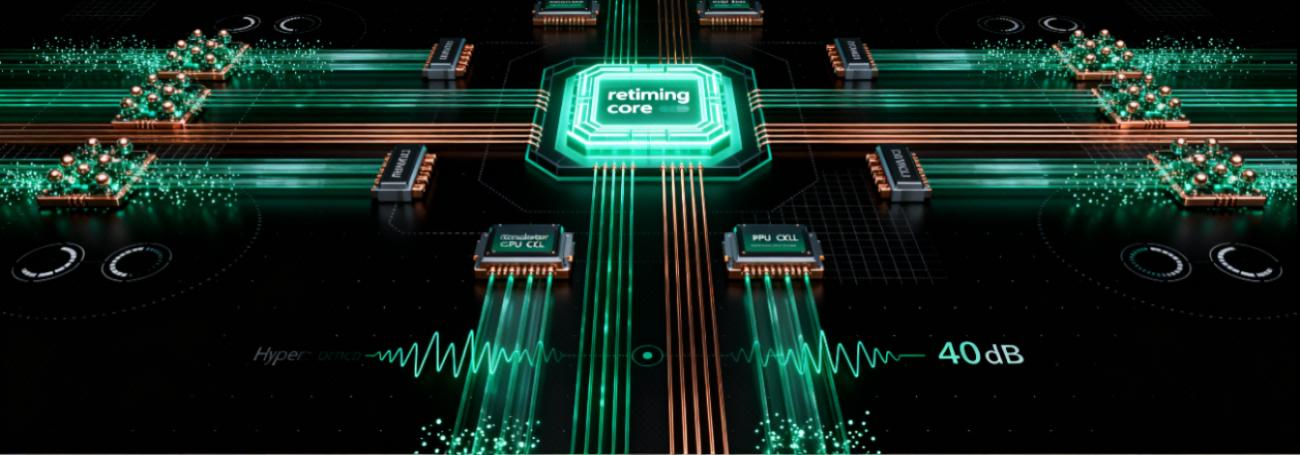
- Built on 5nm PAM4 SerDes, the retimers are architected to compensate for 40 dB of channel loss over long distances.
- The devices are being integrated into platforms by server vendors and embedded into Active Electrical and Optical Cables by partners like Supermicro and TE Connectivity.
- The mass adoption of high-performance retimers suggests system architects are prioritizing fabric reliability over raw accelerator performance.
The News
Marvell Technology announced the widespread industry adoption of its Alaska P PCIe 6 retimer product line, validating its strategy to enable next-generation AI and data center interconnects. This portfolio is architected to scale the complex compute fabric necessary for accelerated workloads, specifically enabling connectivity between GPUs, XPUs, and CXL devices across disaggregated server and cluster designs. The 5nm PAM4 SerDes technology is designed to deliver high-speed, low-power, and low-latency signal integrity across increasing physical distances in massive data centers. Supermicro, TE Connectivity, and TeraHop - key Marvell partners - are leveraging the retimers in their systems and Active Electrical/Optical Cable offerings.
Source: Marvell Announces Adoption of Its PCIe Retimers by AI/DC Providers
What Was Announced
Marvell today detailed the industry embrace of the Alaska P PCIe retimer family, a portfolio designed to solve the signal integrity challenges inherent in high-speed, accelerated AI infrastructure. These devices are fundamentally critical for scaling PCIe 6.0 links, which operate at a challenging 64 gigatransfers per second (GT/s) using PAM4 signaling. The adoption by server vendors aims to deliver seamless, low-latency connectivity between disparate components, specifically AI accelerators, GPUs, XPUs, CPUs, and CXL devices, across systems and clusters. The architecture is built on Marvell's proprietary 5nm PAM4 SerDes technology, which is intended to compensate for significant channel loss, reportedly addressing up to 40 dB of loss. This feature is paramount as AI clusters move towards disaggregated designs, where communication links span greater physical distances, often extending outside the traditional server chassis.
The Alaska P retimers are architected to be deployed flexibly, either integrated onto the mainboards of GPU/XPU platforms, placed on standalone retimer cards for general-purpose servers, or embedded directly into interconnect products. Strategic partners like TE Connectivity and TeraHop are already utilizing the technology to create PCIe AEC and AOC solutions. This deployment flexibility is designed to support diverse cloud customer architectures. Crucially, the chips incorporate advanced telemetry, diagnostics, and fleet-management capabilities. We believe these features highlight Marvell's understanding that performance cannot be divorced from operational reliability in a massive hyperscale environment.
Market Analysis
Adoption of advances like these is going to be foundational to the next wave of compute infrastructure. While the PCIe segment dominated the retimer market in 2024, largelky because of its role in high-performance computing and data centers, the industry is not standing still. Moves toward highly coupled, accelerator-centric compute fabrics are requiring PCIe 6.0's increased bandwidth to feed ever more data-hungry AI models. Without effective retiming, 64 GT/s links simply fail over the distances required for a disaggregated rack design. The announced development puts the company in direct competition with key players such as Broadcom and Astera Labs, where both of these major players also announced Gen 6 solutions in recent years. Broadcom, for instance, in early 2024 launched its own 5nm PCIe Gen 6.0/CXL3.1 retimers. Competitors are not just on going head-to-head on performance, but on other considerations like: SerDes maturity, power efficiency, and hyperscaler ecosystem interoperability testing - a huge priority. For the massive hyperscaler data centers, every retimer milliwatt saved yields millions of dollars in OPEX reduction at scale. Low-power design is the single greatest strategic asset, even more so than other performance factors. Finally, for all of these players, interoperability is table stakes - necessary for any credible solution. Consider the dizzying matrix of GPU generations, CPU platforms, and CXL devices that these components must demonstrate flawless operation across. The supplier that can prove minimal latency variation across these diverse environments will ultimately earn the trust necessary for volume deployment. Milliseconds matter.
Looking Ahead
The key trend we'll be monitoring is the rapid and somewhat jarring acceleration of connectivity standards adoption. Components like the Alaska P are jumping PCIe 6.0's leap to 64 GT/s, and that requires an overhaul of system design far beyond a component swap-out. Enterprises must recognize that the bottleneck is pathways connecting chips, not just the CPU/GPU complex. This will force CIOs to view their internal PCIe fabric as a true, mission-critical network, demanding expertise in signal integrity and power management traditionally reserved for networking engineers. HyperFRAME will be monitoring how the competitive landscape, specifically Marvell, Broadcom, and Astera Labs, manages the imminent transition to PCIe 7.0 and its formidable 128 GT/s target. The supplier that can deliver a successful CXL 3.0-ready solution, minimizing both latency and power burn, will secure the hyperscaler design wins for the latter half of the decade. The complexity is escalating.

Ron Westfall | VP and Practice Leader for Infrastructure and Networking
Ron Westfall is a prominent analyst figure in technology and business transformation. Recognized as a Top 20 Analyst by AR Insights and a Tech Target contributor, his insights are featured in major media such as CNBC, Schwab Network, and NMG Media.
His expertise covers transformative fields such as Hybrid Cloud, AI Networking, Security Infrastructure, Edge Cloud Computing, Wireline/Wireless Connectivity, and 5G-IoT. Ron bridges the gap between C-suite strategic goals and the practical needs of end users and partners, driving technology ROI for leading organizations.
Share

Stephen Sopko | Analyst-in-Residence – Semiconductors & Deep Tech
Stephen Sopko is an Analyst-in-Residence specializing in semiconductors and the deep technologies powering today’s innovation ecosystem. With decades of executive experience spanning Fortune 100, government, and startups, he provides actionable insights by connecting market trends and cutting-edge technologies to business outcomes.
Stephen’s expertise in analyzing the entire buyer’s journey, from technology acquisition to implementation, was refined during his tenure as co-founder and COO of Palisade Compliance, where he helped Fortune 500 clients optimize technology investments. His ability to identify opportunities at the intersection of semiconductors, emerging technologies, and enterprise needs makes him a sought-after advisor to stakeholders navigating complex decisions.