












Research Finder
Find by Keyword
AI Beyond the GPU: A 2025 Recap How AI Factories Reshaped The Semiconductor Stack in 2025
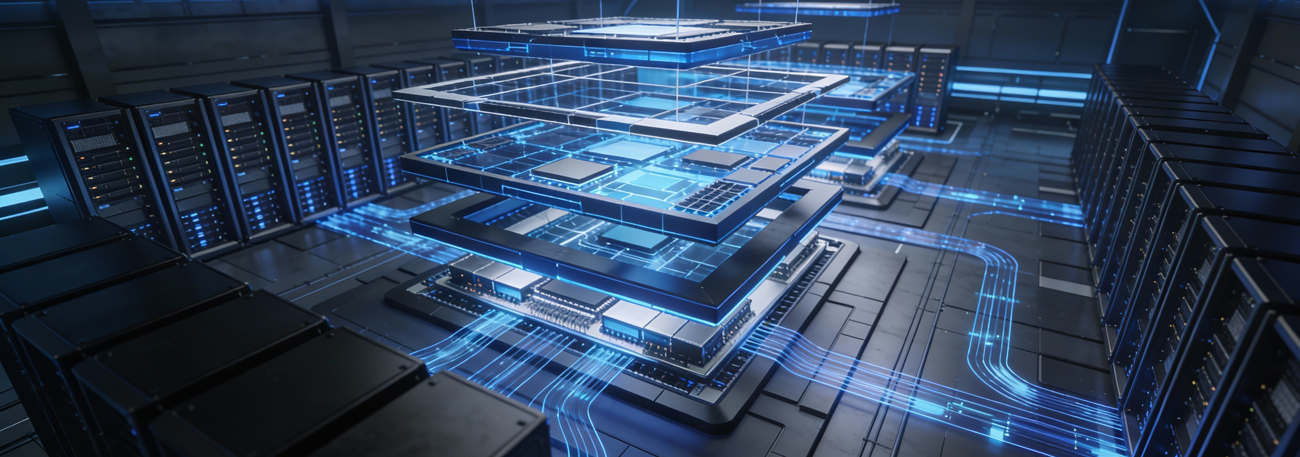
How AI Factories Reshaped the Semiconductor Stack
In 2025, the AI infrastructure market crossed a structural inflection point. What began as a race for GPUs evolved into a far more complex competition to design, deploy, and operate AI factories - integrated systems where compute, memory, packaging, interconnect, power, and software are co-optimized at rack scale and beyond.
This research brief examines how the unit of competition shifted from chips to systems, why traditional semiconductor value chains were reorganized, and which constraints now define winners and losers heading into 2026.
Key Highlights
From GPUs to AI Factories
The market is moving away from component-centric thinking toward fully integrated, rack-scale systems. GPUs remain central, but differentiation is shifting to companies delivering cohesive AI factory platforms with predictable utilization, faster deployment, and lower stranded capital risk.
Memory and Packaging Became Structural Constraints
High Bandwidth Memory (HBM) availability and advanced packaging capacity (particularly TSMCs CoWoS) emerged as the true governors of AI system delivery. In many cases, packaging timelines exceeded wafer availability, reshaping product roadmaps and competitive positioning.
Interconnect and Power Redefined System Economics
Data movement, not raw compute, became the dominant limiter of performance. Ethernet gained hyperscale validation for AI workloads, while power delivery and cooling reasserted physics as a first-order architectural constraint, forcing operators to rethink site selection and facility design.
Custom Silicon Expanded, but Software Still Decided Winners
Hyperscaler custom accelerators advanced rapidly, but ecosystem gravity remained decisive. Software tooling, developer familiarity, and operational maturity preserved incumbent advantages, reinforcing hybrid architectures rather than wholesale platform shifts.
Physical AI Emerged as the Next System Boundary
As AI factories matured, attention shifted to deploying trained models into real-world systems (robots, vehicles, and industrial platforms) with radically different constraints around determinism, power efficiency, safety, and lifecycle support.
Geopolitics and the U.S. Buildout Moved from Shock to Structure
Export controls, regional compliance, and domestic manufacturing transitioned from episodic disruption to enduring design parameters. In the U.S., semiconductor investment shifted from announcements to execution, exposing workforce and ecosystem depth as binding constraints.
AI Beyond the GPU frames 2025 as the year the semiconductor industry reorganized around AI factories; and sets the agenda for the architectural, economic, and geopolitical decisions that will shape AI infrastructure through 2026 and beyond.

Stephen Sopko | Analyst-in-Residence – Semiconductors & Deep Tech
Stephen Sopko is an Analyst-in-Residence specializing in semiconductors and the deep technologies powering today’s innovation ecosystem. With decades of executive experience spanning Fortune 100, government, and startups, he provides actionable insights by connecting market trends and cutting-edge technologies to business outcomes.
Stephen’s expertise in analyzing the entire buyer’s journey, from technology acquisition to implementation, was refined during his tenure as co-founder and COO of Palisade Compliance, where he helped Fortune 500 clients optimize technology investments. His ability to identify opportunities at the intersection of semiconductors, emerging technologies, and enterprise needs makes him a sought-after advisor to stakeholders navigating complex decisions.