

















Research Finder
Find by Keyword
Microsoft: 2026 Next Steps
Microsoft is entering a 2026 AI supercycle with projected revenues of $327 billion, supported by a $125 billion capital expenditure to double its data center footprint and activate massive AI Factories.

07/01/26
Key Highlights
- Microsoft is evolving Azure from a hosting platform into a managed orchestration layer, moving beyond simple chatbots to Agentic AI capable of executing autonomous, multi-step business workflows.
- Through its triple moat strategy (identity, workflow, and orchestration), Microsoft is formalizing digital labor via Entra Agent ID, giving autonomous agents verifiable identities and secure governance frameworks.
- To protect margins, Microsoft is diversifying its silicon stack with in-house Maia accelerators and pursuing energy independence through on-site nuclear (SMR) and advanced liquid-cooling technologies.
- Microsoft needs to neutralize rivals like SAP, Google, Oracle, and ServiceNow by leveraging the Microsoft Graph and Fabric to create a unified enterprise brain that competitors cannot easily replicate.
- By integrating 5G-Advanced and air-gapped Azure Local modes, Microsoft is securing the high-precision market for autonomous robotics, remote surgery, and regulated government digital sovereignty.
The News
In 2026, Microsoft is evolving Azure into a managed orchestration layer for Agentic AI, moving beyond simple chatbots to high-margin inference-as-a-service models that automate complex enterprise workflows. To maintain this lead, the company is formalizing digital labor through the Agent 365 platform and Entra Agent ID, providing the governance and repository intelligence necessary for autonomous agents to securely operate within the Microsoft Fabric ecosystem. Simultaneously, Microsoft is defending its margins against a record $125 billion capital expenditure by pursuing energy autonomy via on-site nuclear power and scaling its in-house silicon stack to meet the massive compute demands of the global AI economy. For more information, see the Schwab Trading 360 segment hosted by Alex Coffey.
Analyst Take
I see Microsoft entering 2026 at the center of an enterprise AI supercycle, with a financial trajectory defined by massive infrastructure spending and high-margin recurring revenue. As such, the fundamentals are in place that the company’s fiscal 2026 revenue can reach approximately $327 billion, supported by the significant $250 billion multi-year Azure contract with OpenAI.
2026 Outlook and Strategic Next Steps
Azure is forecast to maintain growth of nearly 40% in 2026, driven by a shift from AI experimentation to full-scale enterprise production. Microsoft’s focus on inference (running AI models) rather than just training them is expected to yield higher margins and create a more defensible market moat. To capitalize on this, I find that the company should continue diversifying its silicon partners to lower the cost-per-inference and mitigate dependency on external chip suppliers.
Accordingly, Microsoft should prioritize the industrialization of Agentic AI by evolving Azure from a hosting platform into a managed orchestration layer for autonomous enterprise agents. While 2024 and 2025 focused on chat-based assistants, the 2026 mandate for Microsoft is to provide the security and governance frameworks, such as persistent digital identities and Sovereign Landing Zone, that enables these agents to execute multi-step business workflows independently.
By doubling its data center footprint and scaling AI capacity by 80%, Microsoft can support the transition to repository intelligence, where AI understands deep organizational history to automate complex software and operational fixes. Microsoft's success in 2026 can hinge on its ability to move beyond seat-based Copilot licenses and capture the high-margin inference-as-a-service market, positioning Azure as the key operating system for a global economy run by AI-human partnerships.
Monetization of the Copilot Ecosystem
With over 90% of the Fortune 500 already using Copilot, 2026 will see a push for deeper seat penetration and the introduction of higher-tier premium subscriptions. Strategic price increases scheduled for mid-2026 are expected to boost Average Revenue Per User (ARPU) as AI features become standard rather than optional add-ons. From my view, Microsoft's next step should be a heavy emphasis on Agent Mode, transitioning Copilot from a chatbot to an autonomous worker that can execute intricate business workflows.
From my view, Microsoft must bridge the gap between AI as a creative assistant and AI as digital labor by formalizing the governance of autonomous agents. This strategy, centered around the newly launched Agent 365 platform and Entra Agent ID, should focus on giving every AI agent a verifiable identity, enabling IT departments to manage permissions, audit trails, and Agentic Firewalls just as they do for human employees. By embedding Work IQ, a persistent intelligence layer that understands organizational history, Microsoft can ensure that agents don't just execute one-off prompts, but actively monitor supply chains, reconcile financial records, and resolve IT incidents across the Microsoft Fabric ecosystem.
From my viewpoint, to maintain its competitive edge against rivals like Google’s "Antigravity" platform, Microsoft must position its Copilot Studio as the primary marketplace for specialized, industry-specific agents, effectively turning the Windows and Microsoft 365 shell into a high-margin orchestration hub for the global autonomous workforce.
Infrastructure Expansion vs. Margin Pressure
Capital expenditures are projected to hit a record $125 billion as Microsoft doubles its data center footprint to meet insatiable demand for AI compute power. From my viewpoint, while this aggressive buildout demonstrates long-term confidence, it places significant pressure on near-term gross margins due to increased depreciation and energy costs. The company must prioritize ROI per watt by accelerating the deployment of liquid cooling and next-generation power infrastructure to maximize the efficiency of every dollar spent.
Microsoft should solidify its infrastructure lead by transitioning from a model of capacity building to one of energy autonomy. To mitigate the 1GW+ power draw of next-generation facilities such as the Fairwater site in Wisconsin, the company must move beyond renewable energy credits toward direct, on-site energy production. This includes scaling the Grid-Interactive Uninterruptible Power Supply (GUPS) systems, which allow data centers to act as massive batteries for local grids, and finalizing the integration of small modular reactors (SMRs) or reopened nuclear assets like Three Mile Island.
By deploying its recently open-sourced liquid-to-air heat exchanger designs and water-free cooling across its global footprint, Microsoft can drive PUE (Power Usage Effectiveness) toward the theoretical limit of 1.0. This focus on infrastructure-as-a-moat can ensure that while competitors struggle with grid interconnection queues and power shortages, Microsoft remains the only hyperscaler capable of delivering the consistent, high-density compute required for the 2026 agentic AI economy.
Expansion of the Industrial and Sovereign Cloud
I see that digital sovereignty and high-precision industrial applications are emerging as critical B2B growth areas, especially in regulated markets such as healthcare and government. Microsoft has already committed billions to regional super factories in India, Canada, and Europe to address local data residency and low-latency requirements. Moving forward, I expect that the company should aggressively expand its 5G-Advanced and edge computing integrations to unlock the multibillion-dollar market for autonomous industrial robotics and real-time remote surgery.
Microsoft should solidify its dominance in these regulated sectors by evolving the Microsoft Cloud for Sovereignty into a Sovereign Operations platform that guarantees not just data residency, but full operational autonomy. By leveraging the Azure Private MEC (Multi-access Edge Compute) and the transition to 5G-Advanced, Microsoft can provide the sub-10ms latency required for Embodied AI, autonomous robots and medical devices that reason and act in the physical world.
The introduction of Azure Local's disconnected mode in early 2026 can prove a key differentiator, enabling mission-critical industrial sites to run advanced AI models in a completely air-gapped environment when necessary. To fully capture this frontier, Microsoft must bridge the gap between IT and OT (Operational Technology) by standardizing Agentic-Industrial APIs, ensuring that AI agents can securely orchestrate everything from factory-floor digital twins to remote surgical instruments while remaining under strict local jurisdictional control.
Microsoft’s 2026 Mandate: Establishing Agentic Sovereignty and the Triple Moat Defense
In 2026, Microsoft is pivoting from merely enabling AI to establishing Agentic Sovereignty, a move that redefines its relationship with OpenAI. Although a massive $250 billion contract secures Microsoft as OpenAI’s exclusive cloud provider until 2030, the two are increasingly at odds as they both compete to own the primary Agent interface for enterprise clients.
To stay ahead of hyperscale competitors AWS, Google and Oracle, I expect Microsoft to double down on its triple-threat ecosystem, connecting Windows 11 AI PCs, M365 Copilot, and Azure. This integrated approach, bolstered by an Azure Model-as-a-Service platform featuring over 11,000 models, enables Microsoft to maintain a projected 25% market share by turning model diversity into a utility that undercuts the standalone strengths of its rivals.
2026 AI Agent Battlecard: Microsoft vs. Google vs. AWS vs. Oracle
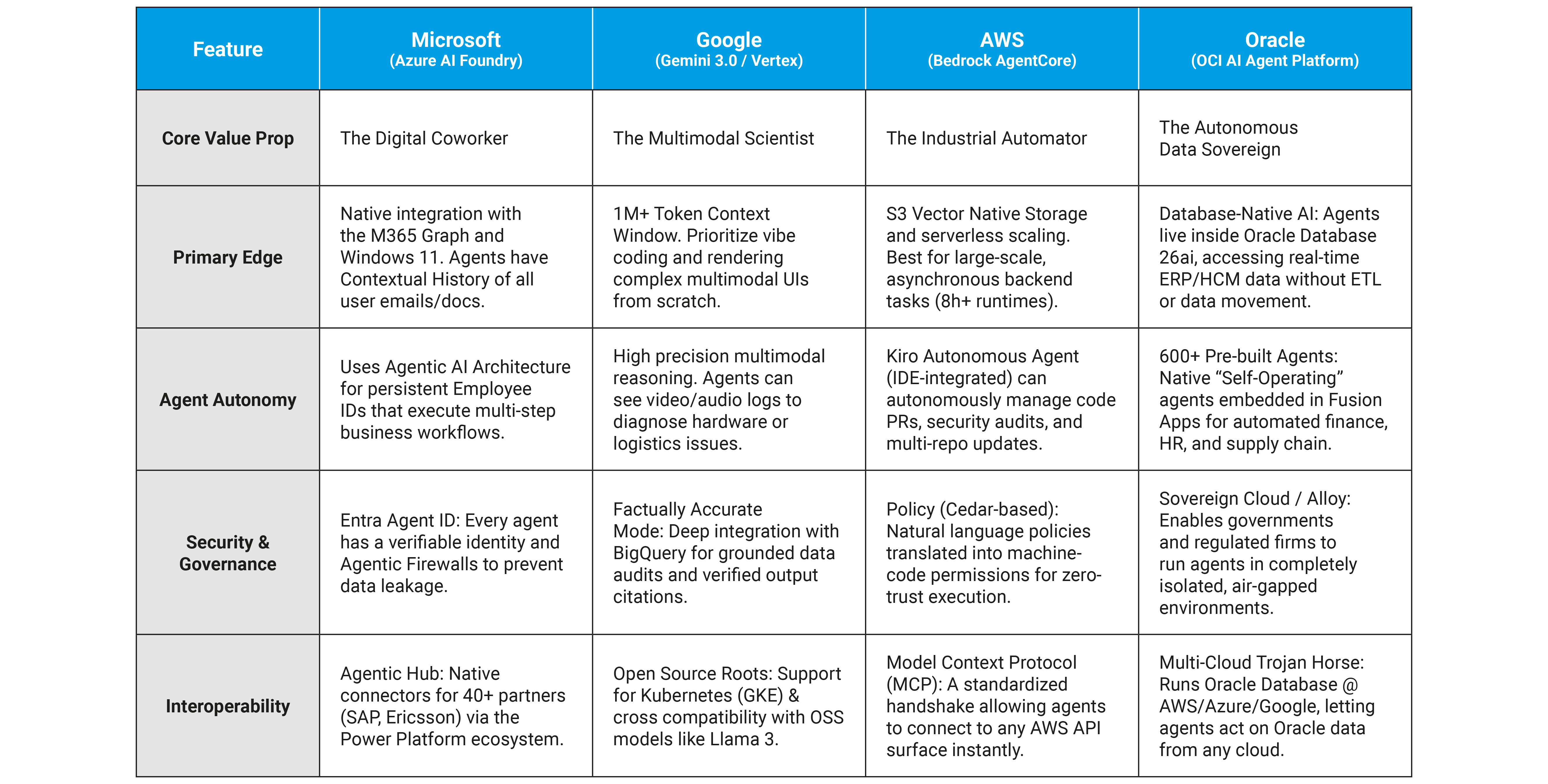
On the hardware front, Microsoft is pursuing a silicon rebalance to reclaim margins from key suppliers such as NVIDIA and AMD. While still a major buyer of NVIDIA’s Blackwell GB300 clusters, Microsoft is migrating internal inference tasks to its in-house Maia accelerators and Intel-manufactured custom chips. This shift reduces reliance on third-party silicon and insulates the company from premium hardware pricing.
Moreover, Microsoft is neutralizing threats from rivals like Oracle by leveraging its $392 billion in backlogged contracts (RPO) and a unified security and data architecture. By aiming to control the entire stack, from the underlying chips to the autonomous agents driving business operations, Microsoft looks to cement its status as the indispensable operating system for the AI economy.
In 2026, I anticipate that Microsoft will further prioritize fortifying its enterprise prominence through a triple moat strategy - identity, workflow, and orchestration - designed to neutralize major and specialized rivals.
Microsoft is making inroads capturing SAP ECC customers ahead of their 2027 end-of-support deadline by positioning Dynamics 365 as a flexible, AI-native alternative. Rather than attempting to replicate SAP’s decades of rigid, industry-specific logic, Microsoft uses AI to automatically map legacy schemas into Dynamics, promising a lower Total Cost of Ownership (TCO) and a faster path to Copilot-driven innovation. While Oracle attempts to defend and win users by embedding AI agents directly within its database, Microsoft counters with Microsoft Fabric, a unified data lake that allows Azure AI agents to read and analyze SAP or Oracle data in real-time without the risk or cost of migration.
To defend its territory in the digital-native and SMB sectors from Google Workspace, Microsoft has rebranded its suite as Microsoft 365 Copilot, signaling a shift from static productivity tools to an intelligence-first platform. Microsoft’s primary weapon is the Microsoft Graph, a comprehensive data map of every meeting, chat, and file within an organization. By positioning M365 as a proactive autonomous teammate that possesses a full enterprise memory, Microsoft aims to relegate Google Workspace to a mere collaboration utility, highlighting Google's lack of a comparable integrated enterprise brain.
While ServiceNow focuses on being the effective operating system for many enterprise departments, Microsoft is positioning itself as the overarching governance layer. Through the ServiceNow AI Control Tower integration, Microsoft allows IT administrators to audit and manage ServiceNow agents directly within Microsoft Copilot Studio. This co-opetition framework effectively envelops ServiceNow; while the latter continues to handle the underlying workflows, Microsoft retains control of the Agentic Identity (Entra) and the primary orchestration interface, turning ServiceNow into one of many high-level skills that a Microsoft agent can trigger and supervise.
Microsoft in 2026: Overall Promising Prospects
Heading into 2026, Microsoft is positioned at the epicenter of an enterprise AI supercycle, with a strategic shift from AI experimentation to full-scale Agentic production. Supported by a massive $250 billion incremental Azure contract with OpenAI and a projected fiscal 2026 revenue of $327 billion, the company is evolving Azure from a hosting platform into a managed orchestration layer for autonomous digital labor.
By doubling its data center footprint and scaling AI capacity by 80%, including the activation of the 2GW Fairwater AI Factory, Microsoft is providing the high-density compute and repository intelligence required for agents to independently execute multi-step business workflows. To protect its margins amidst a record $125 billion capital expenditure, Microsoft is aggressively pursuing energy autonomy through on-site nuclear and SMR integrations while diversifying its silicon stack with in-house Maia accelerators.
Microsoft’s 2026 mandate is the establishment of agentic sovereignty through a triple moat strategy of identity, workflow, and orchestration. By formalizing the governance of autonomous agents via the Agent 365 platform and Entra Agent ID, Microsoft is transforming Copilot from a chatbot into a verifiable digital workforce integrated across the Microsoft Fabric ecosystem.
This dominance extends into high-precision industrial and regulated markets through the Microsoft Cloud for Sovereignty, where 5G-Advanced and disconnected mode edge computing enable real-time, air-gapped AI operations for robotics and healthcare. By controlling the entire stack, from custom silicon and liquid-cooled infrastructure to the marketplace for industry-specific agents, Microsoft is cementing its status as the indispensable operating system for a global economy powered by human-AI partnerships.

Ron Westfall | VP and Practice Leader for Infrastructure and Networking
Ron Westfall is a prominent analyst figure in technology and business transformation. Recognized as a Top 20 Analyst by AR Insights and a Tech Target contributor, his insights are featured in major media such as CNBC, Schwab Network, and NMG Media.
His expertise covers transformative fields such as Hybrid Cloud, AI Networking, Security Infrastructure, Edge Cloud Computing, Wireline/Wireless Connectivity, and 5G-IoT. Ron bridges the gap between C-suite strategic goals and the practical needs of end users and partners, driving technology ROI for leading organizations.