















Research Finder
Find by Keyword
NFR 2026: HPE Elevates Retail with AI, Security, and Scalable Tech
HPE is delivering a unified retail proposition by merging self-driving Aruba CX switching and Mist AIOps at the store edge with fault-tolerant HPE Nonstop solutions at the core to meet evolving retail market demands.
1/13/2026
Key Highlights
The new HPE Nonstop NS9 X5 and NS5 X5 systems ensure continuous transaction processing and 100% hardware availability, even during peak shopping demands or network disruptions.
Through the integration of the Marvis virtual assistant, IT and marketing teams can use natural language queries to gain actionable insights into customer engagement and network health.
The expansion of the Aruba CX 6000 Switch Series introduces compact, silent 8-port models with enhanced PoE capacity to power modern retail tech like Wi-Fi 7 and smart cameras.
User Experience Insight (UXI) sensors provide a sophisticated early-warning system by simulating user behavior on Wi-Fi 7 networks to identify potential issues before they impact revenue.
By offering this entire stack as a service through HPE GreenLake, HPE allows mid-market retailers to access enterprise-grade "six-nines" uptime and advanced security through a flexible subscription model.
The News
At NFR, HPE announced an expansion of its retail-ready portfolio to help customers improve connectivity, security, insight, and performance across their operations. The expanded solutions aim to help retailers manage transactions, data, and shopping experiences with confidence across their entire landscape, from the back office and warehouse to the front of the store and curbside. For more information, read the HPE press release.
Analyst Take
HPE is highlighting its comprehensive retail proposition, which integrates self-driving HPE Aruba Networking CX switching and Mist AIOps at the edge with advanced HPE Nonstop solutions at the core. By merging these technologies with AI-native insights, HPE demonstrates how a secure and resilient foundation is essential for modernizing retail operations and delivering customer experiences with total confidence.
To ensure business continuity during high-traffic periods, the new HPE Nonstop Compute NS9 X5 and NS5 X5 systems can provide the mission-critical reliability needed to keep transactions fluid and data constantly accessible. Complementing this robust core, the HPE Aruba Networking CX 6000 Switch Series now includes compact 8-port models designed for silent, flexible installation in tight retail spaces like checkout lanes or overhead areas.
Accordingly HPE aims to transform always-on retail operations by bridging the gap between edge connectivity, AI-driven intelligence, and user assurance. By fortifying the store edge and enhancing visibility into business operations, HPE can provide a scalable, secure framework that supports everything from initial customer interactions to core backend systems.
To transition retailers from reactive troubleshooting to proactive management, HPE has integrated the Marvis virtual network assistant with HPE Juniper Networking Premium Analytics. This enhancement enables the Mist AIOps platform to process location intelligence and occupancy data through a natural language interface. Now, marketing and IT teams can use simple queries to gain actionable insights into customer engagement and network performance, allowing for faster, data-driven operational adjustments.
The expansion of the HPE Aruba Networking CX 6000 Switch Series introduces new 8-port models designed to handle the increasing power demands of modern retail. These compact switches offer enhanced Power over Ethernet (PoE) capacity, supporting high-bandwidth devices such as Wi-Fi 7 access points, smart cameras, and digital signage. With advanced telemetry and IoT probing, these self-driving switches minimize dropped connections and provide precise energy usage data without requiring a total infrastructure overhaul.
To safeguard revenue during digital transformations, HPE Aruba Networking User Experience Insight (UXI) acts as a sophisticated early-warning system. By using specialized sensors that now support Wi-Fi 7, IT teams can simulate user behavior to identify potential connectivity issues before they impact customers or staff. This continuous testing and performance baselining can enable retailers to deploy new AI-native use cases and manage device growth while maintaining a high standard of service.
Strengthening the Retail Core: HPE Nonstop Advancements in Scale, Security, and AI-Readiness
HPE Nonstop Compute continues to serve as the backbone for mission-critical retail operations, providing fault-tolerant support for backend payment processing and real-time inventory management. By ensuring that applications remain fully operational even during hardware malfunctions or network outages, the platform eliminates costly downtime and protects revenue during the highest-traffic shopping windows.
To meet the rigorous demands of digital and AI-driven transformation, HPE is significantly boosting the performance and scalability of its Nonstop portfolio. The latest solutions deliver a 15% performance increase over previous generations and can scale linearly up to 4,000 nodes through multi-generational clustering. This enhanced capacity allows the Nonstop operating system to manage skyrocketing transaction volumes and support data-heavy applications, such as real-time AI analytics, with ease.
Security and financial flexibility remain central to HPE’s latest updates. New Transparent Data Encryption (TDE) provides robust protection for sensitive customer information, helping retailers stay ahead of complex data privacy and compliance requirements. Furthermore, both the HPE Nonstop Compute and HPE Aruba Networking CX Switching portfolios are available via the HPE GreenLake cloud platform. This as-a-service model enables retailers to shift to a subscription-based investment, closely aligning their technology costs with actual business outcomes.
I see the industry impact of these solutions centering on the shift from fragmented IT management to a unified, self-healing retail environment. By integrating edge-to-core connectivity with AI-native intelligence, HPE could effectively set a new standard for operational uptime, where the network can anticipate and resolve issues before they disrupt the customer journey. This move addresses the critical retail pain point of technical debt; instead of layering disparate tools, retailers can now leverage a cohesive ecosystem that simplifies the deployment of high-bandwidth innovations like autonomous checkout and real-time edge analytics.
Furthermore, the introduction of high-performance, fault-tolerant systems combined with flexible as-a-service consumption models can help democratize high-end resilience. Historically, only the largest tier-one retailers could afford the level of redundancy found in HPE Nonstop systems, but through HPE GreenLake, mid-sized retailers can now scale their infrastructure dynamically to compete during peak seasons like Black Friday. From my view, this levels the playing field, allowing retailers of all sizes to prioritize data security and customer privacy through advanced encryption without sacrificing the agility needed to adopt emerging AI technologies.
HPE Altering the Competitive Landscape
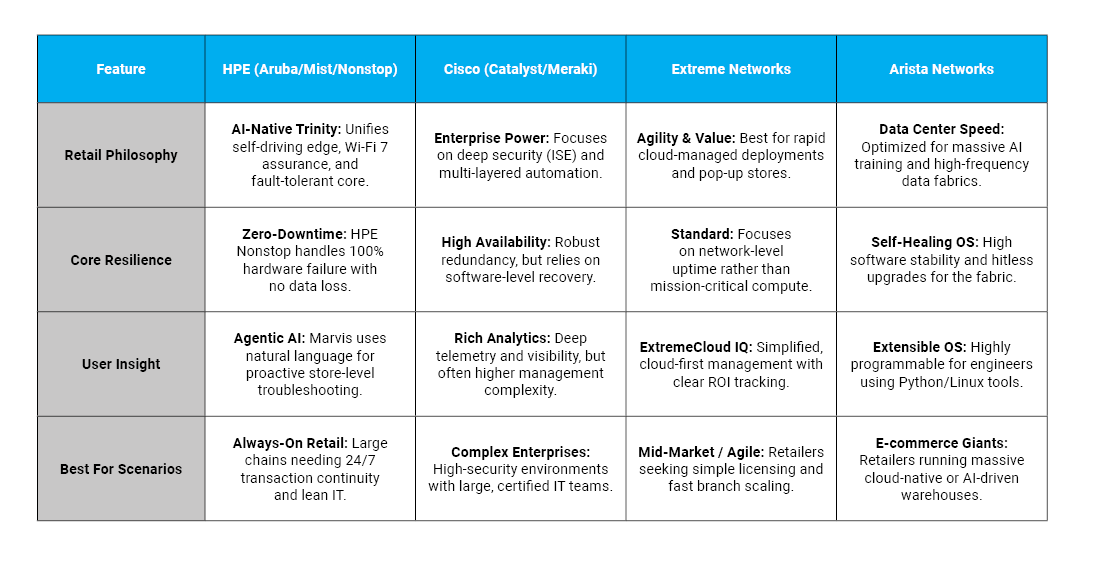
I find that HPE’s retail proposition delivers competitive differentiation by offering a distinct edge-to-core architectural approach. While competitors such as Cisco and Extreme Networks provide sophisticated AI for network management, they primarily focus on the connectivity layer. HPE differentiates itself by integrating the Mist AIOps self-driving edge with HPE Nonstop at the core, a fault-tolerant compute tier specifically designed to ensure that backend payment processing and inventory databases never go offline.
As such, this can create a double-safety environment: the network at the store level fixes its own connectivity issues via agentic AI, while the core infrastructure is physically incapable of a single point of failure, a combination that rivals like Arista (who prioritize high-speed data center throughput) do not natively bundle for retail.
Furthermore, HPE’s acquisition of Juniper has enabled it to show mind share gains across retail Agentic AI initiatives. Unlike Cisco’s solutions, which can require deep technical expertise to navigate complex security policies, HPE’s Marvis virtual assistant allows retail staff to use natural language to solve problems - such as asking, "Why is the POS terminal in Aisle 4 slow?" In contrast, Extreme Networks focuses on extreme licensing flexibility and cloud-native simplicity for mid-market retailers, but it lacks the heavy-duty mission-critical compute backbone that makes HPE’s solution a total enterprise-grade replacement for legacy siloed retail systems. While Arista is established in providing high-performance, low-latency switching for large-scale data centers and AI training environments, HPE provides a more specialized retail ecosystem by combining self-driving branch-edge networking with the mission-critical, fault-tolerant reliability of HPE Nonstop for continuous transaction processing.
2026 Retail Solutions Comparison
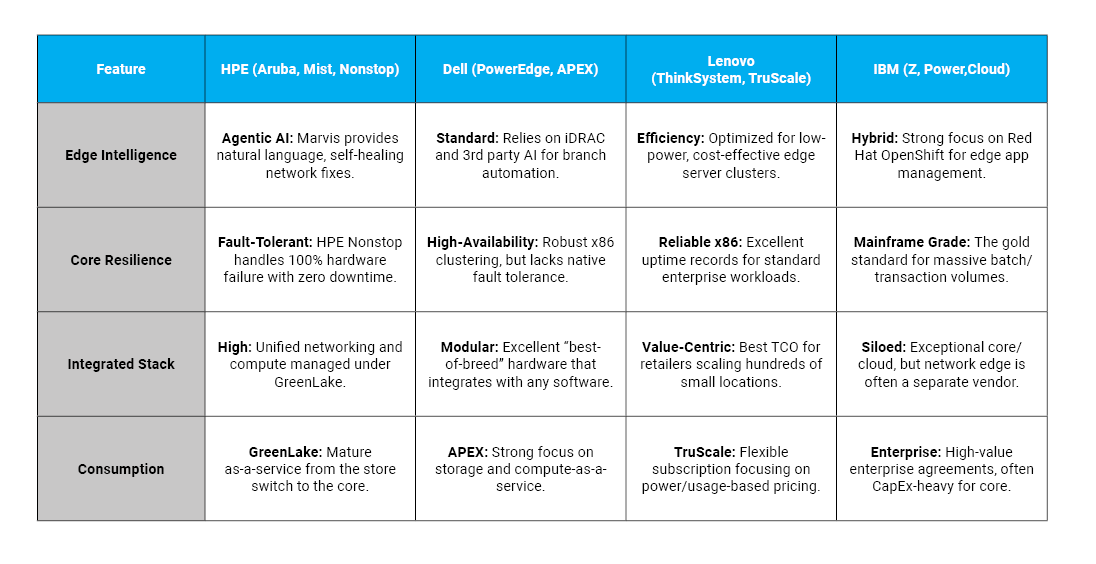
HPE’s retail proposition differentiates itself from the hybrid cloud solutions of Dell, Lenovo, and IBM by offering a vertically integrated intelligence-to-transaction stack. While Dell and Lenovo focus on high-performance general-purpose servers and edge hardware with strong price-to-performance ratios, they often lack a native, AI-driven networking fabric equivalent to the Mist AIOps and Aruba CX integration. HPE’s solution can enable retailers to manage both the network and the mission-critical transaction layer (HPE Nonstop) as a single, self-healing entity. This is a direct contrast to IBM, which remains a powerhouse in the retail core with its Z-series mainframes but lacks the same level of native, unified integration with the modern store-edge Wi-Fi and IoT networking that HPE provides through its Juniper and Aruba portfolio capabilities and innovations.
The primary industry impact lies in the shift from availability to autonomic resilience. Retailers using Dell or Lenovo typically rely on third-party software (like Broadcom or Nutanix) to provide high availability across their hardware, adding management complexity. In contrast, HPE Nonstop provides hardware-level fault tolerance that is designed to be physically incapable of a single point of failure, while Mist AIOps acts as an AI agent that proactively fixes network issues before they hit the point of sale. While IBM offers similar mainframe-level reliability, HPE’s GreenLake model democratizes this "six-nines" uptime for mid-market retailers, offering a cloud-like subscription that covers everything from the 8-port switch in the checkout lane to the transaction engine in the data center - a breadth of edge-to-core as-a-service that competitors have yet to fully consolidate or emulate.
2026 Retail Infrastructure Comparison
Looking Ahead
I believe that HPE can boost its retail competitiveness by deepening the integration of its Agentic AI framework, specifically by evolving the Marvis virtual assistant into a proactive store manager that predicts and remediates supply chain and IoT bottlenecks before they affect the shopper. By expanding the HPE GreenLake ecosystem to include more third-party grab-and-go and computer vision partners, HPE can solidify its role as the primary control fabric for autonomous retail.
The company should also capitalize on its Wi-Fi 7 and Mist AIOps leadership to offer retailers an insurance-backed uptime guarantee, directly challenging the more complex management models of Cisco and Dell. Strategic focus on the 8-port CX switch series allows for a dominant footprint in the often-overlooked micro-edge of checkout lanes and pop-up kiosks. Furthermore, by cross-pollinating Juniper's security telemetry with HPE Nonstop's core resilience, HPE can offer a sharply differentiated security-by-default proposition that protects sensitive customer data across the entire transaction lifecycle. Reinforcing its as-a-service model can democratize mission-critical reliability for mid-market retailers, significantly expanding its influence beyond traditional tier-one enterprise accounts.

Ron Westfall | VP and Practice Leader for Infrastructure and Networking
Ron Westfall is a prominent analyst figure in technology and business transformation. Recognized as a Top 20 Analyst by AR Insights and a Tech Target contributor, his insights are featured in major media such as CNBC, Schwab Network, and NMG Media.
His expertise covers transformative fields such as Hybrid Cloud, AI Networking, Security Infrastructure, Edge Cloud Computing, Wireline/Wireless Connectivity, and 5G-IoT. Ron bridges the gap between C-suite strategic goals and the practical needs of end users and partners, driving technology ROI for leading organizations.