


















Research Finder
Find by Keyword
Is Distance-based Latency the Ultimate Bottleneck in the Inference AI Economy?
QumulusAI and Moonshot announce development of a national inference-optimized platform at the edge, leveraging carrier-neutral IXPs and university campuses to bypass centralized latency constraints.
01/15/2026
Key Highlights
- Moonshot and QumulusAI enter a Strategic Commercial Agreement with Connected Nation IXP.us to deploy a nationally distributed AI compute platform.
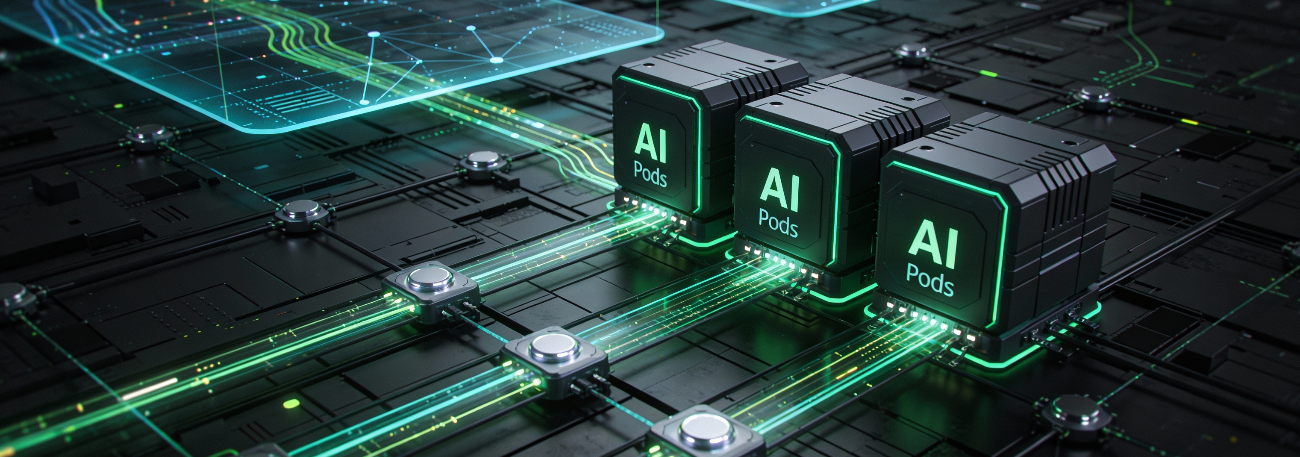
- The joint venture, QAI Moon, aims to pair modular AI Pods with carrier-neutral Internet Exchange Points across 25 initial university and municipal sites.
- The platform is architected to deliver ultra-low-latency GPU-as-a-Service for real-time inference workloads, scaling to 125 sites over five years.
- Each AI Pod is designed to feature dual 400G IP transit, redundant IX ports, and direct high-count dark fiber adjacency.
- QumulusAI and Moonshot prioritize latency-reducing proximity for AI inference over raw capacity, challenging the industry’s focus on centralized gigawatt scaling, which works for AI training.
The News
Moonshot Energy and QumulusAI today announced a strategic partnership with Connected Nation Internet Exchange Points (IXP.us) to deploy a nationally distributed AI compute and interconnection platform. By colocating modular "AI Pods" directly at carrier-neutral exchange points, the collaboration aims to reduce inference latency and extend high-performance compute access to emerging rural markets and university campuses. Initial deployment is scheduled for July 2026 at an "alpha site" on the Wichita State University campus, serving as a repeatable archetype for a planned 125-site national rollout. Details of the strategic agreement can be found in the Moonshot and QumulusAI Announce Strategic Agreement with Connected Nation Internet Exchange Points to Deploy a Nationally Distributed AI Compute and Internet Exchange Platform
Analyst Take
The QAI Moon initiative represents a structural re-engineering of AI infrastructure that moves away from the "cathedral" model of centralized hyperscale data centers toward more distributed, network-adjacent pods. Our analysis suggests this is a necessary response to the shifting physics of AI; as workloads transition from massive training cycles to real-time inference, the bottleneck moves from sheer FLOPS to millisecond-level latency. Latency is a key boundary condition for AI inference, and distance drives latency. By anchoring these deployments on university research campuses through IXP.us, the partners are effectively creating a sovereign AI fabric that bypasses the latency impacts from the traditional routing of data back to a handful of massive cloud regions. Scores of cities in the United States suffer from this geographical separation from crucial interconnectivity.
We observe a significant contrarian reality here: despite the hype surrounding "edge AI," many current deployments ultimately become edge-branded extensions of centralized clouds. This partnership is different because it prioritizes carrier neutrality and physical fiber adjacency as the foundational layer, rather than an afterthought. While hyperscalers are building gigawatt-scale "AI factories," QAI Moon is betting that the real value lies in the "last mile" of the backbone.
What Was Announced
The technical specifications of the QAI Moon AI Pods reflect an architecture optimized for high-density, high-throughput inference rather than generic colocation. Each deployment is designed as a network-dense platform that integrates directly with the DE-CIX-powered switching fabric at IXP.us facilities.
Key architectural requirements for each pod include:
- Connectivity: Dual, geographically diverse 400G IP transit connections, sourced from four independent ISPs for maximum resiliency.
- Interconnection: Redundant 400G IX ports on the DE-CIXaaS switch, thus enabling direct peering to network operators and content providers.
- Fiber Infrastructure: Direct adjacency for high-count dark fiber, supported by TOWARDEX's "Meet-Me Street" design and Connectbase's transparency tools.
- Capacity: An initial module sizing of approximately 2,000kw per market, featuring flexible GPU configurations based on specific customer application needs.
The model aims to deliver a "repeatable national architecture" that pairs Moonshot’s modular infrastructure with QumulusAI’s orchestration software. This modularity allows for comparatively rapid scaling, with a target of 25 sites in the first phase and a total of 125 sites targeted within five years. Using University campuses as the nucleus of this effort leverages existing infrastructure, and may serve to bypass the NIMBY barriers experienced by large standalone data centers.
Market Analysis
The timing of this rollout aligns with a broader industry pivot toward inference-heavy applications. According to Deloitte, inference workloads are expected to account for roughly two-thirds of all AI compute by 2026, reaching a market value of over $50 billion. However, a significant gap exists between centralized capacity and edge demand. While McKinsey reports that data center power demand is projected to grow at a 22% CAGR through 2030, much of that growth remains locked in Tier 1 markets facing severe grid constraints.
By targeting Tier 2 markets and university campuses, QAI Moon addresses a critical market void.
- Competitive Positioning: Unlike Equinix or Digital Realty, which often focus on major metropolitan hubs, the IXP.us partnership focuses on regional "hub communities" and research institutions.
- Strategic Implications: The use of modular "AI Pods" potentially allows Moonshot to bypass the 3-to-5-year lead times typical of large-scale data center construction. This "factory-scale" modularity is a direct challenge to traditional brick-and-mortar builds.
- Customer Impact: For university researchers and regional enterprises, this provides high-performance GPU access without the egress fees and latency penalties associated with centralized public clouds.
We find it telling that the partnership includes TOWARDEX and Connectbase; these are not "AI" companies in the traditional sense, but "plumbing" companies. Their involvement underscores that AI's success in 2026 will be determined by the availability of dark fiber and the transparency of the physical network layer.
Looking Ahead
Our analysis of the market suggests that the "alpha site" at Wichita State University will be the ultimate litmus test for the viability of distributed AI. If QAI Moon can prove that a 2,000kw modular pod can outperform a hyperscale instance for real-time inference tasks, we will see a rapid movement toward similar edge-interconnection models. The key trend we'll be monitoring is whether university research campuses can successfully transition from being "consumers" of AI and HPC to becoming "anchors" of regional AI economies.
Furthermore, the success of this model relies heavily on the "carrier-neutral" promise. If the platform remains truly open to any network operator, it could democratize AI compute in the same way the early Internet Exchanges democratized data transit. However, the primary risk is the complexity of managing a "distributed cloud" across 125 geographically disparate sites; operational consistency will be the barrier between a national platform and a fragmented collection of pods.

Stephen Sopko | Analyst-in-Residence – Semiconductors & Deep Tech
Stephen Sopko is an Analyst-in-Residence specializing in semiconductors and the deep technologies powering today’s innovation ecosystem. With decades of executive experience spanning Fortune 100, government, and startups, he provides actionable insights by connecting market trends and cutting-edge technologies to business outcomes.
Stephen’s expertise in analyzing the entire buyer’s journey, from technology acquisition to implementation, was refined during his tenure as co-founder and COO of Palisade Compliance, where he helped Fortune 500 clients optimize technology investments. His ability to identify opportunities at the intersection of semiconductors, emerging technologies, and enterprise needs makes him a sought-after advisor to stakeholders navigating complex decisions.

Steven Dickens | CEO HyperFRAME Research
Regarded as a luminary at the intersection of technology and business transformation, Steven Dickens is the CEO and Principal Analyst at HyperFRAME Research.
Ranked consistently among the Top 10 Analysts by AR Insights and a contributor to Forbes, Steven's expert perspectives are sought after by tier one media outlets such as The Wall Street Journal and CNBC, and he is a regular on TV networks including the Schwab Network and Bloomberg.