












Research Finder
Find by Keyword
Is the xAI Merger the Grand Narrative for SpaceX's Trillion-Dollar IPO?
Integrating a high-growth AI arm transforms the firm from a logistics provider into a 'universal infrastructure' provider to appeal to institutional investors.
02/03/2026
Key Highlights
- The merger creates a vertically integrated powerhouse internally valued at $1.25 trillion, merging heavy launch capabilities with frontier generative AI.
- SpaceX aims to deliver orbital data centers to solve the escalating power crisis facing land based server farms on the terrestrial grid.
- The acquisition includes the X social media platform, providing a direct data flywheel for xAI’s Grok models within the SpaceX corporate structure.
- Regulatory hurdles remain significant as SpaceX seeks FCC approval for a massive new constellation of one million computing satellites.
The recent absorption of xAI by SpaceX represents more than a mere corporate consolidation of affiliated interests. It is a calculated move to re-architect the physical location of intelligence. By folding the AI startup into the aerospace giant, the entity aims to deliver a solution to the most pressing bottleneck in modern computing: the terrestrial energy wall. As large language models demand exponential increases in power, the friction between data center expansion and aging electrical grids has become a primary risk factor for AI scaling. Ground based infrastructure is increasingly constrained by the local availability of high voltage transmission.
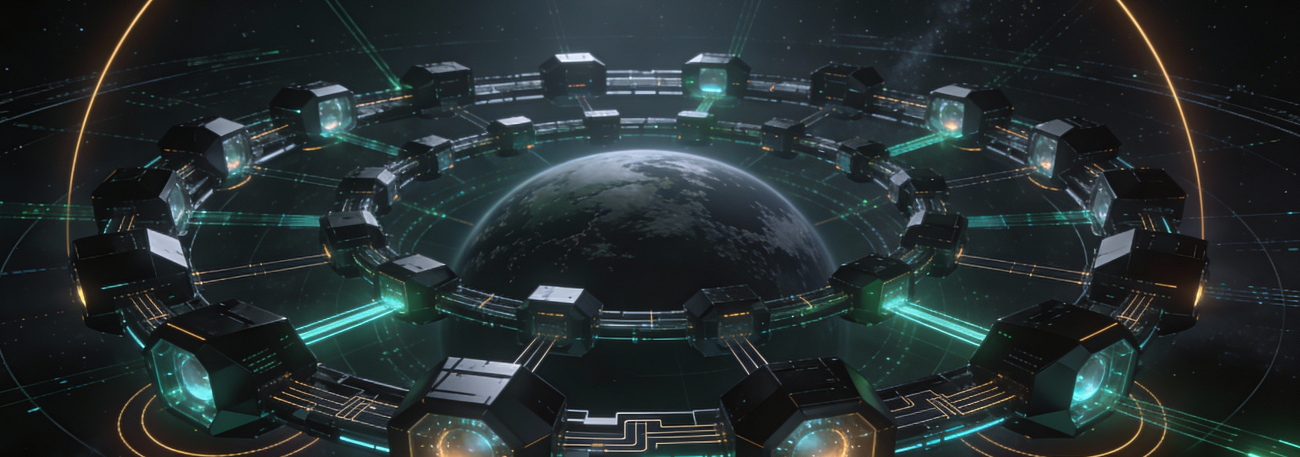
This transaction values the combined entity at approximately $1.25 trillion. Such a figure is not merely reflective of current revenue but is architected to price in the future of "Orbital Compute." Our analysis suggests this is a strategic pivot away from the traditional cloud model. Instead of building more concrete bunkers in Virginia or Ireland that compete with residential neighborhoods for electricity, the strategy focuses on utilizing the Starship launch system to place high density GPU clusters in low Earth orbit. These units are designed to harness near constant solar radiation. This provides a power source that is decoupled from the limitations and rising costs of the global energy market.
The move also serves as a financial stabilizing force. Before this merger, xAI was operating as a capital intensive entity with significant burn rates attributed to compute procurement. This is not unusual, every AI player at this level is operating at a significant loss and must be propped up by either investment or cash flows from traditional profitable businesses - examples include Google's Gemini supported by advertising and cloud business, and Microsoft Copilot supported by cloud and enterprise software revenues. By becoming a subsidiary of SpaceX, xAI gains access to the massive cash flows generated by the Starlink satellite internet constellation.
Furthermore, the inclusion of the X social media platform in this deal, which xAI had previously acquired, ensures that the data pipeline for Grok remains internal. This creates a closed loop system where the hardware, the launch vehicle, the energy source, and the training data are all controlled by a single board of directors.
Competitors are not sitting still, though their approaches differ in fundamental ways. Giants like Microsoft and OpenAI have stayed terrestrial, looking at nuclear restarts and new development to power their ambitions, while Google initiated Project Suncatcher to explore similar orbital hardware. Google has an advantage on both sides of the competitive equation as the company’s parent Alphabet still maintains a significant minority stake in SpaceX, a legacy of its 2015 investment. This dynamic gives Google a position as both a competitor in the AI race and a silent beneficiary of SpaceX's skyrocketing valuation. However, SpaceX holds a distinct advantage over all other players in launch economics. The ability to move beyond the flight-proven Falcon 9 and Falcon Heavy to the massive new Starship platform means the cost per kilogram of getting compute power into orbit goes from its current dominant position to significantly lower than any other player in the market.
The most direct counterweight to this orbital consolidation comes from the tandem of Amazon Web Services and Blue Origin. While SpaceX aims to deliver a proprietary, vertically integrated stack, the Bezos led entities are architecting a more modular, enterprise grade ecosystem. Blue Origin recently unveiled its TeraWave constellation, a network of over 5000 satellites designed to link global data centers with 6 terabit per second speeds. This initiative aims to deliver a "server rack in the sky" that could integrate with AWS services like AWS Bedrock and its agentic AI frameworks. Rather than a closed loop, the AWS and Blue Origin strategy appears designed to provide the plumbing for third party enterprises to move their own workloads into orbit.
The solar argument is the linchpin of this entire strategy. On Earth, solar efficiency is hampered by atmospheric interference, weather patterns, and the inevitable cycle of night. In high sun synchronous orbits, the energy density available to a satellite is significantly higher. SpaceX architected this merger to capitalize on this energy advantage. By positioning compute where the fuel is essentially infinite and free, they aim to deliver an inference cost structure that terrestrial competitors cannot match. This is a play for energy dominance.
The timing of this merger is also quite telling. With a SpaceX initial public offering widely anticipated for late 2026, the addition of a high growth AI arm transforms the company from a "space logistics" firm into a "universal infrastructure" provider. This narrative is likely to appeal to a broader set of institutional investors who might have been wary of a pure play aerospace valuation. The integration is architected to show a path toward a Kardashev-scale civilization, a vision that, while far fetched to some, provides the grand narrative necessary to sustain trillion dollar private valuations.
Looking Ahead
Based on what we are observing, the most significant risk to this vision is not the technology, but the regulatory environment. The FCC filing for one million satellites will be the primary battlefield. The key trend that we will be tracking is how international regulators respond to the "sovereignty of compute." If a significant portion of the world's AI processing moves to a private satellite network, traditional geographic jurisdictions (and censorial controls) over data and algorithms begin to dissolve.
Based on what we see in the market, our perspective is that we are entering an era of "Deep Stack" competition. It is no longer enough to have the best model; one must own the energy and the silicon. Going forward, we will be tracking how the company performs on the deployment of its first dedicated "Compute Nodes" during the next Starship cycles. When you look at the market as a whole, the announcement today suggests that the era of the software-only AI company is drawing to a close.
HyperFRAME Research will be tracking how the company does in balancing the immense capital requirements of this orbital build out against the pressure to show a profitable path to IPO. The integration of Grok into the Starlink user interface will likely be the first consumer facing test of this merger. Our perspective is that if SpaceX can prove even a 20% efficiency gain by moving AI functions to orbit, the terrestrial cloud providers will be forced to follow suit or risk obsolescence.

Stephen Sopko | Analyst-in-Residence – Semiconductors & Deep Tech
Stephen Sopko is an Analyst-in-Residence specializing in semiconductors and the deep technologies powering today’s innovation ecosystem. With decades of executive experience spanning Fortune 100, government, and startups, he provides actionable insights by connecting market trends and cutting-edge technologies to business outcomes.
Stephen’s expertise in analyzing the entire buyer’s journey, from technology acquisition to implementation, was refined during his tenure as co-founder and COO of Palisade Compliance, where he helped Fortune 500 clients optimize technology investments. His ability to identify opportunities at the intersection of semiconductors, emerging technologies, and enterprise needs makes him a sought-after advisor to stakeholders navigating complex decisions.