

















Research Finder
Find by Keyword
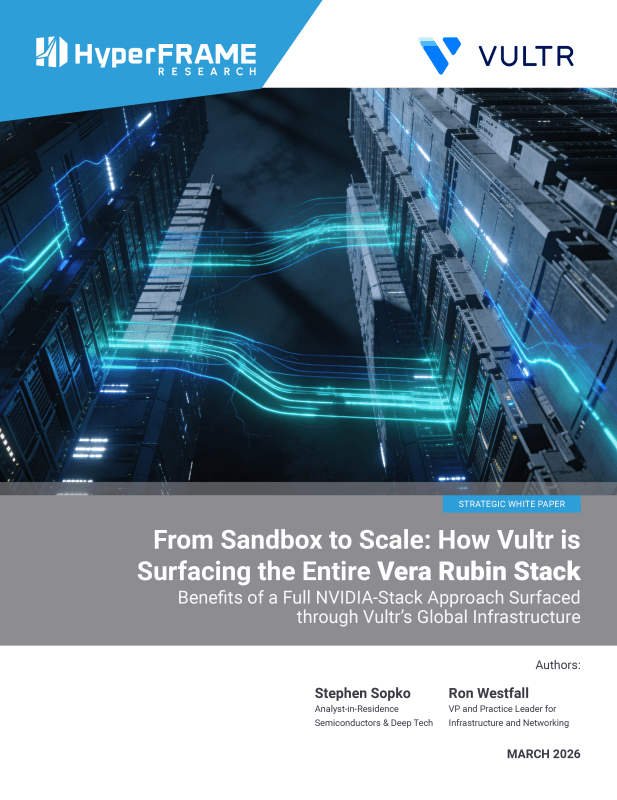
From Sandbox to Scale How Vultr is Surfacing the Entire Vera Rubin Stack
Your GPUs Are Running. Your AI Isn't in Production. Here's Why.
A new HyperFRAME Research white paper, produced in collaboration with Vultr, examines why enterprise AI stalls after the infrastructure decision, and what the NVIDIA Vera Rubin architecture changes about that calculus.

Most enterprises are solving the GPU access challenge. The harder problem, moving a working AI model from sandbox to production, remains largely unsolved. According to HyperFRAME Research Lens data from Q1 2026, only 23% of enterprise AI initiatives are fully deployed and meeting their original business objectives. The other 77% are stalled, partially successful, or still in planning.
This is not a model problem. It is a stack problem.
In From Sandbox to Scale: How Vultr is Surfacing the Entire Vera Rubin Stack, HyperFRAME Research analysts Stephen Sopko and Ron Westfall examine why the full NVIDIA software stack (Dynamo, Nemotron, NeMo, and the Inference Context Memory Storage Platform) matters as much as the hardware it runs on. The cloud partner an enterprise chooses to access Vera Rubin through may ultimately determine more of its production AI outcomes than the chip specifications will.
What this paper covers:
The Vera Rubin architecture is arriving in the second half of 2026 as a rack-scale co-design: GPU, CPU, networking, storage, and cooling developed together. That represents a meaningful architectural departure that demands a different infrastructure conversation than any previous NVIDIA generation. This paper analyzes what that shift means in practice: why KV cache management, not compute, is the bottleneck in agentic inference; why hyperscaler abstraction layers could create a Complexity Tax that dilutes Vera Rubin's performance gains before an enterprise workload reaches production; and why incentive structure, not just technical capability, determines which cloud partner surfaces the full open-source stack most completely.
The paper also presents a structured set of evaluation criteria for IT leaders preparing infrastructure strategy before Vera Rubin instances become available: how to assess lock-in exposure at the right layer, how to benchmark pre-integrated environments against existing deployment paths, and why the procurement conversation should start now.
"The competitive advantage in 2026 enterprise AI is shifting from who has the most GPUs to who has the most production inference running. Infrastructure strategy should reflect that shift."
Ron Westfall, HyperFRAME Research
Download the paper to understand:
- Why nearly half of enterprises lack the integrated stack required for sustained AI execution, despite having secured GPU access
- What the Vera Rubin architectural co-design changes about storage, networking, and orchestration requirements
- How NVIDIA's open-source software strategy (Dynamo, Nemotron, NeMo) reframes the lock-in conversation
- Why hyperscaler incentive structures create friction for enterprises wanting NVIDIA-native inference performance
- What a pre-Vera Rubin evaluation checklist should cover, and why current Blackwell deployments provide a meaningful proxy

Ron Westfall | VP and Practice Leader for Infrastructure and Networking
Ron Westfall is a prominent analyst figure in technology and business transformation. Recognized as a Top 20 Analyst by AR Insights and a Tech Target contributor, his insights are featured in major media such as CNBC, Schwab Network, and NMG Media.
His expertise covers transformative fields such as Hybrid Cloud, AI Networking, Security Infrastructure, Edge Cloud Computing, Wireline/Wireless Connectivity, and 5G-IoT. Ron bridges the gap between C-suite strategic goals and the practical needs of end users and partners, driving technology ROI for leading organizations.
Share

Stephen Sopko | Analyst-in-Residence – Semiconductors & Deep Tech
Stephen Sopko is an Analyst-in-Residence specializing in semiconductors and the deep technologies powering today’s innovation ecosystem. With decades of executive experience spanning Fortune 100, government, and startups, he provides actionable insights by connecting market trends and cutting-edge technologies to business outcomes.
Stephen’s expertise in analyzing the entire buyer’s journey, from technology acquisition to implementation, was refined during his tenure as co-founder and COO of Palisade Compliance, where he helped Fortune 500 clients optimize technology investments. His ability to identify opportunities at the intersection of semiconductors, emerging technologies, and enterprise needs makes him a sought-after advisor to stakeholders navigating complex decisions.