


















Research Finder
Find by Keyword
Amazon Acquires Globalstar: A $11.6 Billion Shift to Spectrum-as-a-Service and the Apple Ecosystem
Amazon’s $11.6 billion acquisition of Globalstar is a strategic move to secure vital Band n53 spectrum and a key partnership with Apple, allowing the company to bypass regulatory hurdles and immediately challenge SpaceX in the direct-to-device market.
4/17/2026
Key Highlights
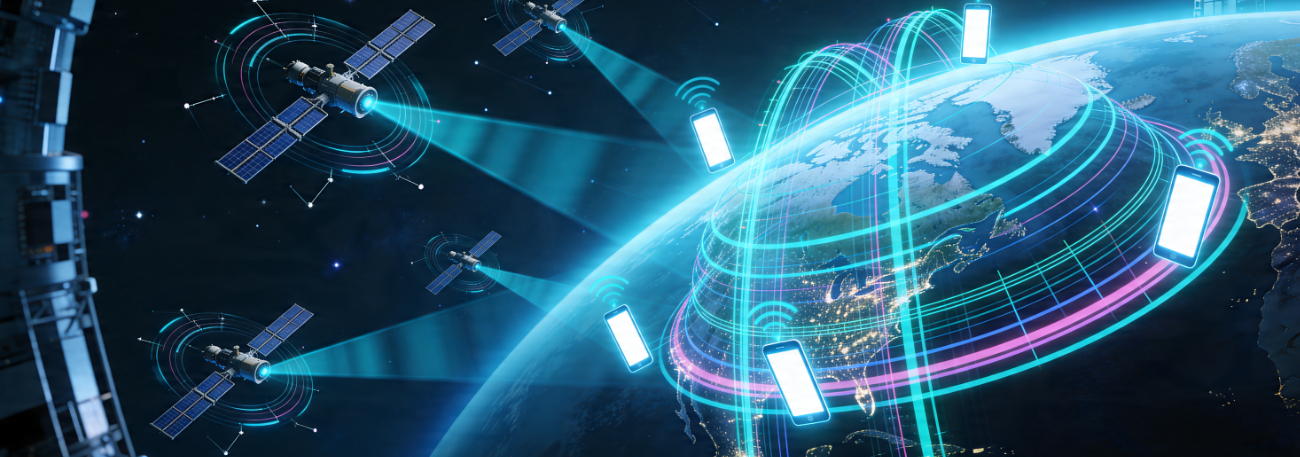
- Amazon announced an agreement to acquire Globalstar for approximately $11.6 billion, the deal would add direct-to-device (D2D) services and critical S-band spectrum to its Amazon Leo low Earth orbit satellite network.
- At the same time, Amazon and Apple agreed to Amazon Leo powering satellite services on iPhone and Apple Watch, including Emergency SOS, Messages, Find My, and Roadside Assistance through satellite.
- Amazon Leo has long planned to deploy its own next-generation D2D satellite system beginning in 2028, the pre-deal announcements covering advanced voice, data, and messaging services to unmodified mobile phones.
- The deals appear designed for Amazon Leo to close a significant spectrum and deployment gap against SpaceX's Starlink, a service already operating over 650 direct-to-cell satellites that initiated commercial D2D service with T-Mobile in July 2025.
- The deals transform Amazon's competitive posture beyond broadband-only LEO operator towards a more multi-service satellite platform that spans fixed, mobile, consumer, enterprise, and government connectivity.
The News
Amazon and Globalstar announced a merger agreement that Amazon will acquire Globalstar for $90 per share in a mix of cash and stock, the deal valued at approximately $11.6 billion. The combined company would add D2D capability, MSS spectrum licenses, and operational satellite infrastructure to the Amazon Leo constellation. Simultaneously, Amazon and Apple entered a separate agreement for Amazon Leo to continue powering satellite features on supported iPhone and Apple Watch models, including Emergency SOS via satellite, a service Globalstar has provided since the iPhone 14 launched in 2022. The transaction, which has already secured written consent from stockholders representing 58% of Globalstar's voting power, is expected to close in 2027 subject to regulatory approvals and satellite deployment milestones. For more information, read the Amazon press release.
Analyst Take
Our initial read on this transaction is that Amazon did not buy a satellite company. It bought a spectrum position, an Apple relationship, and a three-year opportunity to catch up on D2D deployment, all wrapped in a single $11.6 billion check. That is an impressive strategic win for Amazon, and Apple. Amazon Leo, formerly Project Kuiper, has made progress on its broadband LEO constellation with over 200 satellites in orbit and nine completed launch missions.
However, with a regulatory requirement to rapidly accelerate the Leo launch program, the company’s D2D strategy has been conspicuously absent while competitors moved aggressively into direct-to-cell services. This reminds us less of a typical space industry consolidation and more of Google's acquisition of Motorola Mobility back in 2012, where the patent portfolio and strategic positioning mattered more than the hardware itself. The analyst observation here is straightforward: while Amazon may have overpaid for Globalstar's satellite fleet, which numbers roughly two dozen aging spacecraft, we see that it likely underpaid for Band n53 spectrum with global authorizations. That is a commodity that no amount of engineering can replicate.
From our perspective, Amazon’s $11.6 billion acquisition represents a strategic pivot from traditional satellite competition toward a sophisticated Spectrum-as-a-Service model that prioritizes regulatory speed over simple orbital density. By securing the Band n53 spectrum, Amazon bypasses the regulatory barriers that have historically stalled new entrants, transforming a potential multi-year licensing battle into an immediate operational footprint.
This move confirms that while launch capacity can be purchased or engineered, globally harmonized spectrum remains a finite resource and the ultimate barrier to entry in the D2D market. Much like Google’s acquisition of Motorola to shield the Android ecosystem, Amazon is using Globalstar’s existing fleet as a strategic Trojan Horse to carry its advanced 2028 D2D architecture into the global mobile market. By inheriting the critical Apple relationship, Amazon is evolving into the first neutral host of the skies, managing a complex platform that must balance the proprietary needs of a device giant with the wholesale demands of global mobile network operators.
The broader shift in regulatory posture, moving from viewing D2D as a commercial feature to regarding it as critical disaster resilience infrastructures, suggests Amazon may face fewer antitrust hurdles. As the FCC prioritizes redundant emergency connectivity, the deal rationale gains significant political tailwinds. Amazon’s success will depend on its bet that substantially higher spectrum efficiency can outperform the high-count satellite strategies of SpaceX. This suggests that the winner of the D2D race will be determined by competitively advantageous bits-per-hertz and spectral intelligence rather than just the scale of the hardware in orbit.
What Was Announced
The acquisition encompasses Globalstar's full satellite operations, ground infrastructure, and MSS spectrum licenses with global authorizations. Globalstar's existing fleet (as well as the new satellites under construction by MDA Space) are planned to operate alongside Amazon Leo's broadband system. The resulting offering would create a unified network architecture designed to span fixed broadband and mobile D2D services.
We note that with this deal, MDA Space could occupy an increasingly pivotal position in the LEO satellite supply chain. The company is simultaneously building Globalstar's next-generation constellation and Telesat's Lightspeed LEO system. That dual commitment makes MDA a critical supply chain citadel whose manufacturing throughput now intersects directly with Amazon's D2D deployment timeline. This is going to create a dependency that warrants close monitoring as satellite production scales.
Beginning in 2028, Amazon Leo plans to deploy its own next-generation D2D satellite system, which the company claims will offer substantially higher spectrum efficiency than legacy direct-to-cell systems. The complete Amazon Leo network is architected to include thousands of advanced LEO satellites with capacity designed to support hundreds of millions of customer endpoints globally.
The Apple agreement is an equally significant linchpin to Amazon’s strategy. Apple invested approximately $1.5 billion in Globalstar in 2024, including a 20% equity stake and cash commitments for new satellite construction. Apple was consuming ~85% of Globalstar's network capacity for iPhone Emergency SOS, messaging, and location services. Under the new arrangement, Amazon will continue to support these Apple features on existing Globalstar infrastructure and collaborate with Apple on future satellite services using the expanded Amazon Leo network. The transaction terms offer Globalstar stockholders a choice between $90 in cash or 0.3210 shares of Amazon stock per share, with aggregate cash elections capped at 40% of total shares.
Market Analysis
The timing of this deal reflects the velocity of D2D market formation. Deloitte observes in their 2026 TMT Predictions that spending on D2D network infrastructure should reach between $6 billion to $8 billion by 2026. And that the year will see over 1,000 D2D-capable satellites in orbit providing low-bandwidth connectivity services. SpaceX's Starlink has a well-established first-mover advantage with over 650 direct-to-cell satellites and a commercial service launched with T-Mobile in July 2025 - as well as its own path to orbit vertically integrated with SpaceX.
At the same time AST SpaceMobile has signed definitive commercial agreements with both AT&T and Verizon, targeting phased D2D service activation throughout 2026 with a planned constellation of 45 to 60 BlueBird satellites. AST's approach is architecturally distinct from both Starlink and Amazon Leo: its Block 2 BlueBird 6 satellite, deployed in December 2025, features a 2,400-square-foot phased array antenna that is 3.5 times larger than its first-generation predecessors, potentially offering higher per-satellite throughput at the cost of constellation scale. Whether that trade-off favors AST or the higher-count constellation strategies pursued by SpaceX and Amazon remains one of the open engineering questions in the D2D market.
Amazon's entry into D2D through acquisition rather than organic development signals recognition that spectrum scarcity is the binding constraint versus launch capacity, although Amazon faces continuing challenges here. Globalstar's Band n53 spectrum could be the strategic chip enabling Amazon to bypass years of regulatory proceedings and immediately establish a D2D-competitive position. Notably, the spectrum competition underlying this deal is unlikely to settle with the Globalstar transaction alone.
SpaceX continues efforts to lobby the FCC to open EchoStar's 2 GHz band for sharing and the company has floated interest in the upper C-band spectrum the agency would like to see put to more intensive use. Those regulatory proceedings suggest the contest for D2D-suitable frequencies will intensify regardless of the Globalstar acquisition outcome, and Amazon's newly secured spectrum portfolio may face adjacency challenges from a competitor with considerable regulatory momentum.
FCC Chairman Brendan Carr's public statement that the agency is very open-minded to the acquisition is a key tell here. It suggests the regulatory pathway may be smoother than typical transactions of this scale. Not really a surprise because the regulatory posture has shifted in recent years away from viewing satellite D2D as a commercial feature and more towards regarding satellite D2D as critical infrastructure. The real-world demonstration of this shift? During Hurricanes Helene and Milton, SpaceX activated direct-to-phone connectivity for communities whose terrestrial networks had been destroyed, offering emergency communications when nothing else was available. That experience appears to have shifted regulatory framing around D2D from competitive telecommunications policy toward disaster resilience and digital divide priorities, a tailwind that benefits Amazon's deal rationale and the broader D2D sector.
We observe that the Apple relationship transforms the deal from a satellite infrastructure play into an ecosystem play: Amazon is now positioned as an infrastructure provider to the world's most valuable consumer device platform while simultaneously building its own D2D service for mobile network operators. So far, plays by SpaceX and AST Spacemobile have focused on MNOs only. That dual positioning, serving both Apple and MNOs, is architecturally unusual in the satellite industry and could prove to be either a competitive moat or a governance complexity as service priorities evolve.
Looking Ahead
Based on what we are observing, the Amazon-Globalstar-Apple triangle may have just established the structural template for how satellite D2D markets consolidate. The industry is rapidly segmenting into vertically integrated stacks: SpaceX + T-Mobile controls spectrum, satellites, and a carrier relationship; AST SpaceMobile provides infrastructure to AT&T and Verizon; and now Amazon + Globalstar supplies the satellite backbone for both its own MNO partnerships and Apple's consumer services.
We will be tracking three dynamics closely: first, whether Apple's 20% Globalstar equity position converts to an Amazon shareholder relationship or is bought out during the merger, because the answer reveals whether Apple views Amazon as a long-term infrastructure partner or a transitional one. Second, whether Amazon's claimed substantially higher spectrum efficiency for its 2028 Leo D2D system materializes into a genuine performance differentiator against Starlink's massive satellite count advantage. Third, how mobile network operators respond to being courted by three competing satellite D2D platforms simultaneously, a buyer's market that could compress pricing before any of these systems reach scale. HyperFRAME will be monitoring this closely.

Ron Westfall | VP and Practice Leader for Infrastructure and Networking
Ron Westfall is a prominent analyst figure in technology and business transformation. Recognized as a Top 20 Analyst by AR Insights and a Tech Target contributor, his insights are featured in major media such as CNBC, Schwab Network, and NMG Media.
His expertise covers transformative fields such as Hybrid Cloud, AI Networking, Security Infrastructure, Edge Cloud Computing, Wireline/Wireless Connectivity, and 5G-IoT. Ron bridges the gap between C-suite strategic goals and the practical needs of end users and partners, driving technology ROI for leading organizations.
Share

Stephen Sopko | Analyst-in-Residence – Semiconductors & Deep Tech
Stephen Sopko is an Analyst-in-Residence specializing in semiconductors and the deep technologies powering today’s innovation ecosystem. With decades of executive experience spanning Fortune 100, government, and startups, he provides actionable insights by connecting market trends and cutting-edge technologies to business outcomes.
Stephen’s expertise in analyzing the entire buyer’s journey, from technology acquisition to implementation, was refined during his tenure as co-founder and COO of Palisade Compliance, where he helped Fortune 500 clients optimize technology investments. His ability to identify opportunities at the intersection of semiconductors, emerging technologies, and enterprise needs makes him a sought-after advisor to stakeholders navigating complex decisions.