

















Research Finder
Find by Keyword
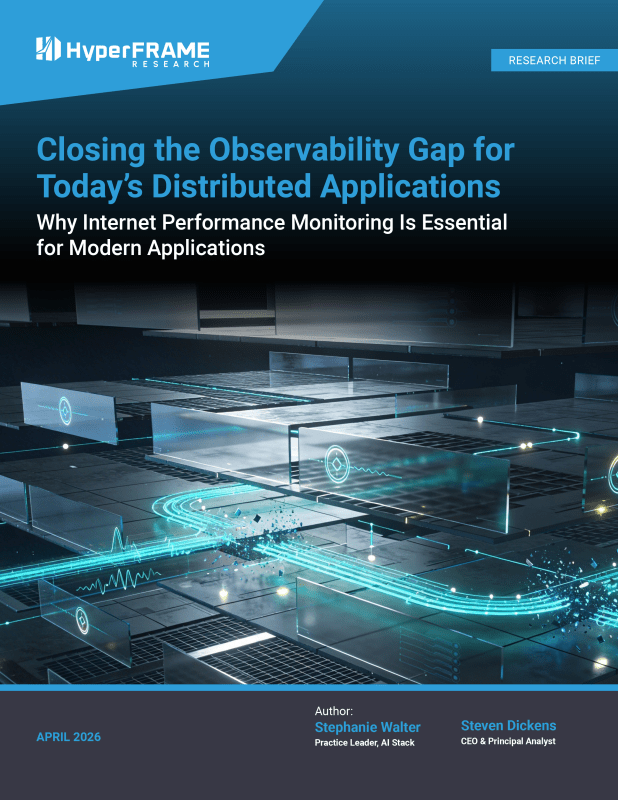
Closing the Observability Gap for Today’s Distributed Applications
Why Internet Performance Monitoring Is Essential for Modern Applications

Modern enterprise applications have evolved into a distributed fabric of cloud platforms, services, and third-party APIs that rely heavily on the public internet for delivery. While traditional observability tools focus on internal infrastructure health, they often fail to account for the internet stack, including DNS, CDNs, and ISP routing, which now represents a primary source of performance failures. This visibility gap is further widened by the rise of AI and agentic workflows, which require constant, low-latency connectivity to function effectively. Consequently, organizations must transition toward internet-native telemetry to ensure that external dependencies do not become unmanaged operational blind spots.
Key Takeaways
- The Observability Gap: Traditional monitoring typically covers only the 30% of infrastructure that organizations own, leaving a 70% "blind spot" consisting of external dependencies like DNS resolution, ISP backbone networks, and third-party APIs.
- AI Increases Fragility: Modern AI architectures, particularly those using Retrieval-Augmented Generation (RAG), are highly sensitive to latency; a minor hiccup in an external routing path can break complex agentic workflows entirely.
- Internet Performance Monitoring (IPM) is Essential: IPM provides "ground truth" by measuring performance from global vantage points, allowing teams to determine instantly if an outage is an internal server error or an external network event.
- Unified Full-Path Observability: Integrating IPM with hybrid infrastructure monitoring, such as the collaboration between Catchpoint and LogicMonitor, creates a single source of truth that correlates internal code performance with real-world internet routing.
- Strategic Risk and Compliance: In regulated industries and digital-first businesses, internet visibility is a requirement for risk management; without it, organizations may inherit liability for failures they cannot accurately diagnose.

Stephanie Walter | Practice Leader - AI Stack
Stephanie Walter is a results-driven technology executive and analyst in residence with over 20 years leading innovation in Cloud, SaaS, Middleware, Data, and AI. She has guided product life cycles from concept to go-to-market in both senior roles at IBM and fractional executive capacities, blending engineering expertise with business strategy and market insights. From software engineering and architecture to executive product management, Stephanie has driven large-scale transformations, developed technical talent, and solved complex challenges across startup, growth-stage, and enterprise environments.

Steven Dickens | CEO HyperFRAME Research
Regarded as a luminary at the intersection of technology and business transformation, Steven Dickens is the CEO and Principal Analyst at HyperFRAME Research.
Ranked consistently among the Top 10 Analysts by AR Insights and a contributor to Forbes, Steven's expert perspectives are sought after by tier one media outlets such as The Wall Street Journal and CNBC, and he is a regular on TV networks including the Schwab Network and Bloomberg.