










Research Finder
Find by Keyword
Google Cloud Next 2026: Google Cloud Architects the Agentic Blueprint with Cross-Cloud Sovereignty and Virgo Fabric
Google Cloud is transforming the competitive landscape by deploying an AI-native infrastructure that integrates the high-scale Virgo network fabric, cross-cloud data accessibility, and sovereign compute capabilities to provide a secure and resilient foundation for the modern agentic enterprise.
04/24/2026
Key Highlights
- Google Cloud is debuting a secure, adaptive foundation specifically engineered to handle the high-speed processing and autonomous logic required by modern AI agents.
- By providing zero-copy, cross-cloud access to AWS and Azure storage, Google enables agents to reason across an entire enterprise footprint without expensive data migrations.
- New architectural shifts allow infrastructure to balance dynamically between traditional apps and AI workloads while maintaining strict jurisdictional control through Distributed Cloud.
- The Agent2Agent (A2A) protocol and Agentic Gateway establish a trusted boundary for non-human identities, ensuring autonomous workflows remain within enterprise governance.
- The Virgo architecture connects 134,000 chips into a campus-as-a-computer, delivering massive bandwidth and low latency to eliminate bottlenecks.
The News
Google Cloud is launching cross-cloud infrastructure for the agentic enterprise to address the immense computational and security stresses that high-speed, autonomous AI agents place on legacy systems. This adaptive foundation introduces innovations in fluid compute, secure connectivity, a unified data layer, and digital sovereignty to transform traditional architectures into high-performance reasoning engines. For more information, read the Google Cloud blog by Nirav Mehta, VP Product Management, Google Compute Platforms and Muninder Sambi, VP Product Management, Google Distributed Cloud.
Analyst Take
Google Cloud is introducing cross-cloud infrastructure for the agentic enterprise, a secure and adaptive foundation designed to meet the high-speed demands of autonomous AI agents. This new architecture features innovations in fluid compute, secure connectivity, a unified data layer, and digital sovereignty to transform traditional data archives into proactive reasoning engines.
We see that Google Cloud is redefining the enterprise infrastructure stack by introducing fluid compute, an architectural shift that acknowledges the resurgence of the CPU in the age of agentic AI. While GPUs and TPUs remain the engines of raw power for model training, agentic workloads require a more nuanced branchy logic and complex control flow that general-purpose processors excel at.
By integrating Google Compute Engine with Kubernetes in a real-time, adaptive feedback loop, Google enables a single machine experience where infrastructure weight shifts dynamically between traditional enterprise apps and high-speed AI agents. This provides a critical bridge for the 80% of organizations not yet AI-ready, enabling them to scale toward trillion-parameter models without abandoning the security and isolation required for operational workflows.
The strategic pivot toward secure cross-cloud connectivity reflects a new reality where autonomous reasoning loops generate massive surges in machine-to-machine traffic that would overwhelm traditional networking. Google’s Agentic Gateway acts as an air traffic controller for this environment, natively understanding specialized protocols such as MCP and A2A to govern non-human identities across diverse cloud environments.
This is not merely a networking update; it is an identity-first security layer that uses AI-powered firewalls and Cloud Network Insights to provide hop-by-hop visibility into agent behavior. By treating agent communication with the same rigor as human traffic, Google addresses the policy-practice gap that often leads to shadow AI, ensuring that as agents spawn other agents, the entire ecosystem remains within enterprise-grade governance boundaries.
At the data layer, Google is collapsing the experimentation-to-execution gap by transforming passive archives into active reasoning engines through the Agentic Data Cloud. The introduction of Smart Storage and Knowledge Catalog means that dark data, the unstructured spreadsheets, PDFs, and images that make up the bulk of enterprise information, is now semantically enriched before an agent ever touches it. This provides the ground truth and business context necessary for agents to move beyond simple chat into autonomous action. By embedding intelligence directly into the storage objects, Google eliminates the data-starvation bottlenecks that typically throttle LLM scaling, enabling a borderless foundation where data can be queried across clouds without the friction of traditional migration or high egress fees.
Google’s commitment to digital sovereignty ensures that the move toward Agentic AI does not come at the cost of jurisdictional control or security. By introducing Confidential External Key Management and bringing Gemini to Google Distributed Cloud, Google enables even the most regulated sectors, such as finance and the public sector, to deploy models in air-gapped or sensitive environments.
This represents a mature, pragmatic adoption profile for AI, where total possession of encryption keys and data residency are treated as foundational requirements rather than technical hurdles. We see these innovations as indicating that Google is no longer just selling compute; the company is providing an agentic blueprint that turns infrastructure into a self-healing, sovereign, and strategically resilient engine for growth.
Google Distributed Cloud: Powering Sovereign AI with Gemini and NVIDIA Blackwell Integration
From our viewpoint, Google Distributed Cloud now offers a comprehensive, end-to-end AI stack that integrates Gemini models with infrastructure to streamline sovereign AI workloads. This hardware evolution is anchored by NVIDIA Blackwell and Blackwell Ultra GPUs, which use fifth-generation NVLink technology to bring massive, data-center scale bandwidth directly into local environments. By combining this raw power with Google’s latest AI models, organizations can accelerate their most complex developmental tasks without compromising data sovereignty.
Performance is further bolstered by the introduction of new VM families, including the A4 series, which provides a 2.25x increase in peak compute to manage intensive inference requirements. For data-heavy operations, the M2 and M3 memory-optimized instances offer the high memory-to-vCPU ratios essential for large-scale ERP and on-premises analytics. Complementing these compute gains, enhanced storage capabilities provide a tenfold performance boost and six times the capacity per zone, ensuring that local data infrastructure can finally match the rapid pace of AI reasoning.
Virgo Network: Reimagining Data Center Fabric for the AI Hypercomputer Era
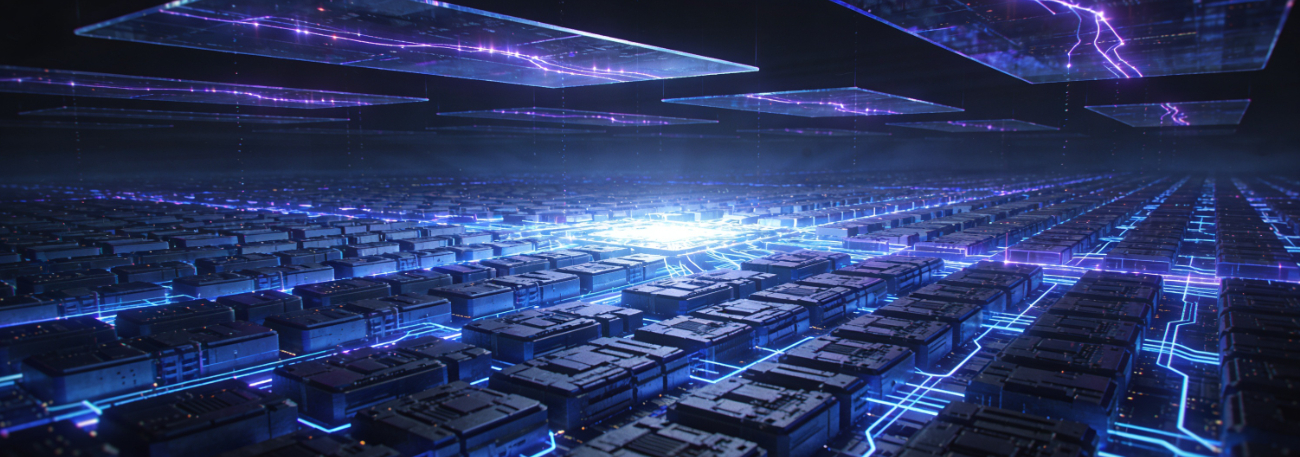
To support the exponential growth of model parameters, Google’s Virgo Network shifts away from general-purpose networking toward a campus-as-a-computer fabric designed for extreme scale. By using a flat, two-layer non-blocking topology and high-radix switches, Virgo minimizes network tiers to connect up to 134,000 chips with a massive 47 petabits per second of bandwidth. This architecture decouples networking into three specialized domains, scale-up, scale-out, and front-end, enabling each layer to evolve independently alongside accelerating hardware cycles.
We find that a critical innovation lies in its multi-planar design, which provides hardware-level fault isolation to ensure that localized failures do not derail synchronized training goodput. Beyond raw speed, the system integrates sub-millisecond telemetry to proactively mitigate stragglers and hangs that traditionally throttle massive clusters. This demonstrates a transition from treating the network as a utility to treating it as a specialized, co-designed component of the AI Hypercomputer itself.
Altering the Competitive Landscape: Engineering the AI-Native Backbone for the Agentic Enterprise
We discern that Google Cloud can gain a competitive edge through redefining enterprise capabilities by pivoting toward an AI-native infrastructure specifically engineered to support the high-scale autonomy and processing demands of modern agentic systems.
By deploying the Virgo fabric, Google creates a massive, unified compute domain of 134,000 chips that eliminates the complex network bottlenecks and excessive hops often found in the training environments of AWS and Azure. The architecture’s flat, multi-planar layout provides a 40% reduction in latency and quadruple the bandwidth per chip, ensuring the steady, jitter-free performance that autonomous agents require for real-time data analysis.
Google’s Agentic Data Cloud outpaces rivals by establishing a cross-platform lakehouse that grants agents instant, zero-copy access to files in AWS S3 or Azure Blob Storage without the need for data migrations. While competitors can struggle with disjointed services or legacy baggage, the A2A creates a unified security boundary where multi-agent systems can communicate and transact with frictionless fluidity.
The deep synergy between TPU v5p hardware and the Virgo network transforms entire data centers into a single campus-as-a-computer, offering a level of full-stack optimization that standard GPU clusters simply cannot replicate. This vertically integrated approach secures a strategic advantage by maintaining high goodput and fault tolerance, ensuring that mission-critical autonomous workflows remain stable even as an enterprise scales its AI operations.
Looking Ahead
We believe that Google Cloud is positioned for competitive success by systematically dismantling the technical and financial obstacles that have traditionally slowed multi-cloud AI adoption. Through the Agentic Data Cloud, it has established a borderless system of action that enables agents to use data across AWS and Azure via zero-copy access. This enables comprehensive processing across an enterprise's entire digital footprint while bypassing the high latency and expensive egress taxes usually incurred when moving data between competing platforms.
At the foundational level, the Virgo fabric provides a massive infrastructure advantage by uniting 134,000 chips into a single compute domain. This architecture delivers the jitter-free, high-bandwidth performance essential for agents to manage thousands of simultaneous tasks, offering a level of fluid, large-scale orchestration that outshines the more rigid and siloed structures of its competitors.
Moreover, Google Cloud facilitates a cohesive operational environment through its A2A Protocol and integrated security fabric. By creating a singular, trusted space for multi-agent systems to communicate and execute transactions, Google provides a unified ecosystem that stands in contrast to the fragmented and complex service catalogs often found in rival cloud environments.

Ron Westfall | VP and Practice Leader for Infrastructure and Networking
Ron Westfall is a prominent analyst figure in technology and business transformation. Recognized as a Top 20 Analyst by AR Insights and a Tech Target contributor, his insights are featured in major media such as CNBC, Schwab Network, and NMG Media.
His expertise covers transformative fields such as Hybrid Cloud, AI Networking, Security Infrastructure, Edge Cloud Computing, Wireline/Wireless Connectivity, and 5G-IoT. Ron bridges the gap between C-suite strategic goals and the practical needs of end users and partners, driving technology ROI for leading organizations.