
















Research Finder
Find by Keyword
Can "Test Like You Fly" Remain a post-IPO SpaceX's Most Defensible Moat?
Starship program Booster 19 abort at 1.88 seconds, lost engines, and a slipped Flight 12 may signal a new disclosure strategy, not a development crisis
04/30/2026
Key Highlights
- SpaceX disclosed two consecutive Booster 19 static fire aborts (March 16 and April 15, 2026), the second halting at 1.88 seconds after a sensor loss issue likely produced a false reading
- The April 24 "Test Like You Fly" video progress report formally introduces the Raptor 3 engine and Starship V3 architecture as a clean-sheet design rather than an iteration on V2
- SpaceX repurposed Raptor 3 engines from Booster 20 onto Booster 19 to preserve schedule after the March abort caused mechanical damage to roughly half the engines fired
- Booster 19 itself replaced Booster 18, which was lost on November 20, 2025 during cryoproof testing, marking the second V3 booster pressed into Flight 12 readiness duty
- My analysis suggests the disclosure of setbacks alongside the program documentary signals a deliberate shift from launch-day spectacle toward engineering credibility, with implications for how Artemis customers and competing propulsion programs price their own development risk
The News
SpaceX has detailed a series of development setbacks behind the slipping debut of its Starship V3 vehicle and the maiden flight of the Raptor 3 engine, according to an April 27 Aviation Week report by Robert Wall. The most recent issue, an April 15 static fire of Booster 19's 33 engines, was aborted approximately 1.88 seconds after engine startup because of a sensor loss issue that may have produced a false reading. The media disclosures arrived alongside an April 24 video progress report from SpaceX titled "Test Like You Fly." The video walks through the V3 architecture and frames the program's setbacks as inputs, data points rather than failures. CEO Elon Musk had said on April 16 that V3's first flight, the 12th in the Starship program, was due "in a few weeks," with the launch window now widely expected in May 2026. That is incidentally just a few weeks before a SpaceX IPO that relies heavily on the Starship program for its record valuation.
Analyst Take
The interesting story here is not the abort, it is the disclosure. SpaceX chose to publicly walk through two consecutive static fire failures, a lost booster from cryoproof testing, and a months-long schedule slip, all in a single 25-minute video. That is unusual behavior for a private aerospace company, and it tells us something important about where the program is headed. Our read is that SpaceX is converting its own development friction into a marketing asset, betting that transparency about hard problems is a stronger signal of program maturity than an opaque ‘fan ready’ apparent absence of problems. The contrarian observation worth holding onto: the Raptor 3 development setbacks may be the clearest validation of the "Test Like You Fly" methodology to date, not its rebuttal. A test campaign that produces zero anomalies is a test campaign that has not yet found the real failure modes. SpaceX appears to understand that distinction better than most operators in the launch industry. This is crucial considering that every thesis about our near-term future in space (lunar bases, orbiting data centers) relies upon launch economics that can only be achieved by a routinely flying Starship program.
What Was Announced
Aviation Week's reporting, drawn from SpaceX's own April 24 video progress report and accompanying disclosures, walks through a development sequence considerably more eventful than the public flight cadence has suggested. The April 15 static fire test of Booster 19's full Raptor 3 engine complement was aborted at 1.88 seconds after engine startup, with SpaceX attributing the cause to a sensor loss issue that may have generated a false reading. That test was itself the second attempt of the day. An earlier test was cut short by a diverter issue, not part of the rocket but the pad itself. A March 16 static fire of just ten Raptor 3 engines on the same booster ended approximately two seconds into the test after a sensor reading prompted a fast shutdown. Fast shutdowns are a brute force safety measure, and as a result post-test data suggested the rapid shutdown caused mechanical damage to about half the engines fired. To preserve schedule, SpaceX pulled Raptor 3 engines from Booster 20 and installed them on Booster 19. The choice of Booster 19 itself was already a contingency, after Booster 18 was lost in November 2025 during on-the-ground cryoproof testing. Booster 19 cleared its own cryoproof test in early April. In separate news, SpaceX completed a full-duration static fire of the Starship V3 upper stage on April 14, ten months after the Massey's test site was damaged in a Starship 36 anomaly during static fire testing. The cumulative picture is one of substantial ground test maturity, with the company reporting that over 600 Raptor engines have been produced to date. All of this progress maps in parallel to the kind of operational surprises that only emerge when full-stack hardware meets a new launch pad on its first integrated test.
Market Analysis
Holding Raptor 3 against the rest of the heavy-lift propulsion field is more useful when the thrust ladder is established on consistent units.
The L3Harris RS-25, used on NASA's Space Launch System (e.g. Artemis 2), produces approximately 418,000 pounds-force at sea level on a hydrolox fuel-rich staged combustion architecture, and is by most reasonable metrics the most efficient staged combustion engine ever flown. It is also expended after every SLS flight. L3Harris is working to soften that economic burden through its RS-25 production restart program, targeting meaningful cost reductions on new-build RS-25E engines and demonstrating that legacy heavy-lift propulsion retains an active development roadmap. The architecture itself is no longer competitive with reusable methalox alternatives on a per-flight cost basis.
Blue Origin's BE-4 (the engine supporting both ULA's Vulcan Centaur and Blue Origin’s own New Glenn), uses an oxygen-rich staged combustion methalox cycle. The engine produces approximately 640,000 pounds-force at sea level following a November 2025 performance increase. BE-4 reusability was validated when the New Glenn booster "Never Tell Me the Odds" successfully landed on Landing Platform Vessel Jacklyn during the second New Glenn flight. That achievement made the BE-4 the second American orbital-class engine demonstrably reusable in flight. That milestone removes "reusability is uniquely SpaceX" from the propulsion narrative. Because we are focused on propulsion here, we wont dig into the second stage issues that lost the customer payload on that flight.
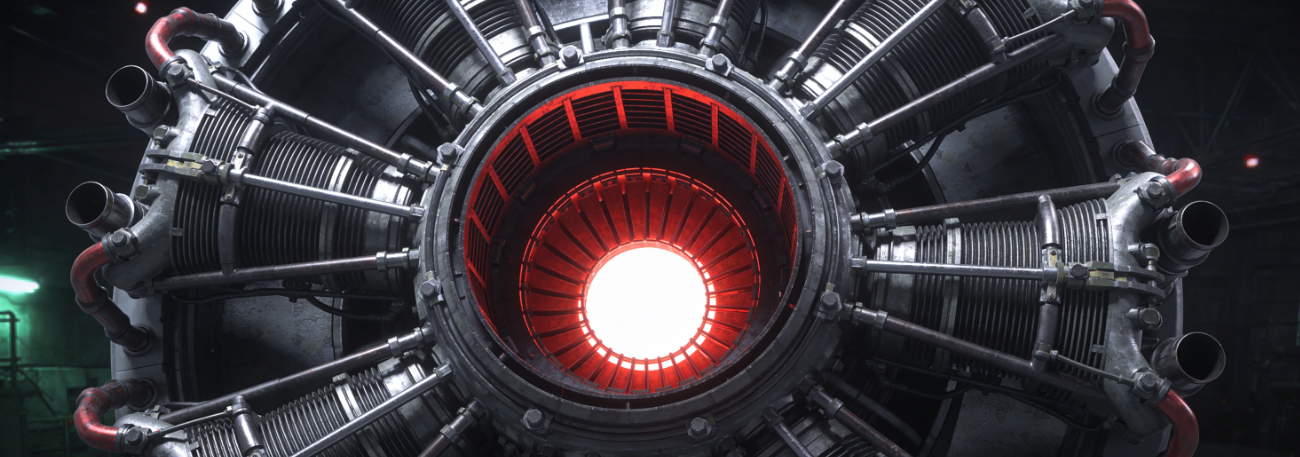
SpaceX Raptor 3, designed around full-flow staged combustion and producing approximately 617,000 pounds-force at sea level, is architected without an external heat shield. There is an emerging analyst consensus that launch industry economics are increasingly driven by manufacturing throughput rather than peak performance metrics. SpaceX is not betting on thrust per engine. BE-4 already produces more sea-level thrust than Raptor 3. The bet is that the full Super Heavy engine cluster, mass-produced at McGregor with minimal refurbishment burden, can clear cycles fast enough to make full reusability operationally credible.
Looking Ahead
The key trend we'll be monitoring is whether the Flight 12 outcome, whenever it occurs, validates SpaceX's manufacturing-throughput thesis or exposes an architectural fragility that ground testing did not catch. We already know Raptor 3 starts cleanly, accumulates substantial test stand runtime, and survives single-engine extreme conditions. What we do not yet know is how 33 of them behave together at flight loads, on a new pad, with a redesigned booster, on the first attempt. Possibly leading into a SpaceX IPO.
No pressure, right?
There is a huge stack of unknowns on the short-term horizon, and knowing SpaceX history, one has to see it as a deliberate choice. SpaceX consistently bundles risk into its test campaigns rather than spreading it across multiple flights. This is due to a company culture in the Falcon 9 program that benefits from the unique vertical stack of launcher and internal revenue creating payloads from Starlink. If Starship Flight 12 succeeds, even in part, the gap between SpaceX's iteration speed and the rest of the launch industry widens further, with downstream implications for Artemis HLS schedules, Starlink V3 deployment economics, and the development trajectories of competing methalox programs. If it fails, certainly it is likely to affect the IPO, but the disclosure pattern we are watching now becomes the template for how the program absorbs the lesson and moves forward.

Stephen Sopko | Analyst-in-Residence – Semiconductors & Deep Tech
Stephen Sopko is an Analyst-in-Residence specializing in semiconductors and the deep technologies powering today’s innovation ecosystem. With decades of executive experience spanning Fortune 100, government, and startups, he provides actionable insights by connecting market trends and cutting-edge technologies to business outcomes.
Stephen’s expertise in analyzing the entire buyer’s journey, from technology acquisition to implementation, was refined during his tenure as co-founder and COO of Palisade Compliance, where he helped Fortune 500 clients optimize technology investments. His ability to identify opportunities at the intersection of semiconductors, emerging technologies, and enterprise needs makes him a sought-after advisor to stakeholders navigating complex decisions.