


















Research Finder
Find by Keyword
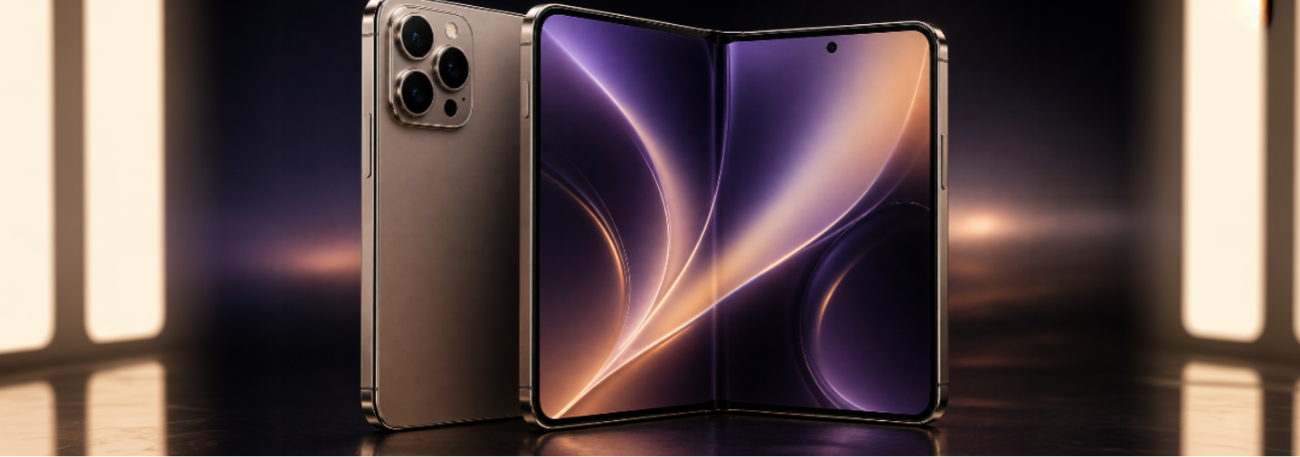
Will Apple's Foldable Debut Make These Foldable Phones Enter The Mainstream?
Strategic divergence in foldable hardware, thermal management challenges, software maturity versus raw specs, and the impending impact of Apple's late entry.
04/30/2026
Key Highlights
- Samsung utilizes the TriFold as a branding tool to retain its innovation lead before Apple enters the foldable market.
- Thermal constraints and high price points remain significant barriers to the mass adoption of triple-screen devices.
- Motorola currently leads in raw hardware metrics like brightness and charging speed, while Samsung maintains a lead in software and durability.
- The transition of Google to TSMC-manufactured silicon has improved Pixel efficiency, but modem performance still trails competitors.
- Apple's expected 2026 entry is likely to focus on the book-style format rather than complex multi-fold designs.
Analyst Take
As a user of a Google Pixel 10 Pro Fold as my daily driver, I have spent considerable time thinking about the diverging paths of the foldable market as we head toward the latter half of 2026. My analysis suggests that the current state of the market is a tale of two distinct philosophies. On one hand, you have the pursuit of the ultimate engineering feat represented by the Samsung TriFold. On the other hand, there is a grounded focus on refining the foldable experience through better batteries and brighter screens as seen with Motorola and Google. This split creates a curious environment for Apple to enter. It is my view that the current landscape is less about who has the most folds and more about who can make a folding device feel like a regular phone when you need it to.
The Samsung TriFold is an impressive piece of kit as my obvious excitement at CES in this video shows. It is architected to solve the aspect ratio problems that have haunted the book style foldables for years. When it is fully open, you get a 10-inch rectangle that actually looks like a tablet, not a squared-off hybrid. We see this as a strategic move to plant a flag. Samsung wants to be the innovator. However, we have to look at the practical side of carrying a $3,000 device. The thermal reality of stacking three layers of silicon and battery is a massive hurdle. Based on our discussions with analysts who had one on trial, managing heat in such a tight profile often leads to heavy throttling. This suggests that while the TriFold is a marvel, it might remain a low-volume halo product for some time.
When we look at the battle between Motorola and Samsung, the contrast is even more apparent. Motorola has made a name for itself by pushing the spec sheet. The Razr Fold is designed to deliver immediate satisfaction with 6,200 nits of brightness and incredibly fast charging. They are using silicon-carbon batteries to keep the device thin while packing in more capacity. It is a hardware-first approach that makes Samsung look a bit conservative. Samsung, however, relies on its eighth-generation hinge and superior water resistance ratings. We find that Samsung's software maturity is still the benchmark. Its One UI 8.0 and DeX mode make the device a genuine tool for work. Motorola still feels like it is running a blown-up version of a standard phone. I need to get hands-on with one as a daily driver, but my experience is based on being hands-on at CES and MWC already this year,
Google has finally found its footing by switching to TSMC for its Tensor G5 chip. This move aims to deliver the efficiency and cool operation that users have been asking for. The Pixel 10 Pro Fold is the choice for those who value software intelligence. Features like the AI driven Magic Fold show a deep understanding of how people actually use two screens at once. Yet, we noticed that Google still struggles with modem performance compared to the Qualcomm hardware found in Samsung and Motorola devices. If you live in an area with a spotty signal, the Pixel might still give you some trouble.
Our analysis shows that the "crease" is becoming a secondary issue for software-focused users, but it remains a sticking point for hardware purists. Motorola's hinge design has largely mitigated this, while Samsung seems to think users will ignore it if the software is good enough. This brings us to the elephant in the room. Apple is looming. We believe Apple will not jump into the TriFold deep end. They are more likely to perfect the book-style fold. They will focus on a device that is thin, durable, and deeply integrated into their existing ecosystem. They don't need to be first. They just need to be the most polished.
The market is currently split between those who want a pocketable workstation and those who want the fastest, brightest gadget available. Samsung is trying to be both, but the TriFold might be a bridge too far for the average buyer. Motorola is winning the spec war. Google is winning the AI war. Apple is waiting to see which side the public chooses. I think the winner won't be the company with the most folds, but the one that makes the folding part feel invisible.
Looking Ahead
Based on what we are observing in the current trifold and bifold landscape, the key trend that we are going to be tracking is the shift from hardware novelty to thermal and economic sustainability. The industry has proven it can fold glass three times, but it has not yet proven it can do so at a price point or a temperature that makes sense for a daily driver. When you look at the market as a whole, the announcement of a $3,000 TriFold feels like a defensive play against the inevitable Apple launch.
My perspective is that Apple will likely skip the triple-fold experimental phase entirely. They are designed to wait until a technology is mature enough to be invisible. We expect their fall release to focus on a refined bifold that prioritizes a seamless hinge and a display that lacks any perceptible crease. While Samsung uses the TriFold to maintain its status as an innovator, Apple will likely use a more traditional foldable format to standardize the category for the masses.
Going forward we are going to be tracking how the big players perform on battery longevity and modem efficiency. The switch to silicon-carbon batteries is a major step for the industry. HyperFRAME will be tracking how the players perform in future quarters as they try to balance these high-capacity batteries with the intense power demands of high-brightness screens and AI processing. The next year will decide if the foldable remains a luxury niche or becomes the new standard.

Steven Dickens | CEO HyperFRAME Research
Regarded as a luminary at the intersection of technology and business transformation, Steven Dickens is the CEO and Principal Analyst at HyperFRAME Research.
Ranked consistently among the Top 10 Analysts by AR Insights and a contributor to Forbes, Steven's expert perspectives are sought after by tier one media outlets such as The Wall Street Journal and CNBC, and he is a regular on TV networks including the Schwab Network and Bloomberg.