
















Research Finder
Find by Keyword
Is Your Operations Stack Just a Collection of Noisy Silos?
The IBM Concert Platform aims to unify fragmented IT operations through a centralized, agentic framework for hybrid cloud environments.

05/05/2026
Key Highlights
- Centralized Nervous System: Correlates signals across infrastructure and application domains.
- Shared Context: Moves teams from reactive firefighting to automated, proactive remediation.
- GPU & AI Focus: Addresses complexity in GPU cost management and AI-specific infrastructure.
- Drift Management: Deep integration with infrastructure-as-code (IaC) to close the gap between desired and live states.
- Six Core Capabilities: Architected to scale security, resilience, and performance across the SDLC.
The News
IBM today unveiled the IBM Concert Platform, an AI-powered operations tool designed to move organizations from passive monitoring to coordinated, intelligent response. The platform functions as an agentic layer that connects data, context, and actions across hybrid environments to eliminate operational silos. It is architected to give teams real-time, full-stack visibility while automating the remediation of vulnerabilities and performance bottlenecks. Check out the press release here.
Analyst Take
We see the launch of the IBM Concert Platform as a direct response to the "AI divide" where organizations struggle to turn vast data pools into tangible operational outcomes. In our view, the modern enterprise has become a sprawling mess of disconnected tools, and the introduction of a unified operating model is a necessary, if ambitious, attempt to bring order to that chaos.
This ambition aligns with a critical finding from the 1H 2026 HyperFRAME Research Lens, which notes that while 78% of organizations agree AI is strategically important, only 37% utilize a structured process for evaluation and deployment. This 41-point "strategy-to-execution gap" underscores the market's hunger for a platform like Concert that can provide the necessary structure to move from intent to industrialized execution.
The platform is not just another monitoring tool; it is designed to act as a connective tissue between existing silos like Instana, Turbonomic, and Cloud Pak for AIOps. From our perspective, the most interesting technical aspect is how the platform handles infrastructure drift. By integrating with tools like HCP Terraform, it surfaces discrepancies that lead to security gaps.
IBM's focus on bridging the gap between IT and operations addresses a significant structural imbalance. HyperFRAME data shows IT departments leading AI oversight in 41% of organizations, while operations leads in only 7%. By centralizing control within an "agentic layer," IBM Concert aims to empower operations teams to take a more proactive, lead role in the AI lifecycle.
What Was Announced
The platform is built on six foundational capabilities:
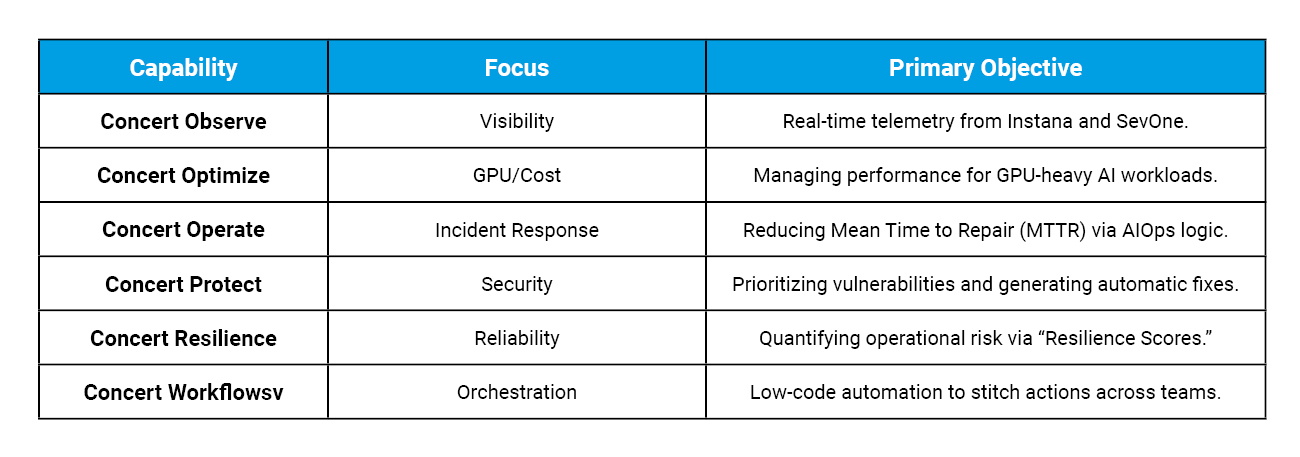
The shift toward "agentic" operations is a theme we have been tracking closely. Most legacy systems are passive. This platform is architected to be active, identifying how a specific database vulnerability might affect a customer-facing application three layers away. By providing a "resilience score," the system aims to give business leaders a quantified view of their operational risk.
Looking Ahead
The IBM Concert Platform represents a significant step in the evolution of the autonomous enterprise. The key trend we are watching is how well IBM can integrate these six distinct capabilities into a seamless experience.
The urgency for this integration is highlighted by the fact that, according our owen data, 72% of enterprises currently treat AI as a near-term performance lever for operational efficiency, yet only 23% of AI/ML projects reached production and met original ROI objectives in the last year. IBM's success will be measured by whether Concert can bridge this "Execution Gap" through its promised automation.
The announcement places IBM in direct competition with players like ServiceNow and Datadog. However, IBM’s deep roots in the mainframe and hybrid cloud give it a unique perspective on legacy interoperability. This is vital, considering that 23% of enterprises are still reliant on legacy on-premises data warehouses, making a hybrid-first approach a necessity for broad adoption in 2026.
Going forward, we will be monitoring how the company performs in migrating its existing Cloud Pak customers over to this more modern, agentic framework. If IBM can convince C-suite leaders to manage their business through "Resilience Scores," they will have successfully moved the conversation from "IT costs" to "business resilience."

Steven Dickens | CEO HyperFRAME Research
Regarded as a luminary at the intersection of technology and business transformation, Steven Dickens is the CEO and Principal Analyst at HyperFRAME Research.
Ranked consistently among the Top 10 Analysts by AR Insights and a contributor to Forbes, Steven's expert perspectives are sought after by tier one media outlets such as The Wall Street Journal and CNBC, and he is a regular on TV networks including the Schwab Network and Bloomberg.