
















Research Finder
Find by Keyword
Compute Continuum: Why Qualcomm Opened Computex
With a Vision Not a Pitch
Cristiano Amon described the era of agents, and redefined how we will interact with everything Qualcomm powers
06/02/2026
There's an old story about a NASA janitor. When President Kennedy toured the facility and asked the man with the broom what he did, the janitor reportedly answered, "I'm helping put a man on the moon." That's the frame for understanding Amon's Computex keynote. He runs a semiconductor company, but he did not give a semiconductor talk. That was the right choice at the right moment. He stood on stage and described the cathedral, not the bricks
Key Highlights
- Amon declared 2026 "the year of agents" and argued the entire surface area of computing devices must be rebuilt for autonomous AI that acts, not just responds.
- The central thesis was a tectonic shift from a phone-centered digital life to an agent-centered one, where billions of phones, PCs, personal AI devices, and (millions of) connected cars become endpoints rather than centers.
- Qualcomm announced Dragonfly, a new brand for its data center products, completing a portfolio Amon framed as spanning sub-milliwatt earbuds to multi-kilowatt server racks.
- The economic engine is tokens: agentic workloads consume roughly one million tokens per task, each, a hundredfold jump over conversational AI, with global demand projected to reach the quintillions by 2030.
- The strategic punchline is distributed computing, with demos indicating the potential for on-device orchestration cutting token cost by sixty percent against cloud-only execution.
The News
At Computex in Taipei, Cristiano Amon’s keynote hinged on a single challenge: AI is changing the human-computer interface, and that change is about to rewrite the architecture of nearly every device people own. He opened with gratitude, thanking Qualcomm's supplier ecosystem and singling out TSMC as an incredible partner, stressing that leadership in technology comes through partnership rather than any one company acting alone.
The keynote framed agentic AI as the inflection point. Agents, in Amon's telling, do not wait for prompts. They act on intent, carry context forward, break goals into steps, and coordinate across on-device data, a user's personal graph, and the cloud until a task is finished. Because today's hardware and software were built for user-initiated actions rather than autonomous ones, Amon argued the entire device surface area needs an upgrade, which could become one of the largest upgrade cycles the industry has seen.
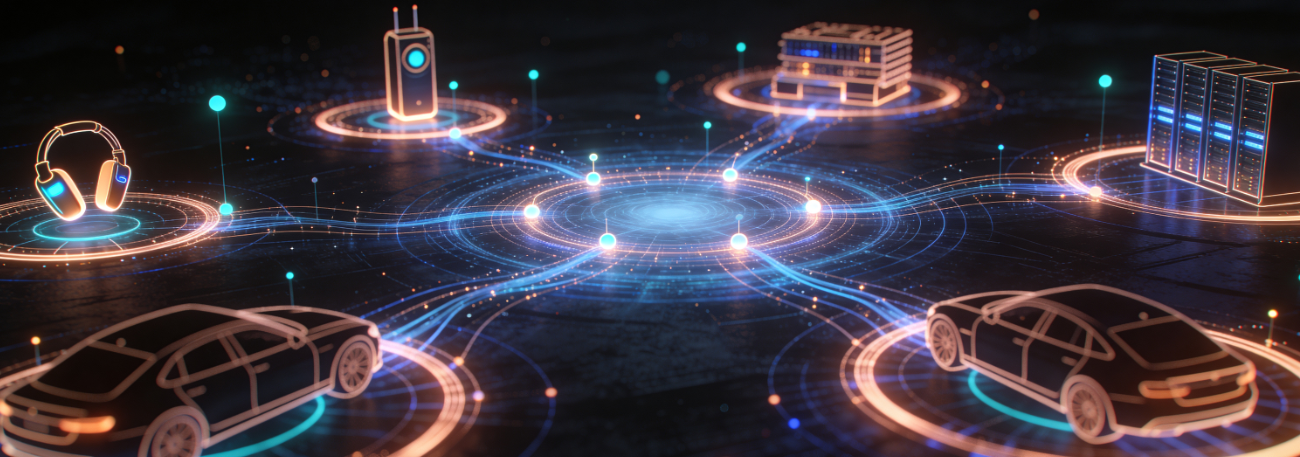
He walked the audience across that continuum. Phones gain two personalities, one operated by the human and one by the agent. Personal AI devices such as glasses scale because they sit naturally near the eyes, mouth, and ears. Cars evolve from software-defined to AI-defined, splitting into cockpit AI and physical AI. Robots demand a three-layer compute hierarchy of instant execution, action and grounding, and reasoning, with Qualcomm building across AMRs, industrial arms, quadrupeds, humanoids, and drones, and naming partners including Figure AI. Amon introduced 6G as the first wireless generation designed for AI, built on connectivity, distributed computing, and sensing, the last of which could turn networks into a real-time digital twin of a city. And he closed on economics, presenting distributed orchestration as the answer to runaway token demand, capped by the Dragonfly data center brand.
Analyst Take
Our cathedral framing reflects on the most important strategic signal we took away from the keynote. We think it deserves more weight than the individual product announcements that will dominate the trade coverage.
For most of its history Qualcomm has been understood, fairly, as the modem-and-mobile-SoC company, with everything else read as adjacency. What Amon did at Computex was refuse that frame in front of the most influential hardware audience on the planet. By opening with TSMC and the surrounding ecosystem rather than a chip, and by spending the bulk of his stage time on what silicon enables rather than the silicon itself, he was making a positioning move far more than a technical one. The janitor is not just sweeping. He is building the moonshot. The question worth sitting with is whether the market is ready to re-rate Qualcomm on that basis, because the company is clearly asking it to do so.
The setting reinforced the argument better than any slide could. Amon's keynote opened Computex, and the show floor this year devoted an entire hall to robots, with hundreds of device manufacturers exhibiting hardware that no longer assumes a single screen at the center of the experience. Walking that floor, the thesis stops feeling like a keynote abstraction and starts feeling like a description of the room. His keynote challenges every manufacturer present to consider building a product that now has to fit inside an ecosystem of other devices rather than stand alone. That reality is the market and paradigm shift Amon's agent-centric model describes. The endpoints already exist in the billions. What is missing is the connective compute fabric, and that absence is the opportunity Qualcomm is positioning itself to fill.
The agent-centric thesis is the load-bearing wall. The claim that the digital center of gravity shifts from the phone to the agent, with devices demoted to endpoints, is designed to reframe the competitive map. If agents become the locus of digital life, then the relevant moat is no longer owning the phone OS or the app store. It is owning the compute fabric the agent runs across, from the earbud to the rack. This is a convenient thesis for a company that has spent years diversifying away from smartphone dependence, and it should be read with that incentive in mind. But it is not merely convenient. The device counts Amon cited (roughly six billion phones, two billion PCs, two billion personal AI devices, and five hundred million connected cars) describe a genuinely heterogeneous endpoint landscape. His repeated insistence that AI platforms are never one size fits all is the strongest argument for why a company spanning the full power envelope has structural advantages a pure-play does not.
The token economics are where the strategy rewards diligence and validation. Amon's progression from roughly ten thousand tokens for conversational AI to one hundred thousand for reasoning to one million per agentic task, a hundredfold jump across two generations, is directionally credible and consistent with what the broader industry is observing about agentic workloads. The projection of global demand reaching the quintillions by 2030 is the kind of number that aims to reframe the entire cost conversation, and it is the foundation for the distributed-computing pitch. The two demos are the proof points to scrutinize: a Claude Opus session that an on-device orchestrator routed to save about 1.4 million tokens and sixty percent of cost, and a web page build completed with thirty percent fewer tokens at a quarter of the cost versus cloud-only. We would want to see these results outside a keynote environment, on workloads the presenter did not choose, before treating sixty percent as a planning assumption. The underlying logic is sound though, inference economics eventually force workloads to the most efficient available compute and that a meaningful share lands at the edge. The specific savings figures are designed to make that logic feel inevitable, and inevitability is the thing keynotes manufacture best.
Two things temper the vision. First, the timeline. Calling 2026 the year of agents is a bold near-term claim, and much of the device, OS, and application re-architecture Amon described is multi-year work, not next-quarter shipping. He is, however talking to partners who must design in his vision in products that will appear in the next 3-5 years. Its the right message for that audience. Agents wont be here fully in 2026, ut by the time a set of smart glasses reaches the market? They’d better reflect this landscape. The 6G material in particular sits years out, and the digital-twin sensing pillar, while genuinely novel, reads as roadmap rather than product. Second, the data center story remains the thinnest part of the portfolio narrative. Dragonfly is a brand and a stated intent to work with hyperscalers, but Amon explicitly deferred the substance to later in the month at the June 24 investor day. For a company asking to be re-rated on full-continuum reach, the highest-value, most contested tier of that continuum is the one with the least disclosed detail. So far. That is the gap to watch and the opportunity the company seeks to create.
The thing the trade press will likely miss is that this keynote was an act of category redefinition aimed at investors and partners as much as engineers. Amon seems to be betting that the agent era dissolves the old boundary between cloud and edge into a single system, and that when it does, the company positioned across every tier of that system wins by default. It is a compelling story, and the engineering logic underneath it is more solid than the savings percentages would have to be for the thesis to hold. Whether Qualcomm can execute on the data center tier, where it is least proven and most challenged, is what turns this from an inspiring keynote into a defensible strategy. The cathedral is beautifully described. We will be watching to see who actually lays the stones.
Looking Forward:
This keynote sets up several concrete tests, and we will be tracking each as Qualcomm's continuing evolution plays out.
The first marker is the June 24 investor day, where Dragonfly has to graduate from brand to substance. We will be looking for customer commitments, a credible performance and power-efficiency goal stack against entrenched data center incumbents, and a roadmap with dates. If the data center narrative stays at the level of intent, the full-continuum thesis loses a crucial load-bearing tier, and the re-rating Amon is implicitly asking for becomes harder to justify.
The second is whether the distributed-orchestration savings hold up outside the demo. The sixty percent and four-times figures are the quantitative heart of the edge thesis, and their durability on independent, unscripted workloads is what separates a planning assumption from a stage prop. We will be watching for third-party benchmarks and, more tellingly, for design wins where a partner chose Qualcomm's on-device orchestration specifically to bend inference cost.
The third is physical AI conversion. The robotics platform spanning AMRs, industrial arms, quadrupeds, humanoids, and drones is ambitious. We are looking forward to seeing if the Figure AI relationship Amon teased is the signal on whether Qualcomm becomes the default compute layer for humanoids, versus one option among several. Named, shipping robotics partners, not reference designs, are going to be the proof point here, and so far the company is delivering. The same applies to the automotive transition from software-defined to AI-defined vehicles, where Qualcomm already has a meaningful design pipeline to convert. We were most taken in the day before discussion with Qualcomm CMO Don McGuire (resurfacing EVP Nakul Duggal in Forbes) framing a car as basically a robot that you drive.
The fourth is the longer arc: 6G and the sensing-as-digital-twin pillar. This is the most novel and the most distant element of the vision, and it is where Qualcomm's modem heritage could translate into a genuinely differentiated position if the standards and silicon arrive on schedule. We are treating this as a multi-year watch item rather than a near-term catalyst, but it is the part of the keynote that, as it lands, would most fully vindicate the agent-centric reframing.
The throughline across all four is execution against breadth. Qualcomm has told a story only a full-continuum company could tell. The risk in that story is the same as its promise: spanning everything means being measured everywhere. We will be watching whether the company can convert an inspiring vision into shipping silicon at each tier, and with Dragonfly we will be paying closest attention to the tier where it has the most upside.

Stephen Sopko | Analyst-in-Residence – Semiconductors & Deep Tech
Stephen Sopko is an Analyst-in-Residence specializing in semiconductors and the deep technologies powering today’s innovation ecosystem. With decades of executive experience spanning Fortune 100, government, and startups, he provides actionable insights by connecting market trends and cutting-edge technologies to business outcomes.
Stephen’s expertise in analyzing the entire buyer’s journey, from technology acquisition to implementation, was refined during his tenure as co-founder and COO of Palisade Compliance, where he helped Fortune 500 clients optimize technology investments. His ability to identify opportunities at the intersection of semiconductors, emerging technologies, and enterprise needs makes him a sought-after advisor to stakeholders navigating complex decisions.