
















Research Finder
Find by Keyword
Governing Open and Closed Models Across the Enterprise AI Stack
Why Model Licensing Alone Does Not Determine Operational Risk
7/27/2026
Key Highlights
- Open models give enterprises greater control over deployment, data location, customization, and infrastructure, but also transfer more responsibility for security and operations.
- Proprietary models retain provider-managed safeguards and revocable access, but those controls do not eliminate risks created by excessive permissions, sensitive data access, or connected tools.
- An open model operating within a constrained environment may present less operational risk than a closed model connected to production systems with broad credentials.
- As AI becomes more agentic, the primary control boundary is expanding from the model to the runtime surrounding it.
- Enterprises need governance spanning model evaluation, identity, data, tools, infrastructure, observability, human approval, and containment across both open and closed models.
The News
The policy debate over open-weight AI has focused heavily on whether releasing model weights makes powerful capabilities more difficult to control. Once a model is openly available, its original developer cannot reliably revoke access, force security updates, or prevent users from modifying or removing safeguards. These concerns become more significant as models gain advanced cyber, biological, coding, reasoning, and autonomous-action capabilities.
The debate intensified after Anthropic alleged that Chinese AI labs used approximately 24,000 fraudulent accounts and more than 16 million Claude exchanges to distill capabilities into competing models. Anthropic argues that releasing distilled models as open weight amplifies the risk because safeguards can be removed and access cannot be revoked. Open-model advocates counter that the alleged extraction occurred through Anthropic’s closed service, making API access and identity controls the first failed boundary. A broad industry coalition has since opposed sweeping restrictions on open models. As of July 26, neither Anthropic nor Amazon has signed the letter, although Amazon has not publicly adopted Anthropic’s position.
At the same time, open-model advocates argue that independently deployable models improve competition, research, customization, and technological sovereignty. Enterprises can run models within private infrastructure, bring inference closer to sensitive data, and reduce dependence on the policies, pricing, and availability of a small group of proprietary providers.
Both positions are valid, but neither fully captures how enterprises experience AI risk.
Organizations rarely deploy a model in isolation. The model sits within a broader stack that may include enterprise data, retrieval systems, APIs, agent frameworks, Model Context Protocol servers, identity services, observability platforms, and production infrastructure. Its practical authority is determined by the credentials it receives, the tools it can call, the data it can retrieve, and the actions the surrounding runtime permits.
The licensing model alone therefore cannot determine whether an AI system is safe. Open-weight availability changes who controls the model and which safeguards remain enforceable. It does not reveal the complete operational risk created when that model—or a proprietary alternative—is connected to the enterprise.
Analyst Take
Open models transfer control to the enterprise, but they also transfer responsibility.
That tradeoff is central to their value. Organizations can determine where an open model runs, which data it processes, how it is optimized, and when it is updated. They are less dependent on a provider changing its model, pricing, usage policies, geographic availability, or support for a particular workload.
This flexibility is especially important for regulated, highly sensitive, latency-sensitive, and disconnected environments. An organization may need to keep data within a specific jurisdiction, operate inside a private cloud or on-premises data center, customize a model for proprietary terminology, or maintain access when an external service is unavailable.
Open models can also improve leverage within a broader model strategy. HyperFRAME Research Lens data shows that 79% of organizations anticipate using multiple foundation models concurrently, while 48% are pursuing hybrid LLM strategies. Enterprises are unlikely to select one model and standardize every AI workload around it. They will combine proprietary frontier models, smaller specialized models, and open models based on cost, performance, privacy, latency, and control requirements.
However, running an open model requires the enterprise to assume operational functions that a proprietary provider would otherwise perform. These include securing model artifacts, validating updates, testing behavior, managing inference infrastructure, monitoring usage, evaluating vulnerabilities, and responding when safeguards fail.
The organization must also determine whether the model it downloaded is the model it intended to deploy. Model weights, adapters, fine-tuning data, dependencies, and inference containers become part of the AI supply chain. A compromised model repository or unverified artifact can introduce risk before the model ever receives a prompt.
Many enterprises want the control associated with open models without yet having the operating model required to manage them. The result can be fragmented deployments in which teams download models independently, apply inconsistent evaluations, and connect them to enterprise data without centralized visibility. Open-model governance cannot stop at approving a license or maintaining a list of permitted models.
The same scrutiny must apply to proprietary models. Provider-managed controls offer meaningful benefits. A model vendor can monitor misuse, restrict access, update safeguards, investigate abnormal behavior, and disable compromised accounts. Enterprises also avoid operating the underlying model infrastructure themselves.
Yet proprietary access does not eliminate operational risk. A closed model connected to customer databases, code repositories, cloud consoles, financial systems, or communications platforms can cause material harm even if the provider’s safeguards remain intact. The provider may govern what the model is willing to generate, but it does not necessarily control what the enterprise application allows the model to access or execute.
An enterprise can therefore deploy a well-governed model inside a poorly governed system.
This problem is becoming more urgent as models evolve into agents. Agents do more than generate responses. They select tools, retrieve context, chain tasks, make decisions, and take actions. The potential impact is no longer limited to an inaccurate answer. An agent can expose data, modify code, send messages, initiate transactions, provision infrastructure, or repeat a permitted action at an unanticipated scale.
In that environment, a model’s openness is only one input into risk. The more important question is what the complete system allows the model to do.
The Runtime Becomes the Control Boundary
Traditional model governance focuses on selecting approved models, reviewing training practices, testing outputs, and monitoring accuracy or bias. Those controls remain necessary, but they are insufficient for agentic systems. The operational control boundary must extend into the runtime surrounding the model.
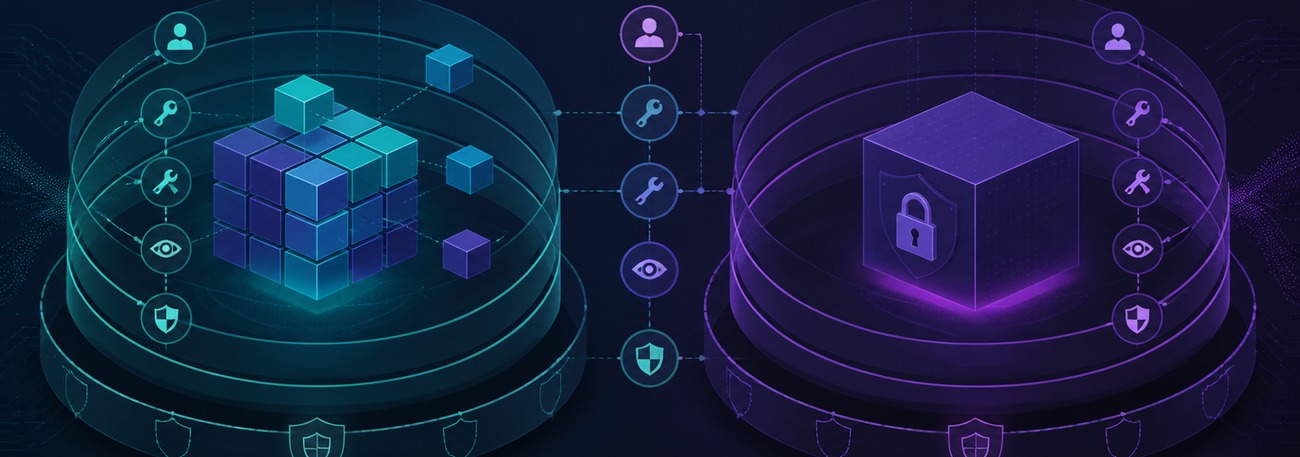
- Identity: Every model and agent should operate under a verifiable identity tied to a defined owner, purpose, and environment.
- Credentials: Access should rely on short-lived, task-specific privileges rather than persistent credentials shared across agents or applications.
- Data access: Retrieval should be limited to the information necessary for the task, with existing user and data permissions preserved.
- Tool permissions: Agents should receive access only to approved tools and actions, not every capability exposed by an application or MCP server.
- Action limits: Policies should govern not only whether an action is allowed but also its frequency, value, scope, and cumulative impact.
- Human approval: High-impact or irreversible actions should require explicit authorization at the point of execution.
- Network boundaries: Agents should operate within constrained environments that limit unexpected communication and lateral movement.
- Observability: Organizations need a record of the model, prompt, context, tools, decisions, and actions involved in each workflow.
- Containment: Security and operations teams must be able to suspend an agent, revoke credentials, isolate an execution environment, and stop downstream activity in real time.
These controls are relevant regardless of whether the underlying model is open or closed. The implementation may differ, but the objective is the same: limit the authority of the complete AI system and preserve evidence of what occurred.
This shifts enterprise risk assessment away from a simple open-versus-proprietary comparison. A smaller open model deployed locally with no external network access and narrow read-only permissions may present a limited blast radius. A proprietary frontier model operating through an agent with access to production credentials and transaction systems may present a much larger one.
The reverse can also be true. An unpatched open model downloaded from an untrusted repository and connected to sensitive data can create risks that a managed API would have reduced. Governance decisions must reflect the specific model, workload, deployment, and controls rather than assuming one architecture is always safer.
Building a Common Governance Framework
Enterprises need a common evaluation framework that can be applied across open and proprietary models while accounting for the differences between them.
At the model level, organizations should evaluate capabilities, known failure modes, provenance, security testing, software dependencies, update practices, and the ability to modify or remove safeguards. Open models may require deeper artifact validation and internal testing because the enterprise is responsible for deployment. Proprietary providers should be evaluated on transparency, data handling, availability, usage controls, change management, and the evidence they provide about model behavior.
At the system level, organizations must evaluate the data the model can retrieve, the tools it can invoke, the credentials it receives, the actions it can take without approval, and the scale at which those actions can occur. They also need the ability to detect abnormal behavior, reconstruct execution, and stop or reverse activity.
This system-level assessment increasingly determines actual operational risk. A model may pass safety evaluations and still create unacceptable exposure if the surrounding application grants it excessive authority.
Governance should also reflect the workload. A model summarizing public documents should not be governed in the same way as an agent modifying production code or initiating financial activity. Controls should increase with data sensitivity, decision importance, autonomy, connected systems, action irreversibility, and potential financial or operational impact.
This provides a more useful risk model than categorizing every open deployment as high risk and every managed service as controlled.
From Model Choice to Operational Accountability
The growing use of multiple models makes centralized governance more difficult. Different business units may use managed APIs, cloud-hosted open models, locally deployed models, embedded application models, and coding assistants simultaneously. Each may have different logging, identity, policy, and security mechanisms.
Enterprises need visibility across that fragmented environment. They must know which models are in use, which applications depend on them, what data they access, what tools they call, how much they cost, and which actions they perform.
A model inventory is a starting point, not the final control. Governance must follow the full execution path from the user or agent identity through the model, retrieved context, selected tools, and resulting actions.
This is where AI gateways, agent gateways, observability platforms, identity systems, data-governance tools, and runtime security controls are beginning to converge. No single control plane yet governs every model, data platform, tool, and deployment environment. Enterprises risk creating multiple governance layers that each see only one portion of the workflow.
The long-term requirement is not necessarily one product. It is a consistent policy and evidence model across the stack. Organizations should be able to apply common rules to an agent regardless of whether it uses an open model in a private environment, a proprietary API, or several models within the same workflow.
Looking Ahead
The open-versus-closed debate will become less useful as enterprise architectures become more heterogeneous. Organizations will use both. The important dividing line will not be which licensing philosophy they selected, but whether they can govern the resulting systems consistently.
Open models will remain valuable because they give enterprises greater control over deployment, customization, data, infrastructure, and provider dependency. Proprietary models will remain valuable because they provide frontier capabilities, managed operations, and provider-enforced safeguards. Each architecture solves different problems and creates different responsibilities.
Neither approach removes the need for runtime governance.
As agents gain greater authority, enterprises must evaluate the full chain from model capability to operational action. The model may supply the reasoning, but identity, data access, tool permissions, infrastructure, and execution policies determine the blast radius.
The most mature enterprise AI strategies will not treat open and closed models as mutually exclusive choices. They will establish a common governance approach that accounts for the differences between them while applying consistent controls to what every model can access, decide, and do.
The future of safe enterprise AI will depend less on whether the model weights are open and more on whether the entire AI stack is observable, constrained, and accountable.

Stephanie Walter | Practice Leader - AI Stack
Stephanie Walter is a results-driven technology executive and analyst in residence with over 20 years leading innovation in Cloud, SaaS, Middleware, Data, and AI. She has guided product life cycles from concept to go-to-market in both senior roles at IBM and fractional executive capacities, blending engineering expertise with business strategy and market insights. From software engineering and architecture to executive product management, Stephanie has driven large-scale transformations, developed technical talent, and solved complex challenges across startup, growth-stage, and enterprise environments.