
















Research Finder
Find by Keyword
Does the Automotive Cockpit Really Need a Separate Audio Chip in 2026?
NXP folds AM/FM reception and neural audio into one chip, betting that acoustic sensing as a safety BOM line outlives the analog broadcast debate.
7/29/2026
Key Highlights
- NXP announced the SAF9800 on 21 July 2026, an automotive audio and radio processor that integrates analog AM and FM reception with AI/ML-enabled audio processing on a single device that the company states has been sampling since May 2026.
- The part pairs a Cadence Tensilica HiFi 5 audio DSP carrying neural-network processing with NXP's hardware biquad accelerators, which NXP claims delivers more than 10x the audio processing performance of prior generations.
- AI-driven acoustic source separation is designed to isolate voice commands, emergency sirens, and mechanical fault signatures from cabin background noise, moving audio from fixed filtering toward data-driven inference.
- EVAM-lite, NXP's latest AM denoising technology, is supported on the SAF9800 series and aims to counter electromagnetic interference that traction inverters and high-voltage electronics push into the AM band.
- Our read is that the radio content is the entry ticket and the microphone is the product, positioning audio as a sensing modality that competes for the same safety budget as radar and camera.
The News
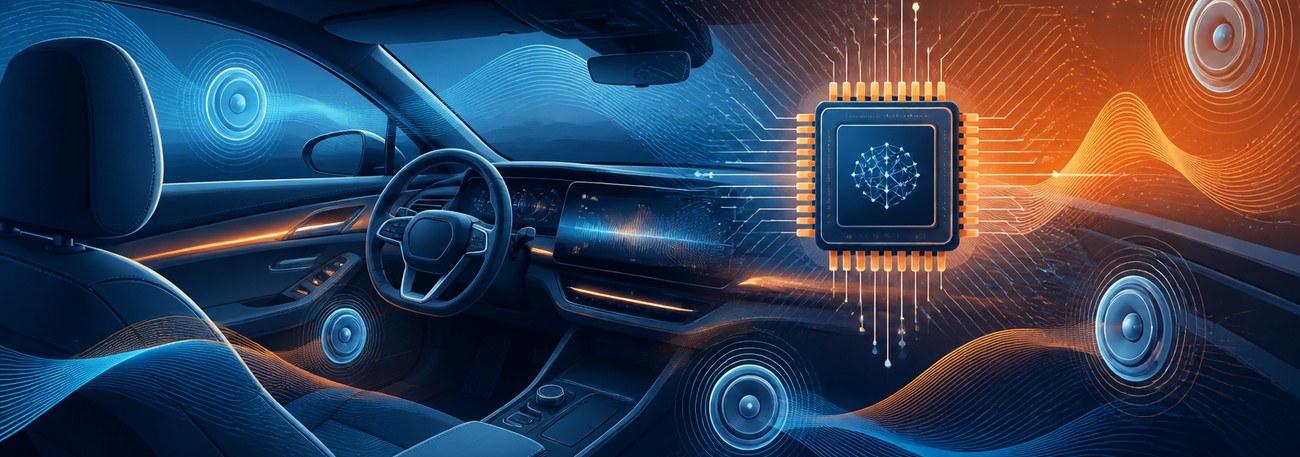
NXP Semiconductors announced the SAF9800 on 21 July 2026, an automotive audio and radio processor that combines analog AM and FM reception with AI/ML-enabled audio processing. The offering is a single-chip solution designed to consolidate functions previously spread across discrete radio and audio components. NXP is positioning for software-defined vehicle architectures, where radio and audio features can be configured and upgraded through software without hardware changes. The launch lands against unresolved US policy on mandated in-vehicle AM access and against interference challenges that electrification introduces into the AM band. Both of these factors are pushing automakers toward flexible rather than fixed radio implementations. NXP states the SAF9800 has been available since May 2026 with development support and software enablement tools.
Analyst Take
Car radio silicon has spent two decades as a quiet annuity for NXP and STMicroelectronics, with the only real third franchise being the one Silicon Labs built and sold to Skyworks in 2021. What is changing is the territory around it. Qualcomm, Texas Instruments, and Analog Devices are each contesting a different part of the audio chain, pulling this area into the same architectural argument consuming every other domain in the vehicle, namely, where should the compute sit? NXP's answer with the SAF9800 is that radio reception and cabin audio inference belong together, on a dedicated part, outside the cockpit system-on-chip.
The DSP core is not the differentiator, since HiFi 5 is merchant IP licensed from Cadence rather than NXP silicon. As a result, the contest revolves around the accelerators, the tuner front end, and the software stack. The obvious counter is that the whole product is defensive. Qualcomm, and to a degree Texas Instruments, argue that a central processor already carrying a large neural unit makes a separate audio DSP a bill-of-materials line waiting to be absorbed. That holds for the inference workload. It holds far less well for the radio front end, which has so far resisted absorption. And, beyond defense of analog radio, there are deeper opportunities around safety that this requirement may address.
By combining neural acoustic processing with analog AM/FM reception on a single die, we see NXP strategically shifting traditional radio silicon from a legacy infotainment expense into a multi-modal safety sensor competing directly for radar and camera budgets. While central cockpit SoCs attempt to absorb generic AI inference workloads, dedicated audio processors retain a clear architectural moat through specialized high-voltage electromagnetic noise suppression, deterministic low-latency processing, and an always-on power envelope that central units handle inefficiently. The long-term survival of standalone audio silicon depends not on defending declining broadcast radio mandates, but on whether automakers permanently embrace acoustic intelligence as an essential, non-negotiable safety layer for software-defined vehicles.
What Was Announced
The SAF9800 integrates an analog AM and FM tuner with a HiFi 5 audio DSP carrying neural-network processing capability, supported by NXP's hardware-based biquad accelerators. NXP states the combination delivers more than 10x the audio processing performance of previous generations. An impressive figure we would argue should be seen as a headroom claim for concurrent inference workloads rather than a benchmark of any single algorithm. The functional target is acoustic source separation: taking multi-microphone cabin data and pulling out signals of interest, including: spoken commands, emergency vehicle sirens, and the acoustic signature of a developing mechanical fault. Separating each of these from ambient noise that defeats fixed filtering.
Positioning inside NXP's own portfolio is worth attention. The SAF9xxx family launched in 2024 with the SAF9000, a multi-standard flagship spanning DAB, HD Radio, DRM, CDR, and analog broadcast, and the SAF9100, which dropped the radio front end entirely to serve as a dedicated audio DSP. The SAF9800 sits between them, appearing to be architected for the volume tier: analog broadcast only, paired with enough neural capability to run features previously reserved for premium platforms. The enablement path seems to us as impactful as the silicon. The family leans on Audio Weaver tooling from DSP Concepts with algorithm plugins from Bose, DTS, and others. This means that a design win for the chip arrives with a tuning environment the OEM's acoustic team has likely already used.
EVAM-lite is the second half of the design intent. Electric powertrains inject electromagnetic interference into the AM band, which has been the technical argument automakers use for deleting AM entirely. Addressing that interference in the signal chain is designed to remove the engineering excuse rather than satisfy a compliance checkbox. The regulatory backdrop is thinner than it looks. The AM Radio for Every Vehicle Act cleared House Energy and Commerce with an amendment shortening its sunset to eight years, which caps the tailwind NXP is partly selling into and makes software configurability across regional standards the more durable feature.
Market Analysis
The competitive question is not whether rivals can process audio. All of them can because this is not new tech. It is where they think that processing belongs, and how much of the signal chain their answer actually covers. Qualcomm's Snapdragon Cockpit Elite family concentrates cockpit workloads, including AI-enabled zonal audio, on a central processor whose neural unit was specified for multimodal vision and language work. The company's Leapmotor D19 design win demonstrates the unified compute thesis in production. That centralization applies to the inference stack rather than the radio front end, so a Cockpit Elite platform still carries external tuner silicon.
Texas Instruments takes a cost-consolidation angle with its AM275x-Q1 and AM62D-Q1 devices, standalone audio processors pairing a C7x DSP and matrix accelerator that sit alongside discrete Class-D amplifiers rather than inside them. These enable (per TI estimates) implementation cost reductions of as much as $20 per vehicle. Analog Devices attacks the problem at the transport layer. That company's A2B 2.0 transceiver family released to production this spring quadrupling bus bandwidth and making distributed microphone arrays cheaper to wire, though it complements an external DSP rather than replacing one. STMicroelectronics retains a deep tuner franchise through the STAR family paired with its Accordo application processors. Read that offering as the closest like-for-like alternative to what NXP is selling, delivered as a multi-chip partition rather than a single die.
The sensing thesis itself is contested rather than proprietary. Renesas has published work on passive audio detection of road participants, including sirens and obstructed-view vehicles, which suggests acoustic ADAS is becoming a category several suppliers intend to occupy. NXP is also playing both sides of its own argument, having unveiled the S32N7 super-integration processor series in January 2026 to serve exactly the centralized architectures that would, taken to their conclusion, absorb a dedicated audio part.
McKinsey's automotive electronics research has consistently argued that electrical and electronic architectures are consolidating toward zonal and central compute while software-defined content per vehicle rises. Both halves matter. Consolidation pressures discrete parts, and rising content creates room for new functions. NXP's Q1 2026 call made the second point commercially, with management placing software-defined vehicle processors, radar, and electrification products north of 45% of automotive revenue composition, up from 39%, and crediting them with nearly all of the segment's year-over-year growth. Audio is a plausible fourth leg, cheap enough to specify on a base trim and attached to a safety narrative cameras and radar cannot fully cover.
Comparative callout: where the audio workload sits:
Supplier
Approach
Radio tuner integration
AI audio path
Architectural bet
NXP (SAF9800)
Dedicated radio plus audio SoC
Analog AM/FM on-die, EVAM-lite denoising
HiFi 5 DSP with neural engine, biquad accelerators, >10x prior gen
Audio and radio stay partitioned from cockpit compute
NXP (SAF9000 / SAF9100)
Flagship and audio-only variants
Up to five tuners (SAF9000), none (SAF9100)
Dual HiFi 5 with NN accelerators, Audio Weaver ecosystem
Tiered coverage from premium to audio-only
NXP (S32N7)
Super-integration central processor
None
Vehicle-level compute consolidation
Both sides of the partition argument
Qualcomm (Snapdragon Cockpit Elite)
Central cockpit SoC
None, external tuner front end required
NPU targeted at ~12x prior cockpit generations, AI zonal audio
Absorb the inference stack, leave the RF chain alone
Texas Instruments (AM275x-Q1, AM62D-Q1)
Standalone edge audio processor and MCU
None
C7x DSP plus matrix accelerator as NPU
Cost-down premium audio alongside discrete Class-D amps, up to ~$20 per vehicle claimed
Analog Devices (A2B 2.0, ADAA245x)
Audio transport and networking
None
Complements an external DSP, not a replacement
4x bandwidth to 98.3 Mbps full duplex, 62 us latency, 119 channels each way, up to 30% system cost reduction claimed
STMicroelectronics (STAR, Accordo)
Multi-chip tuner plus infotainment processor
Standalone STAR tuners (TDA7707, TDA7708), multi-standard
Conventional DSP, less publicized neural path
Radio breadth and single-PCB regional scalability, no single-die neural equivalent
Renesas (Seeing-with-Sound)
Passive acoustic detection research
Not applicable
Published work, not a shipping audio SoC line
Acoustic ADAS as a sensor fusion input
Looking Ahead
The key trend we'll be monitoring is whether acoustic sensing earns a safety budget line rather than an infotainment one. That distinction decides the addressable market. Entertainment audio is a feature negotiation with a cost engineer. Acoustic detection of an approaching emergency vehicle, or of a bearing beginning to fail, is a stethoscope wired into the dashboard, and it argues for its own qualification path, its own latency budget, and its own always-on power envelope.
The broadcast rationale is on a clock, since the AM mandate has not passed and even if enacted would expire on a fixed schedule in its amended form, which leaves sensing as the durable justification for the silicon. NXP reports second quarter 2026 results this week, and we will be listening for whether infotainment and audio are named alongside SDV processors, radar, and electrification as a growth driver, or left inside the base business.

Stephen Sopko | Analyst-in-Residence – Semiconductors & Deep Tech
Stephen Sopko is an Analyst-in-Residence specializing in semiconductors and the deep technologies powering today’s innovation ecosystem. With decades of executive experience spanning Fortune 100, government, and startups, he provides actionable insights by connecting market trends and cutting-edge technologies to business outcomes.
Stephen’s expertise in analyzing the entire buyer’s journey, from technology acquisition to implementation, was refined during his tenure as co-founder and COO of Palisade Compliance, where he helped Fortune 500 clients optimize technology investments. His ability to identify opportunities at the intersection of semiconductors, emerging technologies, and enterprise needs makes him a sought-after advisor to stakeholders navigating complex decisions.

Ron Westfall | VP and Practice Leader for Infrastructure and Networking
Ron Westfall is a prominent analyst figure in technology and business transformation. Recognized as a Top 20 Analyst by AR Insights and a Tech Target contributor, his insights are featured in major media such as CNBC, Schwab Network, and NMG Media.
His expertise covers transformative fields such as Hybrid Cloud, AI Networking, Security Infrastructure, Edge Cloud Computing, Wireline/Wireless Connectivity, and 5G-IoT. Ron bridges the gap between C-suite strategic goals and the practical needs of end users and partners, driving technology ROI for leading organizations.