
















Research Finder
Find by Keyword
Is Supply, Not Demand, Now the Ceiling on Arm's AGI CPU?
Memory costs squeeze handsets upstream, the CPU market forecast keeps climbing, and Arm has pointedly not raised its own targets.

8/03/2026
By the Numbers
All figures in US dollars as reported. Arm reports in dollars but carries a large share of its cost base in pounds and euros, per prior management commentary, leaving the operating expense line FX-sensitive in a way the reporting currency conceals; management did not quantify the effect this quarter. Peer comparisons drawn from SK hynix and Samsung Electronics are stated as growth rates rather than absolute amounts, since both companies report in Korean won.
- Total revenue: $1,289 million, up 22% year over year, a first-quarter record, against consensus near $1,270 million
- Royalty revenue: $715 million, up 22% year over year, a first-quarter record
- License and other revenue: $574 million, up 23% year over year, a first-quarter record, including $193 million from the technology licensing and design services agreement with SoftBank
- Non-GAAP EPS: $0.45, up 29% year over year, above the high end of company guidance, against a consensus that ranged from roughly $0.36 to $0.41 across providers
- Non-GAAP operating income: $531 million, margin of about 41%, up roughly 200 basis points year over year
- GAAP operating income: $91 million, 7.1% margin
- Non-GAAP operating expenses: $733 million, up 18% year over year, roughly $27 million below guidance
- Non-GAAP gross margin: approximately 98%
- Free cash flow: $665 million in the quarter, $1,397 million on a trailing twelve month basis
- Annualized contract value: $1,732 million, up 13% year over year, against 22% last quarter and 28% in each of the three quarters before that
- Data center royalty revenue: more than doubled year over year again
- Neoverse: cumulative core shipments surpassed 1.5 billion, with the most recent 500 million in the past nine months against six years for the first billion
- Armv9: approximately 33% of royalty revenue
- Q2 FYE27 guidance: revenue of $1,380 million plus or minus $50 million (about 22% year over year at midpoint), non-GAAP operating expenses of approximately $780 million, non-GAAP EPS of $0.47 plus or minus $0.04, license and other revenue up approximately 30%, royalty revenue up low teens
- Full-year royalty growth: revised to the high teens from approximately 20%
- Arm AGI CPU, product: launched March 2026, developed with lead partner Meta, flagship configuration of up to 136 Neoverse V3 cores at 300W on TSMC 3nm, with lower-core variants planned; Haas described the current design as 128-core on the call, against the 136-core flagship spec published at launch
- Arm AGI CPU, commercial: first product delivered to multiple customers, demand pipeline now described as north of $2 billion across FYE27 and FYE28, against the $2 billion cited last quarter, itself roughly double the opportunity framed at the March launch; manufacturing capacity secured for the first $1 billion
- FYE31 targets, unchanged: approximately $25 billion total revenue, IP and CSS at $10 billion with non-GAAP operating margin above 65%, Arm AGI CPU at $15 billion with margin above 30%, non-GAAP EPS above $9
The News
Arm reported first quarter fiscal 2027 revenue of $1.29 billion, up 22% year over year, with royalty and licensing revenue both setting first-quarter records and data center royalties more than doubling again. Non-GAAP earnings per share landed above the high end of company guidance, and second-quarter revenue and earnings guidance were both set above the Street at the midpoint. The disclosure that moved the model was narrower than most coverage suggested, since the Arm AGI CPU demand pipeline was already described at $2 billion ninety days ago, and what changed is that management now puts it north of that level with improved confidence in securing supply beyond the first $1 billion. Full results are on Arm's investor relations site, with the summary release available there.
Analyst Take
Arm printed a record first quarter and the reaction would seem to indicate that the market has stopped trading Arm on the quarter. It is trading the transition. The bear case deserves stating plainly, and it is not the royalty trim. It is that annualized contract value, the metric Arm itself nominates as the honest read on licensing, grew 13% after four quarters in the twenties. Management described that as maintaining strong momentum, and while one might note that the same phrase was used when the number was 28%, the long-term expectation Child gave on the Q3 FYE26 call was mid to high single digit. If licensing is the designated offset to smartphone softness, the offset is decelerating. The counter is real, since contract value smooths deal timing and still sits above Arm's stated long-term licensing target. We would want the deceleration explained rather than relabeled.
What the Numbers Mean
Two pieces of call color jumped out for us.
The first is CFO Jason Child's explanation of the operating expense line, which came in roughly $27 million below guidance. The reflex is to call that a deferral and discount the margin beat. Child slammed that door directly, telling analysts to bank the savings, with the full-year spending plan largely unchanged and the shortfall traced to tool utilization, emulation and cloud spending rather than to headcount timing. The engineering ramp is intact and the savings appear real.
The second is a composition question the print raises and does not resolve, set out in the callout below. Arm has disclosed the SoftBank relationship consistently and describes the revenue as durable. So we dont flag this as a transparency complaint, but we think it is a modeling issue. As we view licensing as the counterweight to royalty softness, it begs the question of how much of that counterweight reflects third-party demand.
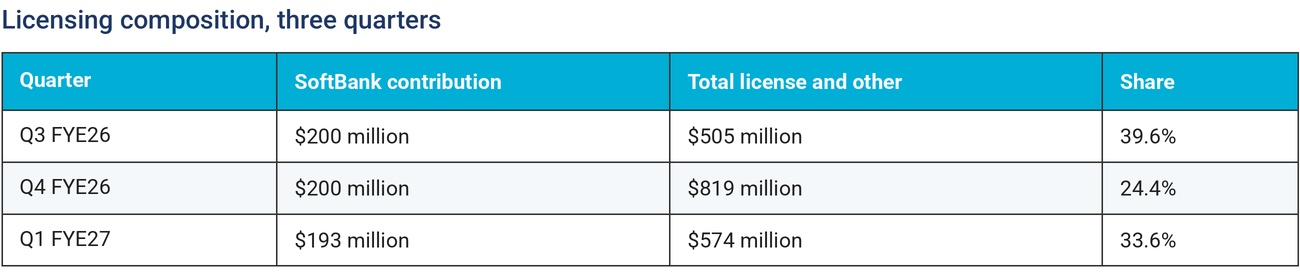
Child guided the SoftBank run rate to approximately $200 million per quarter for the balance of the fiscal year.
On royalties, the framing was that softness is cyclical rather than structural and that the multi-year growth target remains intact. The weakness is no longer confined to the entry tier, since elevated memory pricing is lifting handset bills of materials across mid and premium tiers. Even so, Arm expects double-digit royalty growth in smartphones while the handset market itself is projected down by double digits, which is what higher Armv9 and compute subsystem rates are buying. Management also confirmed that its royalty forecast leans on analyst-driven industry projections, so the guide moves when third-party forecasts move.
On the silicon side, the named customer list now spans workload types rather than clustering in one. Cerebras and OpenAI sit on head node, Cloudflare and co-developer Meta across agentic and general purpose, with Oracle Cloud Infrastructure added. That breadth argues against the single-customer concentration that was a fair worry when the program launched with Meta attached as a single anchor name.
Market Analysis
The same-quarter prints around Arm tell a consistent story, and it is not a demand story.
TSMC delivered record revenue, raised its full-year outlook and lifted 2026 capital spending to a range of $60 billion to $64 billion, describing advanced packaging as effectively sold out. SK hynix posted record operating profit yet missed consensus on HBM4 shipment timing, with DRAM average selling prices up roughly 30% sequentially. Samsung's memory division set records while its handset division reported an operating loss, the cleanest available illustration of the cost pass-through Arm described. Qualcomm reported the same evening, with revenue down year over year on handset softness while non-handset and data center lines carried the forward narrative. Handset weakness this cycle is being manufactured upstream as memory suppliers reallocate constrained wafer capacity toward higher-margin AI. This is our take as opposed to any collapse in consumer demand despite handset price increases.
Against that, the forward market estimate keeps climbing while Arm's own targets sit still, as the second callout shows. Management noted the direction of travel and declined to move its numbers. Restraint, or supply realism. We would also factor in a question about data center deployment given power, siting, and regulatory constraints into 2027.
The competitive nuance is more interesting than the usual framing allows. Qualcomm's data center entry is Arm-based, as is NVIDIA's Vera, now in production, and NVIDIA's NVLink Fusion approach would let an Arm-family CPU attach to a third-party accelerator. That commercial alignment remains alongside unresolved litigation between Arm and Qualcomm over the Nuvia acquisition, reported for trial in the fourth calendar quarter of 2026. That case is the lens through which many licensees will read Arm's move into its own silicon. Haas extended the agnostic logic to model licensing, calling open-weight models neutral to positive on the argument that agents require CPUs regardless of what runs above them, with smaller efficient open models favoring Arm's edge footprint. Arm monetizes the layer underneath the argument.

An AMD analyst day last week framed a comparable $220 billion figure by decade end, with agentic workloads the largest contributor. Arm has not revised its own forecast. The demand mechanism underneath these numbers is that agentic workloads generate more than 15x the requests per user and require roughly 4x more CPU cores per gigawatt of data center capacity. That assumption carries the royalty growth target, while it should be noted that the numbers are drawn from Arm's earnings deck and vendor-modeled rather than independently benchmarked.
Looking Ahead
The key trend we'll be monitoring is the fiscal 2028 silicon breakout. Management committed to reporting Arm AGI CPU revenue as a separate third line once it clears roughly a tenth of total revenue. That date is anticipated by the company in fiscal 2028, with first shipments at the end of this calendar year and a fuller revenue and margin update promised at the third-quarter print. Until that line exists, investors are underwriting a blended margin structure without seeing its components. Running underneath it is a regulatory question that spans jurisdictions. An FTC inquiry reported in May examines whether Arm might degrade or withhold architecture licenses now that it sells competing silicon, and it follows a South Korean regulatory inspection in November 2025 and a European Commission review. It is the only disclosed item we can identify that would structurally alter the licensing annuity, and management did not address it once on this call. While understandably conservative about discussing ongoing regulatory issues, managements remaining silence on the matters is worth watching closely.

Stephen Sopko | Analyst-in-Residence – Semiconductors & Deep Tech
Stephen Sopko is an Analyst-in-Residence specializing in semiconductors and the deep technologies powering today’s innovation ecosystem. With decades of executive experience spanning Fortune 100, government, and startups, he provides actionable insights by connecting market trends and cutting-edge technologies to business outcomes.
Stephen’s expertise in analyzing the entire buyer’s journey, from technology acquisition to implementation, was refined during his tenure as co-founder and COO of Palisade Compliance, where he helped Fortune 500 clients optimize technology investments. His ability to identify opportunities at the intersection of semiconductors, emerging technologies, and enterprise needs makes him a sought-after advisor to stakeholders navigating complex decisions.