
















Research Finder
Find by Keyword
Could Europe Quietly Take the Lead in Building Orbital Structures?
First print in exposed space shifts large solar arrays from folding problem to manufacturing problem, with data center power in view.
8/15/2026
Key Highlights
- Orbital Matter reported on 12 August 2026 that one of four printers aboard its Replicator 2 satellite extruded resin and cured it into solid structure while exposed to the vacuum of low Earth orbit, which the company describes as an industry first.
- Replicator 2 is an 8U CubeSat weighing roughly 13 kilograms, launched 7 July 2026 aboard SpaceX Falcon 9 Transporter-17, carrying four independent 1U printer modules.
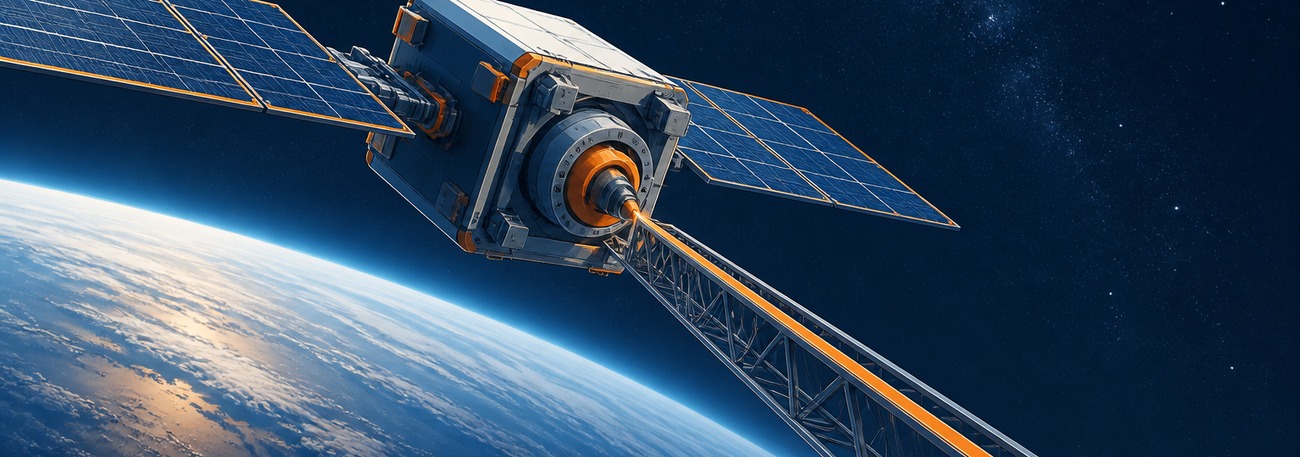
- Each module is designed to produce a one-meter rigid boom with no hinges and no moving parts in the finished structure, with two booms intended to deploy a stowed flexible solar array and the other two an antenna and a camera.
- Four in-house inspection cameras, one per printer, feed an image recognition system that interprets material behavior during the print without a person in the loop.
- Our read: the print retires the physics question, while the commercial question, whether boom length scales toward the 100-meter-plus structures the company describes, sits entirely ahead of it.
The News
Orbital Matter announced on 12 August 2026 that a printer aboard its Replicator 2 satellite extruded photopolymer resin and cured it under ultraviolet light into solid structure. It accomplished this while flying exposed to vacuum and extreme temperature swings in low Earth orbit. Prior demonstrations of in-space additive manufacturing were performed inside the pressurized, temperature-controlled cabin of the International Space Station. That makes this run a move for the process into the environment where large structures would actually be built. The company frames the print as an early stage in a staged sequence that runs from spacecraft commissioning through core process proof, then to scaled full-length booms, and finally to deployment of the solar array stowed on board. Source: A first in orbit: 3D printing in the open vacuum of space.
Analyst Take
Power is the binding constraint on orbital compute, but structure is the binding constraint on power. Every serious proposal for compute in orbit assumes arrays far larger than anything that has flown, and every mechanical deployable gets more fragile as it gets bigger. That is the wall Orbital Matter is aiming at. Exciting, but the bear case deserves a fair hearing. The company produced a small piece of cured resin, not a load-bearing boom. Also, this is the Orbital Matter’s second run at the problem because while the first demonstrator flew on Ariane 6's maiden flight in July 2024 under ESA's PUSH program, public tracking noted deployment without confirmed two-way contact. So ann apparent failed attempt. Therefore, in a strict reading, Replicator 2 is a recovery as much as a milestone. What tempers that is the nature of the unknown being retired. Vacuum behavior had already been shown on the ground. Microgravity flow, cure without gravity to settle material, and orbital thermal conditions had not. No chamber fully replicates that combination.
What was Announced
The company reported a completed extrusion and ultraviolet cure sequence performed by one of the printers carried on Replicator 2, filmed end to end by the printer's own inspection camera. The process appears architected around a specific constraint of the space environment: conventional thermoplastic extrusion depends on convective cooling that does not exist outside a spacecraft, which leaves radiation as the only path for parts to shed heat. A photopolymer that cures under UV light sidesteps that problem, and Orbital Matter has described the approach as printing without generated heat, which is what makes a continuous structure practical rather than a months-long thermal exercise.
In our view, two design choices deserve more attention than the milestone itself. The first is redundancy through independence. Four printers fly on this mission, each operating on its own, so a single successful boom carries the technology claim while three others provide margin. That is a procurement mindset rather than a research mindset. We have seen the same pattern reward hardware programs on the enterprise side, where the vendor who ships four independent paths to a working outcome beats the vendor who ships one elegant one.
The second is the vision system. The cameras are in-house, and the same feed drives an image recognition layer designed to interpret what the material is doing as it is laid down, without human supervision. Quality control, not photography. For a company whose end state involves printing structures far longer than the spacecraft producing them, closed-loop process monitoring is the piece that makes scale-up credible, since no one is going to inspect a one-meter boom by eye and then trust a hundred-meter one.
Market Analysis
The demand signal here is not really satellites. It is compute and orbital power. Orbital data center proposals have moved from thought experiment to funded program inside eighteen months, with Starcloud raising at a valuation that would have drawn laughter two years ago, Google's Project Suncatcher pairing TPUs with Planet Labs satellites for a prototype flight, and Axiom fielding free-flyer nodes. Each of those architectures needs power in the tens of kilowatts per spacecraft at minimum, and the gigawatt-class visions in FCC filings need array areas measured in square kilometers. Nobody is going to fold that inside a rocket fairing.
The incumbent answer remains roll-out arrays, where Redwire's ROSA line has genuine flight heritage on the International Space Station and commercial platforms. Roll-out technology is proven and low risk, and it will win the next several years of procurement on those grounds alone. Its ceiling is the problem. Stowed volume and mechanical complexity both climb with size, and the American program meant to demonstrate printing plus robotic assembly at scale, OSAM-2 or Archinaut One, concluded in 2023 without flying. Large-structure additive assembly is therefore demonstrated on the ground by the US incumbent and not in orbit.
Europe has stepped into that opening, and the capital is following the same logic. Orbital Matter received €500k from the European Innovation Council Pre-Accelerator on 10 July 2026, explicitly aimed at solar arrays for megawatt-class satellites. We read that as continuity with the ESA PUSH slot that flew the first demonstrator rather than a one-off grant. More consequential for the commercial thesis is the 20 July 2026 collaboration with Thales Alenia Space, describing a VHF antenna prototype deployed on an in-space manufactured support boom. That would be the first prime-contractor validation path for the technology. Against a space economy projected by McKinsey/WEF to reach $1.8 trillion by 2035, printed structures are a small slice. That said, they are the slice everything larger depends on. Think coral rather than umbrella, a structure grown to size instead of unfolded into it.
Looking Ahead
The key trend we'll be monitoring is whether printed boom properties hold as length scales, and whether the materials survive time. A one-meter print in orbit demonstrates process. A full-length boom carrying a tensioned array demonstrates engineering, and the two are separated by stiffness, cure depth through thicker sections, and dimensional stability across repeated thermal cycles. Beyond that sits the least-discussed risk in the entire thesis: atomic oxygen erosion, ultraviolet embrittlement, and thermal cycling behavior of cured photopolymer over multi-year exposed missions. It is also the first question any prime contractor will ask, which makes the Thales Alenia Space antenna work a useful proxy to watch. If a printed boom holds an antenna through a qualification campaign, the materials conversation changes character. The near-term catalysts are clear enough: the scaled boom prints, then the array deployment itself, which is what converts a technology claim into a product claim.

Stephen Sopko | Analyst-in-Residence – Semiconductors & Deep Tech
Stephen Sopko is an Analyst-in-Residence specializing in semiconductors and the deep technologies powering today’s innovation ecosystem. With decades of executive experience spanning Fortune 100, government, and startups, he provides actionable insights by connecting market trends and cutting-edge technologies to business outcomes.
Stephen’s expertise in analyzing the entire buyer’s journey, from technology acquisition to implementation, was refined during his tenure as co-founder and COO of Palisade Compliance, where he helped Fortune 500 clients optimize technology investments. His ability to identify opportunities at the intersection of semiconductors, emerging technologies, and enterprise needs makes him a sought-after advisor to stakeholders navigating complex decisions.