

















Research Finder
Find by Keyword
Did Intel Just Move The Xeon Fight From Cores To Fabric?
18A-P, Intel 3 base tiles and UCIe-S substrate links make Diamond Rapids a foundry proof point as much as a Xeon refresh.
8/26/2026
Key Highlights
- Diamond Rapids is described in the Hot Chips session materials as the first Intel Xeon built on a Fan-out Fabric Architecture. The real novelty is not the existence of modular tiles because Intel has been moving along the mesh → tiled mesh → 2.5D/3D functional partition path for years. The novelty is in the degree of centralization: memory controllers, high-speed I/O and accelerator complexes now sit in two Fabric Hubs, with an explicit claim of uniform memory latency for every core regardless of physical location.
- The part is specified at up to 256 cores and 1.28 GB of last level cache across four compute building blocks, with sixteen memory channels reaching up to 8000 MT/s DDR5 or 12800 MT/s MRDIMM.
- I/O spans 128 lanes configurable as PCIe Gen6, CXL 3.0 or UPI 3, delivered from two Fabric Hub tiles on Intel 3 that sit alongside sixteen core chiplets on Intel 18A-P and four base tiles on Intel 3-T, joined by Foveros 3D Direct hybrid bonding and UCIe-S substrate copper links.
- Crescent Island, disclosed in the same session, is specified at 32 Xe cores with up to 480 GB of LPDDR5X on a 350 watt air cooled card, framing Intel's intended host plus inference pairing.
- Our read is that the on-die snoop filter, which replaces DRAM-resident directory state, may matter more to enterprise buyers than the headline core count, because it returns full ECC coverage to memory that previously carried directory overhead.
The News
At Hot Chips 2026, Intel presented the architecture of Diamond Rapids, its next generation Xeon. In the session materials, the company describes it as the first Xeon designed around a Fan-out Fabric Architecture; this term refers to separating compute building blocks from centralized Fabric Hubs holding memory, I/O and acceleration. Intel looks to be positioning Diamond Rapids towards enterprise scale agentic AI, where the host processor is asked to orchestrate data movement across the rack rather than carry the model itself. The newsroom release below confirms the core count and cache figures. It also indicates the design is built exclusively on Intel technology including 18A-P, Foveros Direct 3D packaging and early adoption of UCIe for chiplet interconnect. https://newsroom.intel.com/client-computing/intel-outlines-architectures-for-agentic-ai-at-hot-chips-2026
Analyst Take
The reflex reading of Diamond Rapids is core count, and that reading will dominate the first news cycle. Up to 256 cores. The same ceiling, reached differently. The bear case writes itself: Intel is disclosing in August 2026 a ceiling that a competing x86 part reached at launch in July, on an external foundry's 2nm node, and disclosure at a technical conference is not silicon in a rack. That case deserves to be taken seriously, and it is directionally fair on timing. It is also the wrong axis. What Intel actually presented is a floorplan change, not a bin change. By lifting memory controllers, high speed I/O and accelerator complexes out of the compute path and into centralized Fabric Hubs, Intel appears to be decoupling core scaling from I/O and memory scaling for the first time in the Xeon line. That decision, if it holds through production, shapes several generations. Core count shapes one.
Intel did not disclose the Panther Cove core microarchitecture itself. What we received is a packaging and uncore/floorplan disclosure, not a core design brief.
What Was Announced
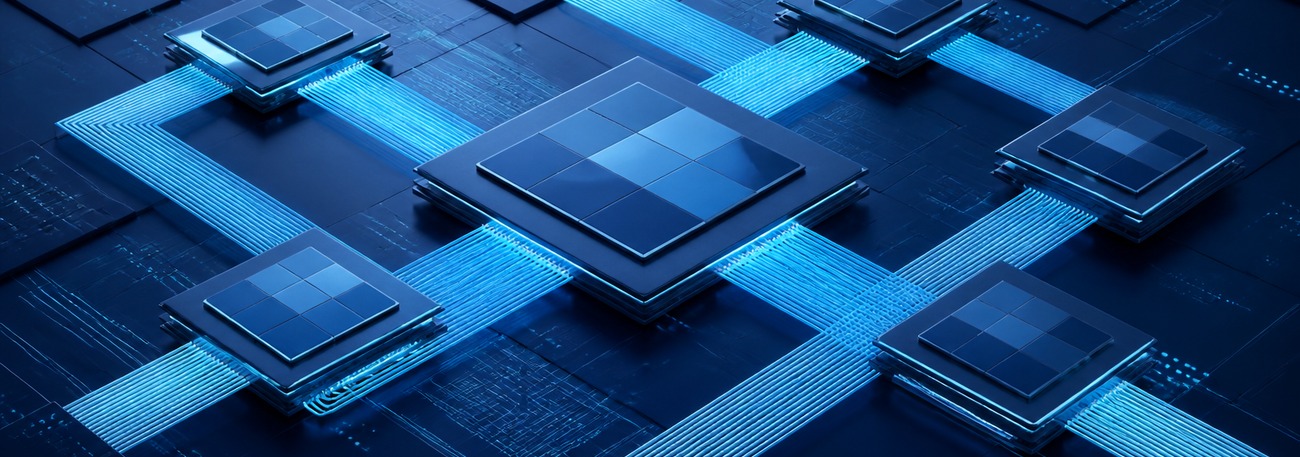
While Core microarchitecture details (Panther Cove) remain undisclosed in this session, the disclosed architecture organizes around two repeating units. Compute building blocks hold core chiplets sitting on a base tile, with a three dimensional crossbar connecting cores to a shared last level cache resident on that base tile, plus a caching agent and snoop filter. Fabric Hubs hold everything else: the memory subsystem, the Flexbus I/O fabric and two accelerator complexes carrying QAT, DSA and IAA. Intel describes both the number of core chiplets per base tile and the number of compute building blocks per package as scalable, which is the part worth noting. The shipping configuration is one point on a curve, not the curve itself.
Cache aggregates to 1.28 GB across the package, and the memory subsystem is architected to deliver up to 1.6 TB/s. The memory path adds a Memory Value Function supporting CXL memory in one level or flat two level mode with mirroring, and an encryption engine covering both DDR and CXL. Coherency moves on die through a home agent and home snoop filter, eliminating the DRAM-resident directory state that previous generations carried. On the instruction side, Intel APX adds general purpose registers, three operand instructions, flag suppression and conditional encodings, and Intel frames it as a recompile with no source changes required. AMX and AVX-10.2 extend matrix and vector work into FP8, FP16 and BF16. Power management splits into distinct DVFS domains for core, uncore, I/O and memory, which suggests Intel expects mixed utilization rather than uniform load.
Market Analysis
The interesting fact about this disclosure is how little of it is contested. AMD brought a Zen 6 EPYC Venice to market in July on TSMC's 2nm node at the same core ceiling, with a matching memory channel count, Gen6 I/O and a comparable bandwidth target (AMD, July 2026), though the two get there differently, AMD through dense cores with multithreading and Intel through performance cores, so the socket-level comparison will not resolve until independent per-thread data exists. Two independent design teams, different processes, different packaging philosophies, arriving at the same spec envelope. That convergence tells us the workload definition is now settled at the buyer level: the host CPU is being purchased as the orchestration layer for accelerator racks, and orchestration is a data movement problem before it is a FLOPS problem. Both roadmaps are answering the same question, and both deserve to be evaluated on execution rather than on slideware.
Where Intel differentiates is vertical integration. Core chiplets on 18A-P, base tiles on Intel 3-T, Fabric Hub tiles on Intel 3, bonded with Foveros 3D Direct and linked over UCIe-S. That is a foundry demonstration wearing a product badge. Diamond Rapids is reported as the first product to ship on 18A-P, which means its yield curve and ramp behavior will be read publicly as a proxy for what Intel Foundry can offer external customers. Prospective foundry clients cannot audit internal defect density reports. They can watch whether a four-tile-type package that mixes 18A-P compute with Intel 3 base and hub tiles under hybrid bonding and UCIe-S ships on schedule. Hybrid bonding plus UCIe-S at this complexity has no prior high-volume server precedent at Intel; while Intel execution has improved, schedule risk for a 2027 product remains non-zero.
For the enterprise buyer, the quieter items may land harder. Intel paired this disclosure with Crescent Island, an air cooled inference GPU sized for existing rack footprints, which signals how the two are meant to be sold together: host processor as orchestrator, accelerator as token engine, both inside power envelopes that avoid a facilities project. Our 1H 2026 HyperFRAME Lens survey of roughly 520 qualified infrastructure and operations leaders found that 49 percent rank platform interoperability above AI acceleration as a scaling priority, which puts flexible lane allocation across PCIe, CXL and UPI closer to the purchase decision than any matrix extension. Configurability sells sockets. Not benchmarks.
Looking Ahead
The key trend we'll be monitoring is whether the Fabric Hub abstraction survives contact with production economics. Intel has committed to a topology in which memory, I/O and acceleration live on separate silicon from the cores, connected by hybrid bonding underneath and substrate copper links across. That structure is designed to let Intel refresh cores on a leading node while leaving memory and I/O on a mature one, the same disaggregation logic that reshaped storage arrays two decades ago. Supply is the other variable. The memory ceiling here depends on MRDIMM reaching 12800 MT/s in volume, and module suppliers move on their own qualification schedules, so MRDIMM readiness is a gating item separate from anything happening inside Intel's fabs. Watch three areas:
- the first independent memory latency measurements,
- MRDIMM qualification announcements from module vendors, and
- whether Intel opens up the core architecture, because the fabric story only closes once the core story opens.

Stephen Sopko | Analyst-in-Residence – Semiconductors & Deep Tech
Stephen Sopko is an Analyst-in-Residence specializing in semiconductors and the deep technologies powering today’s innovation ecosystem. With decades of executive experience spanning Fortune 100, government, and startups, he provides actionable insights by connecting market trends and cutting-edge technologies to business outcomes.
Stephen’s expertise in analyzing the entire buyer’s journey, from technology acquisition to implementation, was refined during his tenure as co-founder and COO of Palisade Compliance, where he helped Fortune 500 clients optimize technology investments. His ability to identify opportunities at the intersection of semiconductors, emerging technologies, and enterprise needs makes him a sought-after advisor to stakeholders navigating complex decisions.