
















Research Finder
Find by Keyword
How Fast Can Physical AI Arrive if Demand Is Global But Supply Is Not?
Four demographic lanes argue robotics demand arrives early, verified humanoid fleets suggest otherwise, and much of the supply chain sits outside the West.

8/24/2026
Key Highlights
- The demand case is demographic and largely locked in: China's 16 to 59 age cohort fell about 6.62 million in 2025, nearly twice the total population decline and roughly three times faster in percentage terms, while a total fertility rate of 0.96 against 2.1 replacement puts each successive generation at under half the size of the last.[1][2]
- Western labor scarcity runs in parallel, examples: the BLS projects about 81,000 US electrician openings annually through 2034, and only 22,700 net new plumber, pipefitter and steamfitter jobs across the decade against roughly 44,000 openings a year, while PHI counts an estimated 9.7 million direct care openings from 2024 to 2034.[3][4][5]
- Non-humanoid robotic deployment is already at industrial scale: IFR counted 542,076 industrial robots installed worldwide in 2024 against an operational stock of 4.66 million, Waymo runs roughly 500,000 paid autonomous rides a week after growing tenfold in under two years, and Intuitive's da Vinci (healthcare) installed base reached 11,710 systems by June 2026.[6][7][8]
- Humanoids, the category the market actually watches, remain small: Morgan Stanley estimates 13,000 to 16,000 units shipped globally in 2025, and its own enterprise survey found just 23% of buyers satisfied with available products.[9][10]
- Production sits where the demographic squeeze is sharpest: Asia took 74% of new industrial robot installations in 2024 and China alone 54%, with Chinese suppliers outselling foreign competitors at home for the first time at 57% domestic share.[6]
- Which leaves the silicon layer as the Western position: Eindhoven-based NXP and San Diego-based Qualcomm both sell into assembly lines they do not own, and products such as NXP's MCX A5 is the coordination tier reaching general availability this quarter.
Analyst Take
The skeptical read is available and reasonable. Vendors selling picks have always been early on the gold rush. But the sequencing in Dachs’ sentence is the part most coverage skips, and it is the part that matters. While the humanoid robot is the concept car. The autonomous forklift is the fleet.
From our perspective, the acceleration of physical AI is fundamentally an actuarial imperative driven by labor flow collapse rather than a speculative tech narrative. While equity markets fixate on humanoid shipment counts, a misleading proxy shaped by labor-replacement valuation models, practical deployment is already scaling through specialized form factors across autonomous transit, surgical robotics, and industrial automation. To bridge these legacy physical assets with modern AI architectures, we see chipmakers such as NXP and Qualcomm are embedding low-latency coordination layers directly into edge silicon, establishing the essential control planes required to automate brownfield infrastructure.
HyperFRAME Lens State of the Enterprise I&O 1H 2026 survey data confirms that 49% of I&O leaders identify platform connectivity and interoperability as a primary procurement requirement, whereas only 36% prioritize AI acceleration. This empirical divide reinforces the excerpt's central thesis that solving real-world integration bottlenecks takes precedence over chasing high-TOPS processing units or speculative humanoid form factors.
In practical deployment, this pragmatic adoption model mandates upgrading brownfield infrastructure before higher-level physical AI can be operationalized. Millions of deployed industrial robots and field assets remain tied to decades-old, non-IP protocols such as RS-485 and CAN. By embedding integrated 10BASE-T1S single-pair Ethernet and post-quantum security into low-cost microcontrollers, such as NXP's MCX A5 family, chipmakers provide the critical coordination and reflex tier needed to transition legacy environments onto IP networks, resolving the fundamental connectivity barriers that precede enterprise AI execution.
Is It Coming Faster Than We Can Imagine
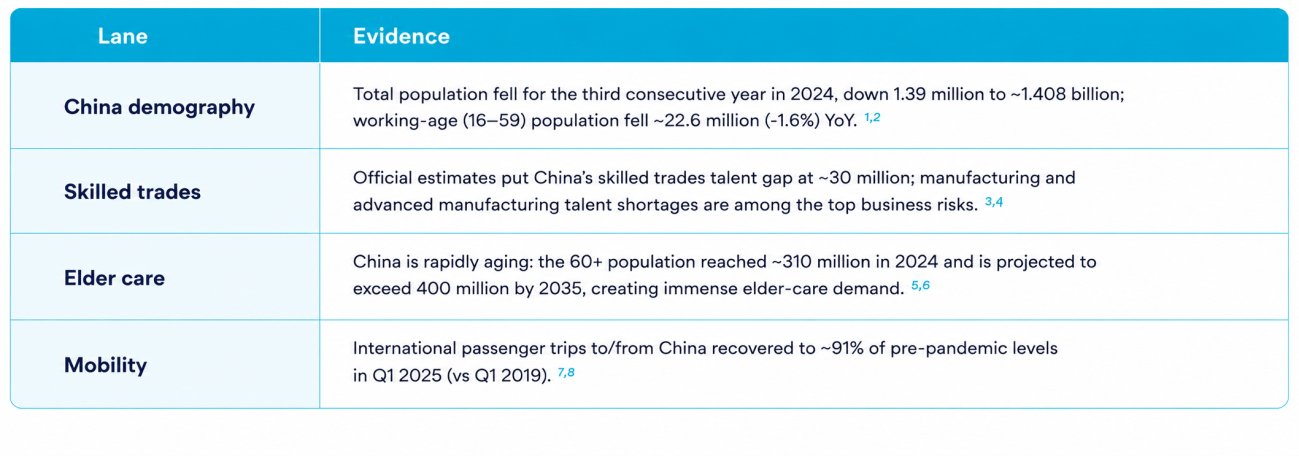
China supplies the sharpest version, though the headline numbers understate it badly. Total population fell 3.39 million in 2025, which against 1.405 billion reads as 0.24% and invites dismissal.[1] That is the wrong denominator. Population is a stock and stocks move slowly by construction. Labor supply is a flow, and in China the flow is collapsing: the 16 to 59 cohort dropped roughly 6.62 million against a base near 851 million, a 0.78% annual decline that runs 1.95 times the headline rate.[2] The gap is structural. The cohort aging out at 60 was born in the mid-1960s boom; the cohort aging in at 16 was born in 2010. Every entering cohort for the next two decades is already born and already counted.
The generational ratio is the number that should worry planners. On a total fertility rate of 0.96 against 2.1 replacement, each generation arrives at under half the size of the one before it. AEI framed the same arithmetic more bluntly: on the 2025 birth pattern there would be only 43 future daughters and 18 future granddaughters for every 100 Chinese women of childbearing age today.[14] Deaths ran 1.43 per birth in 2025, against a UN projection that China would reach 2.3 by 2050. A quarter century early.
Western scarcity runs on a slower clock but in the same direction. The BLS shows 504,500 US plumbers, pipefitters and steamfitters in 2024 with net decade employment change of 22,700 against roughly 44,000 annual openings, which describes a system running to stand still.[4] McKinsey estimates 30% of union electricians reach retirement age within the decade against a four to five year apprenticeship pipeline.[15] Energy constrains the constraint: the IEA reports retirements outnumbering new entrants 1.7 to 1 in nuclear-related trades and 1.4 to 1 in grid trades.[16]
Elder care is the most expensive lane and transport the most quietly urgent. On the latter, the framing has moved. The widely quoted projection that 68% of the world would be urban by 2050 came from the 2018 revision and has been superseded by a different way of counting. World Urbanization Prospects 2025 applies the harmonized Degree of Urbanisation methodology, which classifies settlements by population density grids rather than by each country's own definition, allowing cities, towns and rural areas to be compared consistently across borders. On that basis the world is already 81% urban/town: 45% of the world already lives in cities and another 36% in towns, with 33 megacities today against eight in 1975.[17] Denser than the old number implied, and already here rather than pending.
Comparative Callout: The Four Demand Lanes
Why The Humanoid Debate Is The Wrong Measurement
Here we part company with most of the coverage, including some of our own earlier framing.
The market has decided that humanoid shipments are the scoreboard for physical AI, and by that scoreboard the skeptics win easily. Morgan Stanley estimates 13,000 to 16,000 humanoids shipped globally in 2025.[9] Its own enterprise survey found 23% of Chinese buyers satisfied with available products, against more than 150 companies chasing the sector and battery life around two hours, with the bank warning of a shake-out.[10] That is the same institution that revised its China shipment forecast from 14,000 to 28,000 to 50,000 inside six months.[19] Both readings are Morgan Stanley's. The tension between them is the honest state of that category.
It is worth asking why this category became the scoreboard at all. The most influential humanoid framework on the sell side, the $5 trillion by 2050 model and the accompanying Humanoid 100 list, comes from Adam Jonas, working with Sheng Zhong.[25] Jonas covered Tesla at Morgan Stanley for more than a decade and moved to AI and robotics coverage in 2025.[26] The underlying model is a labor-replacement model, built across 831 US job classifications, against a global labor addressable market the firm sizes near $30 trillion, which structurally makes the human-shaped machine the unit of account.[27] We are not questioning the analysis. We are noting that the measurement convention the market now uses was built by people whose prior work made a robot-shaped case for equity valuation, and that the shipment revisions we cite above share an author with the bull case. Analytical frameworks carry their origins forward. The same caution applies to us and to the vendors in this note: every chip supplier positioned at the edge benefits from the physical AI narrative regardless of which form factor eventually wins.
The gap between AI ambition and AI execution is measurable in enterprises that have no robots at all. In our HyperFRAME Lens study, 84% of I&O leaders agreed that AI deployment has consumed more budget and operational resources than originally planned.[28] If deploying software AI is running over budget at that rate, the assumption that embodied AI arrives on schedule deserves more scrutiny than it gets.
Now lets challenge the objection properly. The skeptic says every executive on these stages has an incentive to pull the timeline forward, and the humanoid data seems to prove it. We think the skeptic is right on the evidence and wrong on the question, because Dachs did not claim humanoids were imminent. He put them last, deliberately, behind autonomous vehicles, industrial robots and healthcare. Judging his claim by humanoid unit counts is judging a freight business by the concept vehicle in the lobby.
What Is Actually Deployed
Industrial is the largest by an order of magnitude. IFR counted 542,076 industrial robots installed in 2024, the second-highest annual figure on record, against a global operational stock of 4,664,000 units growing 9% year over year.[6] That is roughly 35 times the entire 2025 humanoid shipment estimate, in a single year, in a single category. Robot density has climbed everywhere: Western Europe reached 267 robots per 10,000 manufacturing employees in 2024, North America 204, Asia 131, with Korea at 1,220.[7]
Autonomous vehicles are the category that most directly tests the "faster than we think" claim, because they spent so long looking slow. Waymo now runs roughly 500,000 paid rides a week across ten US cities, up tenfold from 50,000 in May 2024, and served more than 14 million trips in 2025 against roughly a third of that in 2024.[8] Seventeen years of visible effort, then a tenfold move in under two. That shape is exactly what Dachs was describing, and it is why the long flat stretch is a poor guide to what follows it. Baidu's reported Q1 2026 results put Apollo Go at 3.2 million fully driverless rides in the quarter with weekly volume peaking above 350,000 and total rides up more than 120% year over year, which places two operators at comparable scale on opposite sides of the Pacific.[20]
Healthcare is also further along than generally understood. Intuitive grew its da Vinci installed base to 11,710 systems as of June 30, 2026, up 12% year over year, placing 468 systems in the quarter against 395 a year earlier, with worldwide procedures up approximately 16% and quarterly revenue of $2.89 billion.[21] None of those machines is a humanoid. All of them are physical AI operating under safety certification in an environment where failure is not recoverable, which is the hard version of the problem the humanoid demos have not yet had to solve.
Will It Be Western Companies?
The uncomfortable arithmetic is that the region facing the sharpest labor squeeze is also the region building the machines, and it holds across categories rather than just humanoids. Asia took 74% of new industrial robot installations in 2024 against 16% for Europe and 9% for the Americas, with China alone at 54% and an operational stock of 2,027,000 units, roughly 43% of the world total.[6] The supplier shift matters more than the installation share: Chinese robot makers outsold foreign competitors in their home market for the first time in 2024, taking 57% domestic share against 47% a year earlier.[6] In humanoids the concentration is starker still, with Morgan Stanley putting Chinese manufacturers at roughly 90% of 2025 global shipments while US and Japanese rivals remained largely at prototype stage.[9] These numbers suggest the answer about western companies is split, and that the split favors the semiconductor layer.
Companies like Qualcomm, NXP, and others appear to be architecting for exactly that outcome. NXP’s Neural Axis is a claim on the nervous system, not the body. Amon’s Computex keynote extended the same logic into connectivity, presenting 6G as the first wireless generation designed for the AI era and resting it on connectivity, distributed computing and sensing. While these companies aren’t building robots, subject to export controls they are selling to the companies that do.
Where the Coordination Layer Actually Matters
MCX A5 does not compete with Qualcomm’s Dragonwing IQ10. The IQ10 is the reasoning tier, company claimed at up to 700 TOPS, 18 Oryon cores, aimed at AMRs and humanoids.[22] A 240 MHz Cortex-M33 with integrated 10BASE-T1S is the coordination and reflex tier. In a Neural Axis framing they are complements. An automated warehouse can buy both.
The more relevant contest is with discrete single-pair Ethernet silicon. Microchip has shipped 10BASE-T1S PHYs since 2023, along with MAC-PHYs that let low-cost microcontrollers reach those networks over SPI.[23] NXP’s claim is integration: because the digital PHY sits on the MCU, the system needs only a simpler PMD.[24] Fewer parts, one vendor, one toolchain.
Buyer priorities support that framing. Our own HyperFRAME Lens survey of 520 enterprise I&O leaders found 49% rating platform connectivity and interoperability a very significant factor in infrastructure procurement, against 36% for support for AI capabilities and acceleration.[28] The integration problem outranks the intelligence problem in the purchase decision.
That matters first in buildings and manufacturing, then in robotics. The 4.66 million industrial robots already operating sit on fieldbus infrastructure laid down over decades. A large share of what sits below those robots was never networked at all. Sensors, actuators and remote I/O still run on RS-485 and CAN links that leave them invisible to IP networks, because pulling full Ethernet to every one of them was never reasonable. Moving that tier onto IP is the unglamorous work required before any higher-level physical AI architecture becomes addressable at scale. The same logic applies to building management and industrial I/O. The differentiator worth watching is post-quantum: industrial and building nodes carry lifecycles measured in decades, so cryptography chosen in 2026 must still be viable in the 2040s. NXP positions MCX A5 as post-quantum-capable with a security architecture targeting PSA Level 3 and SESIP Level 3 [11]; which are claims about the retrofit path, not the demo.
Looking Ahead
MCX A5 does not compete with Qualcomm’s Dragonwing IQ10. The IQ10 is the reasoning tier, company claimed at up to 700 TOPS, 18 Oryon cores, aimed at AMRs and humanoids.[22] A 240 MHz Cortex-M33 with integrated 10BASE-T1S is the coordination and reflex tier. In a Neural Axis framing they are complements. An automated warehouse can buy both.
The more relevant contest is with discrete single-pair Ethernet silicon. Microchip has shipped 10BASE-T1S PHYs since 2023, along with MAC-PHYs that let low-cost microcontrollers reach those networks over SPI.[23] NXP’s claim is integration: because the digital PHY sits on the MCU, the system needs only a simpler PMD.[24] Fewer parts, one vendor, one toolchain.
Buyer priorities support that framing. Our own HyperFRAME Lens survey of 520 enterprise I&O leaders found 49% rating platform connectivity and interoperability a very significant factor in infrastructure procurement, against 36% for support for AI capabilities and acceleration.[28] The integration problem outranks the intelligence problem in the purchase decision.
That matters first in buildings and manufacturing, then in robotics. The 4.66 million industrial robots already operating sit on fieldbus infrastructure laid down over decades. A large share of what sits below those robots was never networked at all. Sensors, actuators and remote I/O still run on RS-485 and CAN links that leave them invisible to IP networks, because pulling full Ethernet to every one of them was never reasonable. Moving that tier onto IP is the unglamorous work required before any higher-level physical AI architecture becomes addressable at scale. The same logic applies to building management and industrial I/O. The differentiator worth watching is post-quantum: industrial and building nodes carry lifecycles measured in decades, so cryptography chosen in 2026 must still be viable in the 2040s. NXP positions MCX A5 as post-quantum-capable with a security architecture targeting PSA Level 3 and SESIP Level 3.[11] Which are claims about the retrofit path, not the demo.
[1] NBC News, "China's population falls for a fourth straight year," January 2026.
https://www.nbcnews.com/world/asia/chinas-population-falls-fourth-straight-year-rcna254757
[2] National Bureau of Statistics of China, 2025 annual data, via Asia Times.
https://asiatimes.com/2026/01/chinas-population-falls-for-fourth-year-amid-economic-woes/
[3] US Bureau of Labor Statistics, Occupational Outlook Handbook, Electricians, 2024–34 projections.
https://www.bls.gov/ooh/construction-and-extraction/electricians.htm
[4] US Bureau of Labor Statistics, Occupational Outlook Handbook, Plumbers, Pipefitters, and Steamfitters.
https://www.bls.gov/ooh/construction-and-extraction/plumbers-pipefitters-and-steamfitters.htm
[5] PHI, "Direct Care Workers in the United States: Key Facts 2025."
https://www.phinational.org/resource/direct-care-workers-in-the-united-states-key-facts-2025/
[6] International Federation of Robotics, World Robotics 2025.
https://ifr.org/ifr-press-releases/news/global-robot-demand-in-factories-doubles-over-10-years
[7] International Federation of Robotics, "Robot Density Surges in Europe, Asia, and Americas," April 2026.
https://ifr.org/ifr-press-releases/news/robot-density-surges-in-europe-asia-and-americas
[8] TechCrunch, "Waymo's skyrocketing ridership in one chart," March 2026.
https://techcrunch.com/2026/03/27/waymo-skyrocketing-ridership-in-one-chart/
[9] Morgan Stanley via South China Morning Post, May 2026.
https://www.scmp.com/economy/global-economy/article/3352781/humanoids-robots-drive-next-chapter-chinas-manufacturing-dominance-morgan-stanley
[10] Morgan Stanley enterprise survey via The Next Web, May 2026.
https://thenextweb.com/news/china-humanoid-robot-boom-commercialisation-reality-check
[11] NXP Semiconductors, MCX A5 product page.
https://www.nxp.com/products/MCX-A5
[12] HyperFRAME Research, MCX A5 research note.
https://hyperframeresearch.com/2026/08/19/why-ship-post-quantum-crypto-years-before-the-threat-arrives/
[13] NXP Semiconductors, transcript of Rafael Sotomayor's Computex 2026 keynote.
https://www.nxp.com/docs/en/supporting-information/TRANSCRIPT-RAFAEL-CEO-COMPUTEX.pdf
[14] American Enterprise Institute, "China's Coming Population Crash," March 2026.
https://www.aei.org/commentary/chinas-coming-population-crash-scrambles-the-global-balance-of-power/
[15] McKinsey, "Tradespeople wanted: The need for critical trade skills in the US," April 2024.
https://www.mckinsey.com/capabilities/people-and-organizational-performance/our-insights/tradespeople-wanted-the-need-for-critical-trade-skills-in-the-us
[16] IEA data via POWER Magazine, January 2026.
https://www.powermag.com/bridging-the-gap-how-the-power-industry-is-tackling-its-workforce-crisis/
[17] UN World Urbanization Prospects 2025 via Copernicus.
https://www.copernicus.eu/en/news/news/observer-seven-things-we-learned-un-world-urbanization-prospects
[18] World Health Organization, "Road deaths fall by 21% globally," July 2026.
https://www.who.int/news/item/20-07-2026-road-deaths-fall-by-21--globally-but-stronger-action-is-needed-to-save-lives
[19] CNBC, "Morgan Stanley doubles China humanoid robot shipment forecast," June 2026.
https://www.cnbc.com/2026/06/24/morgan-stanley-china-humanoid-robot-market-forecast.html
[20] Baidu Q1 2026 results, Apollo Go figures.
https://www.prnewswire.com/news-releases/baidu-announces-first-quarter-2026-results-302774476.html
[21] Intuitive Surgical, Q2 2026 earnings release, July 2026.
https://isrg.intuitive.com/news-releases/news-release-details/intuitive-announces-second-quarter-earnings-6
[22] Qualcomm, "Introducing the Qualcomm Dragonwing IQ10 RRD," June 2026.
https://www.qualcomm.com/news/onq/2026/06/dragonwing-iq10-robotics-reference-design
[23] Microchip Technology, 10BASE-T1S Ethernet products.
https://www.microchip.com/en-us/products/high-speed-networking-and-video/ethernet/single-pair-ethernet/10base-t1s
[24] CNX Software, "NXP MCX A5 Cortex-M33 MCU family," August 2026.
https://www.cnx-software.com/2026/08/19/nxp-mcx-a5-cortex-m33-mcu-family-supports-10base-t1s-single-pair-ethernet-and-post-quantum-cryptography/
[25] Morgan Stanley, "Humanoid Robot Market Expected to Reach $5 Trillion by 2050."
https://www.morganstanley.com/insights/articles/humanoid-robot-market-5-trillion-by-2050
[26] CNBC, "Noted Tesla analyst Adam Jonas moving into new role at Morgan Stanley," August 2025.
https://www.cnbc.com/2025/08/04/noted-tesla-analyst-adam-jonas-moving-into-new-role-at-morgan-stanley.html
[27] Morgan Stanley, "Robots in Our Near Future," Thoughts on the Market.
https://www.morganstanley.com/insights/podcasts/thoughts-on-the-market/ai-humanoid-robots-adam-jonas
[28] HyperFRAME Research Lens, "State of Enterprise Infrastructure & Operations, 1H 2026," June 2026, based on 520 qualified I&O leaders across North America, EMEA, APAC and South/Central America.
https://hyperframeresearch.com/hyperframe-lens-research-2/

Stephen Sopko | Analyst-in-Residence – Semiconductors & Deep Tech
Stephen Sopko is an Analyst-in-Residence specializing in semiconductors and the deep technologies powering today’s innovation ecosystem. With decades of executive experience spanning Fortune 100, government, and startups, he provides actionable insights by connecting market trends and cutting-edge technologies to business outcomes.
Stephen’s expertise in analyzing the entire buyer’s journey, from technology acquisition to implementation, was refined during his tenure as co-founder and COO of Palisade Compliance, where he helped Fortune 500 clients optimize technology investments. His ability to identify opportunities at the intersection of semiconductors, emerging technologies, and enterprise needs makes him a sought-after advisor to stakeholders navigating complex decisions.

Ron Westfall | VP and Practice Leader for Infrastructure and Networking
Ron Westfall is a prominent analyst figure in technology and business transformation. Recognized as a Top 20 Analyst by AR Insights and a Tech Target contributor, his insights are featured in major media such as CNBC, Schwab Network, and NMG Media.
His expertise covers transformative fields such as Hybrid Cloud, AI Networking, Security Infrastructure, Edge Cloud Computing, Wireline/Wireless Connectivity, and 5G-IoT. Ron bridges the gap between C-suite strategic goals and the practical needs of end users and partners, driving technology ROI for leading organizations.