











Research Finder
Find by Keyword
IBM’s Dual-ISA Processor: Can Arm-Native Linux Finally Reach Mainframe Data Gravity?
Software supply, not hardware capability, has long been the binding constraint on Z, and this design with Arm aims squarely at it.
8/26/2026
Key Highlights
- IBM disclosed at Hot Chips what it describes as the first dual-architecture mainframe processor, designed for future IBM Z and LinuxONE systems, and the first processor milestone from the IBM and Arm collaboration established in April 2026.
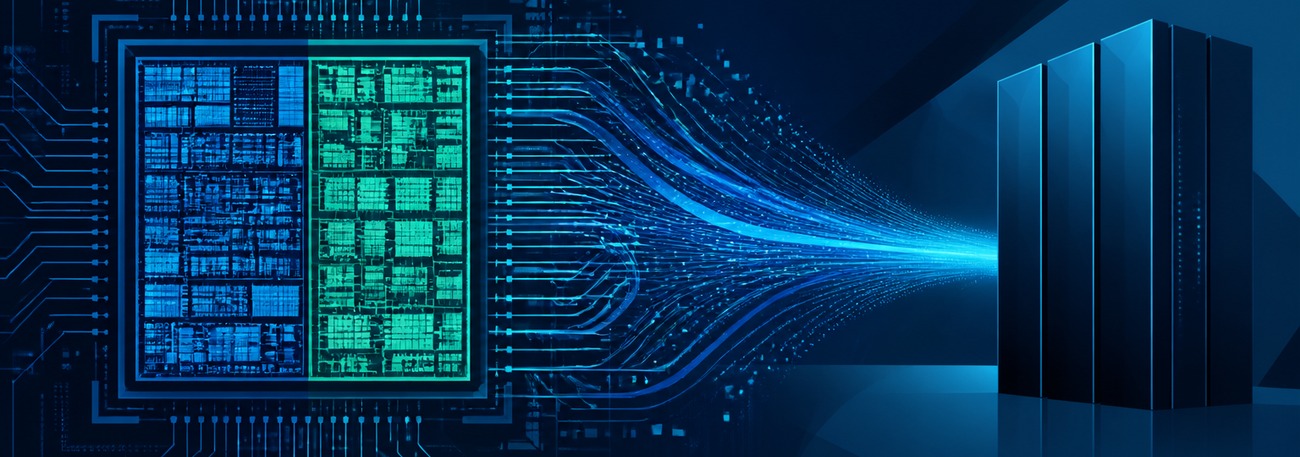
- The design carries 11 high-performance cores (SMT-2) on a 2 nm node running above 5.7 GHz. Each core natively executes both z/Architecture and AArch64. It includes 36 MB private L2 per core, 432 MB Virtual-L3 and 3.5 GB virtual-L4, a dedicated on-chip DPU for I/O acceleration, plus on-processor AI, compression, cryptography and sort acceleration.
- IBM states the chip is a dual-ISA core design (not separate Arm and z cores, not a chiplet partition, and not a translation layer). Each core natively executes both z/Architecture and AArch64. The implementation retains ‘CISC Mainframe DNA’ (high frequency, large BTB/TLBs/caches, reliability and strong ordering) so the platform’s established performance, security, encryption and availability characteristics remain primary.
- Arm brings a software ecosystem it puts at more than 22 million developers, and the stated intent is to let Arm-native Linux environments run alongside z/OS and existing Linux on Z.
- Coexistence is achieved through Linux KVM and OpenShift Virtualization: z/OS runs in one logical partition while a second logical partition hosts both Linux-s390x and Linux-ARM64 guests on the same dual-ISA processor.
- No system name, configuration, or availability date accompanied the disclosure, and IBM attached its standard forward-direction disclaimer, which suggests this is an architecture preview rather than a product launch.
The News
IBM announced at Hot Chips a dual-ISA processor (each core natively executes both s/390x and AArch64 v9.3) designed to run both IBM and Arm compute platforms natively within future IBM Z and LinuxONE systems. The announcement is the first silicon milestone from the strategic collaboration with Arm formed in April. The stated design intent is to let Arm-native Linux environments operate simultaneously with z/OS and Linux on Z, giving Arm workloads access to IBM's enterprise security and resilience characteristics while giving IBM customers access to software written for a much larger developer base. Arm frames the move as its ecosystem extending from cloud and standard servers into high-reliability enterprise environments. Full detail is in the IBM announcement and the accompanying Arm newsroom post.
Analyst Take
The mainframe has never had a hardware problem. It has had a supply problem, and the scarce good is software written for the platform. This disclosure appears designed to address that directly, by importing an instruction set that already has a developer population rather than trying to develop one with limited resources. Timing sharpens the question. IBM Z revenue fell 42 percent year over year in the second quarter as the z17 program moved past its peak, and while this was a normal market structural shift, it brought attention on what widens the platform's workload aperture next. Although you have to look at the cyclical nature of the platform for context, we are 5 quarters into the z17 cycle, so this trend should not be overstated, but seen in a cyclical context.
The bear case deserves a fair hearing. Much of what runs on Arm-native Linux runs on a Graviton instance at materially lower cost per core, which makes a dual-architecture mainframe look like an expensive answer to an already solved problem. But this misses the point. This is not about running Arm on just another processor. That reading holds right up until you account for where the data sits. Workloads that need physical proximity to the system of record, inside the same compliance perimeter, do not price out the same way.
What was Announced
IBM disclosed a processor, not a system. There is no generation name, no configuration detail beyond the chip level, no ship date, and the release carries the company's usual statement that future direction is subject to change. We would read this as an architecture disclosure timed to Hot Chips, with the commercial disclosure to follow.
The architectural choice is the substance. IBM states the chip is architected not to contain separate Arm and IBM cores, and that each core is designed to natively execute both instruction sets concurrently. This is not a co-processor, not a chiplet partition, and not a translation layer. From an operator's seat, the closer comparison is a dual-fuel engine rather than a second engine bolted to the frame. The Hot Chips presentation shows that Little-Endian Arm execution sits inside the existing Big-Endian micro-architecture, with 2,792 AArch64 instructions and 239 system registers implemented while reusing major dataflows, the TLB, and the recovery unit. New controls were added only where required, e.g. SVE, FP16/Bfloat16, crypto, Arm table-walk.
Dual-instruction-set execution in a shared pipeline has a long record of partial success. Memory ordering semantics, exception models, register architecture, and the privilege model all differ between z/Architecture and Arm, and reconciling them without imposing a penalty on the incumbent path is the difficult part. IBM appears aware of which side wins that argument, stating that the platform's established performance, security, encryption, and availability characteristics take priority.
Generational Comparison
- Telum II, powering IBM z17: eight cores, 5.5 GHz, Samsung 5nm, 600mm2 die, 43 billion transistors.
- Dual-architecture design, for future IBM Z and LinuxONE: 11 high-performance cores, above 5.7 GHz, 2 nanometer node, transistor count not disclosed.
Read against that baseline, the core count rises modestly, and the clock rises slightly, while the process jump is the aggressive part of the design. Holding a mainframe-class frequency through a node transition of that size is thermally demanding, and IBM has managed the trick before.
Eleven cores is also an unusual number. Independent analysis of the Telum II die suggested more physical cores than IBM's published count, which highlightss that the disclosed figure here is a usable-core number rather than a physical one.
The foundry partner was not named, and the omission is a live question rather than a detail. IBM built both Telum generations with Samsung, which makes continuity the obvious assumption. The company's separate 2 nanometer relationship with Rapidus gives the question a second plausible answer, and the choice would carry supply chain and geopolitical implications well beyond this part.
Market Analysis
For Arm, the royalty math here is close to immaterial. Mainframe silicon ships in volumes that would not register against a business where the company reported its share of CPU compute at the top hyperscalers at roughly 50 percent for the fiscal year ended March 2026. What Arm gains is categorical rather than financial. Its instruction set becomes present inside the most conservative, most heavily regulated systems in the enterprise, a credential that carries more weight in on-premises procurement than in cloud, where the argument was settled some time ago.
Arm is also running two strategies at once, and the tension is worth watching. In March the company unveiled the Arm AGI CPU, its first complete production part, stepping into merchant silicon and competing directly with licensees it has spent decades supplying. Here it does the opposite, licensing its architecture into a closed proprietary system it will never build. Both moves point at the same objective, presence in every enterprise compute socket that matters, but they pull on opposite ends of the business model.
For IBM the calculation runs the other way. The Z install base is durable, and the transaction volumes it carries are not in dispute, though the platform's growth has been paced by capacity upgrades rather than by new workload categories. Widening the software surface is one of the few levers that changes that pattern. The demand signal supports the direction. HyperFRAME Lens 1H 2026 found that 49 percent of surveyed infrastructure and operations leaders rate platform interoperability above AI acceleration as a priority. Buyers appear more concerned with what their environments can talk to than with peak throughput.
The open question is commercial rather than technical. If Arm-native Linux on Z is priced on mainframe capacity metrics, only workloads with a specific data-gravity justification will move. That decision has not been disclosed, and it likely matters more to adoption than any specification announced today.
Looking Ahead
The key trend we'll be monitoring is whether the software ecosystem treats this as a first-class target or a niche port. Developer ecosystems respond to reachable install bases, and the Z footprint, while valuable, is small in unit terms. IBM has opened a community page for parties to register interest, which reads as demand discovery ahead of a system commitment. Silicon is also only one of three workstreams the April collaboration described. That announcement identified:
- virtualization of Arm-based software environments inside IBM platforms (realized in the presentation as KVM + OpenShift Virtualization hosting concurrent Linux-s390x and Linux-ARM64 guests),
- performance and efficiency work aimed at letting enterprise systems recognize and execute Arm applications, and
- long-term ecosystem growth through shared technology layers between the two platforms.
Two of those three are software and ecosystem problems, which suggests the disclosures still ahead may matter more to adoption than the processor itself.

Stephen Sopko | Analyst-in-Residence – Semiconductors & Deep Tech
Stephen Sopko is an Analyst-in-Residence specializing in semiconductors and the deep technologies powering today’s innovation ecosystem. With decades of executive experience spanning Fortune 100, government, and startups, he provides actionable insights by connecting market trends and cutting-edge technologies to business outcomes.
Stephen’s expertise in analyzing the entire buyer’s journey, from technology acquisition to implementation, was refined during his tenure as co-founder and COO of Palisade Compliance, where he helped Fortune 500 clients optimize technology investments. His ability to identify opportunities at the intersection of semiconductors, emerging technologies, and enterprise needs makes him a sought-after advisor to stakeholders navigating complex decisions.

Steven Dickens | CEO HyperFRAME Research
Regarded as a luminary at the intersection of technology and business transformation, Steven Dickens is the CEO and Principal Analyst at HyperFRAME Research.
Ranked consistently among the Top 10 Analysts by AR Insights and a contributor to Forbes, Steven's expert perspectives are sought after by tier one media outlets such as The Wall Street Journal and CNBC, and he is a regular on TV networks including the Schwab Network and Bloomberg.