















Research Finder
Find by Keyword
Can Software-Defined Lidar Deliver Where Repair is Not an Option?
AEye's Apollo sensor heads to the Lunar South Pole, where solid-state architecture and software-defined scanning face conditions no road can simulate.
9/01/2026
Key Highlights
- Lunar Outpost has selected AEye’s Apollo long-range lidar for the Pegasus Lunar Terrain Vehicle, a multi-million-dollar award that opens space mobility as a fourth AEye vertical alongside automotive, defense, and industrial. Note: Apollo is the AEye brand, with no relation to the original NASA Apollo program.
- Our read: the value accrues in qualification credentials and per-unit pricing power rather than unit volume, and the durability record Apollo builds on Pegasus is portable to the defense and industrial buyers to whom AEye is already selling.
- Pegasus is one of two vehicles NASA funded in May 2026 under Phase 1 High Achievability Mission task orders of the Lunar Terrain Vehicle Services contract, with Lunar Outpost’s award valued at $220 million and surface delivery targeted for 2028.
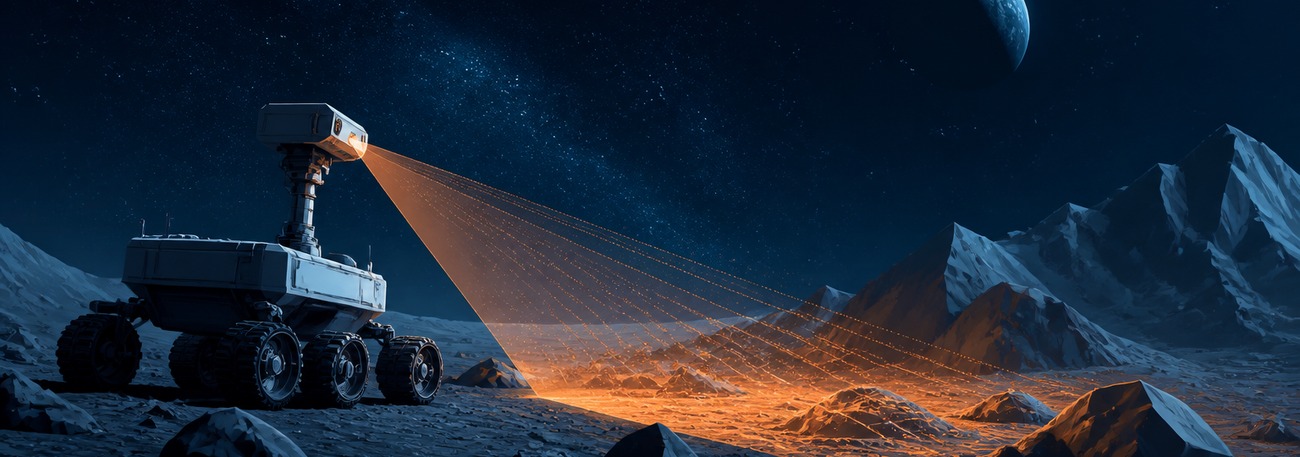
- AEye specifies the Apollo lidar to detect objects at up to one kilometer, and its software-defined architecture appears to let Lunar Outpost tune scan patterns and resolution to mission profiles without changing hardware.
- AEye brings contract manufacturing through a dedicated LITEON line designed for an initial annual output of up to 60,000 Apollo units, and closed Q2 2026 with $71.5 million in cash and marketable securities, a balance-sheet capacity that may support a multi-year qualification and supply effort.
The News
AEye announced that its Apollo-branded long-range lidar has been selected by Lunar Outpost for integration onto the Pegasus Lunar Terrain Vehicle. Pegasus LTV is one of two rovers NASA has contracted to carry Artemis astronauts across the Lunar South Pole once crewed landings begin. The award, which AEye characterizes as multi-million-dollar, extends the company’s commercial footprint beyond its core automotive, defense, and industrial markets into space mobility. Apollo is designed to support terrain perception, obstacle detection, and autonomous navigation for Pegasus, functions that carry crew safety consequences rather than convenience ones. https://www.aeye.ai/press-releases/aeyes-apollo-lidar-selected-by-lunar-outpost-for-pegasus-lunar-terrain-vehicle-opening-a-new-market-category-in-space-mobility/
Analyst Take
Space mobility is a small market, but in tech anything lunar has large implications. AEye enters the frame at a moment when the lidar sector has sorted itself into two camps: volume manufacturers competing on cost per unit, and specialists competing on what a sensor can be instructed to do. The bear case on this announcement writes itself because skeptics will argue that the award is large relative to current AEye revenue and tiny relative to the $220 million rover, also that a handful of lunar rovers cannot scale into a business. We take the objections seriously, and yet we think unit count is the wrong lens. Extreme-environment programs pay for qualification and engineering in ways automotive procurement never has. Lunar Outpost is buying a sensor for a high-stakes vehicle whose maintenance plan would involve a nine-figure delivery contract and a rocket launch. While Lunar Outpost is buying survivability proof as part of the Pegasus rover, AEye stands to earn the same thing, and proof of that kind resonates with buyers who will never leave Earth.
What Was Announced
Apollo is a software-defined sensor, which in this context means scan pattern, range allocation, and resolution are set in software rather than fixed in optics and mechanics at the factory. What makes Apollo unusual is what it does not do. Long-range lidar traditionally scans by rotating an assembly or spinning a mirror, familiar to anyone who has hailed a Waymo. This approach means bearings, a motor, and a wear surface that in the lunar context would have to survive launch and then keep turning for the duration of the mission. AEye steers its beam with a MEMS mirror measuring less than a millimeter across, an order of magnitude smaller than the mirrors common in rotating designs. The engineering argument, which is AEye’s own, is that torque from shock and vibration scales with mirror area, so a smaller mirror tolerates loads that would damage a larger one. Whether that holds through lunar qualification is unproven. But it explains why a team facing launch loads, deep thermal cycling, and no possibility of field repair would start from this architecture rather than a rotating one.
AEye describes Apollo as detecting objects at distances up to one kilometer. The company also offers OPTIS, a full-stack perception platform. For a lunar rover, while peak range is meaningful, versatility through software definition is the key attribute. A vehicle creeping along a permanently shadowed crater rim needs dense returns close in. The same vehicle on a long traverse needs reach and a narrower field. Fixed-configuration sensors force that tradeoff at design freeze, long before launch. Apollo may let Lunar Outpost set those parameters before launch and, in principle, retune later if the flight software allows.
Lunar Outpost’s stated selection criteria track failure modes the AEye design appears to address, including solid-state construction that aims to address launch vibration and a service life with no possibility of field repair. Thermal extremes and vacuum operation are qualification questions rather than feature questions, and the qualification path is the natural next disclosure as integration proceeds. We would expect that record to become a more interesting story than the award itself. Form factor matters for a separate reason because mass and volume on a lunar vehicle are rationed against power, thermal management, science payload, and crew accommodation.
Functionally, Apollo is slated to handle the perception workload Pegasus depends on for safe traverse. Pegasus is designed to operate autonomously, under teleoperation, or with crew aboard, and those modes place materially different latency and reliability demands on the same sensor.
Market Analysis
One of AEye’s primary verticals, automotive, has spent recent quarters demonstrating how punishing the volume game has become. Luminar filed for Chapter 11 in December 2025, and MicroVision bought certain of its lidar assets for $33 million in a Section 363 auction, a fraction of a valuation that once ran into the billions. Koito took Cepton private, Ouster absorbed Stereolabs, and Hesai guided 2026 shipments at 3.0 to 3.5 million units. Together these events describe an automotive industry consolidating around scale. Aerospace and defense are very different customer sets, while industrial straddles the line.
That scale context is what makes the Lunar Outpost award interesting rather than decorative. NASA issued task orders to Lunar Outpost and Astrolab in May 2026 under the Lunar Terrain Vehicle Services contract, with surface delivery targeted for 2028. These are firm-fixed-price, milestone-based programs with serious primes attached, since General Motors, Goodyear, and Leidos sit on the Pegasus team. We have not found public detail on Astrolab’s sensor supply chain, which leaves the most useful comparison in the program unavailable for now. A sensor that clears integration on a crewed lunar vehicle acquires a reference that travels, and in our experience, defense buyers tend to take lunar qualification very seriously.
The last crewed vehicles to drive on the Moon carried no perception system at all. NASA’s Apollo rovers navigated by directional gyro and odometer, with a graduated post casting a sun shadow to check the drift. The parallel Soviet program drove Lunokhod 2 from Earth on a camera returning roughly one frame every twenty seconds. Lidar has reached the Moon since then, but only in the descent role, where NASA Langley’s Navigation Doppler Lidar guided Intuitive Machines’ Odysseus after the lander’s own rangefinders failed. Descent is a bounded problem measured in minutes. Surface traverse is unbounded, dusty, and repeated for a year.
We see a procurement signal underneath the commercial one. NASA Goddard developed its own Space Qualified Rover Lidar and has been seeking licensees to commercialize it, so a purpose-built NASA-origin lidar exists as a licensing option. Lunar Outpost still bought an automotive/defense-derived unit. If that choice holds across the program, it suggests operators of extreme-environment vehicles are increasingly willing to source from the commercial sensor base rather than wait on space-heritage instruments.
What Lunar Qualification Actually Proves
What, exactly, would surviving demonstrate?
Four of the Lunar South Pole’s hazards have rough Earth analogs. Launch vibration resembles the random-vibration profiles automotive scan blocks already face. Abrasive dust is a mining and agriculture problem. Wide thermal swings are a defense problem. Unattended long-duration operation is an infrastructure problem. A sensor that holds up against those is telling defense and industrial buyers something they can act on, which is most of the reason the Lunar credential carries commercial value.
Two hazards have no Earth analog. First, vacuum removes convection, so every watt the sensor generates has to leave by conduction or radiation, a constraint terrestrial automotive or industrial designs have never had to satisfy. Then, ionizing radiation, unshielded by any magnetosphere, acts on the processor and receiver electronics in ways terrestrial silicon qualification does not address at all. If AEye publishes results against those two, the durability claim becomes hard to dismiss. If it does not, lunar qualification means the sensor survived a rocket ride and a hard vacuum, which is worth something but less than the phrase suggests.
There is also an argument specific to the Lunar South Pole that favors active sensing on the merits. The sun sits near the horizon there. Shadows run long and hard-edged, and permanently shadowed craters hold no ambient light at all. Passive cameras degrade badly under those conditions. A lidar supplies its own illumination and does not suffer from that limitation set. In this narrow sense, the Moon is a friendlier environment for this class of sensor than a sunlit highway.
The broader observation is about where durability standards now originate. Automotive qualification evolved to meet long service lives with near-zero field service, which produced shock, vibration, and thermal-cycling regimes considerably more punishing than the term automotive-grade implies. The volume war that ended Luminar also forged that floor. Now the floor is exporting to environments the automotive industry never contemplated. Space-heritage components have historically carried a substantial cost premium, so if industry-derived parts can be qualified for lunar surface use, the cost structure of operating on the Moon shifts, and that matters more to NASA’s Moon Base economics than to any single supplier.
One limit worth stating plainly. A design win is not a qualification. Lunar Outpost’s engineers reviewed the architecture and judged it worth the integration risk, which is peer review with money behind it, but it is not test data. The test data arrives over the next two years.
Looking Ahead
Based on what we are observing, the figure to track is the qualification record AEye stands to generate from this award more than the revenue numbers. Pegasus targets surface delivery in 2028, which means integration, environmental testing, and mission rehearsal fill the intervening period, and each stage produces evidence that either strengthens or weakens Apollo’s claim to extreme-environment durability. Two risks deserve monitoring alongside the technical ones. Artemis has slipped before, and the FY2027 NASA topline is still being fought in Congress. Lunar Outpost closed a $30 million Series B in May 2026 led by Industrious Ventures, a reasonable raise for the stage that nonetheless sits against a fixed-price government program where milestone timing governs supplier cash flow. What appears more durable than short term revenue is longer term direction of travel. Sensor buyers across defense, space, and industrial autonomy seem to be converging on programmable hardware because mission profiles in these sectors are changing faster than procurement cycles.

Stephen Sopko | Analyst-in-Residence – Semiconductors & Deep Tech
Stephen Sopko is an Analyst-in-Residence specializing in semiconductors and the deep technologies powering today’s innovation ecosystem. With decades of executive experience spanning Fortune 100, government, and startups, he provides actionable insights by connecting market trends and cutting-edge technologies to business outcomes.
Stephen’s expertise in analyzing the entire buyer’s journey, from technology acquisition to implementation, was refined during his tenure as co-founder and COO of Palisade Compliance, where he helped Fortune 500 clients optimize technology investments. His ability to identify opportunities at the intersection of semiconductors, emerging technologies, and enterprise needs makes him a sought-after advisor to stakeholders navigating complex decisions.