













Research Finder
Find by Keyword
Akuity Gives AI Agents Governed Access to Software Delivery
Akuity connects AI agents to deployment context and existing delivery controls, but enterprises will still need to decide which production actions they are willing to delegate.
9/18/2026
Key Highlights
- Akuity introduced its Agentic Control Plane and MCP Server to connect AI agents to its software delivery platform.
- Agent requests inherit the connected user’s identity and permissions, while an additional policy layer can restrict sensitive production actions.
- Claude, Codex, Cursor, and other clients can access deployment history, cluster health, and change lineage through the MCP Server.
- The immediate value is likely to come from troubleshooting and routine delivery tasks, not fully autonomous production changes.
- Adoption will depend on how well the platform fits existing delivery environments and whether customers can demonstrate faster recovery without weakening governance.
The News
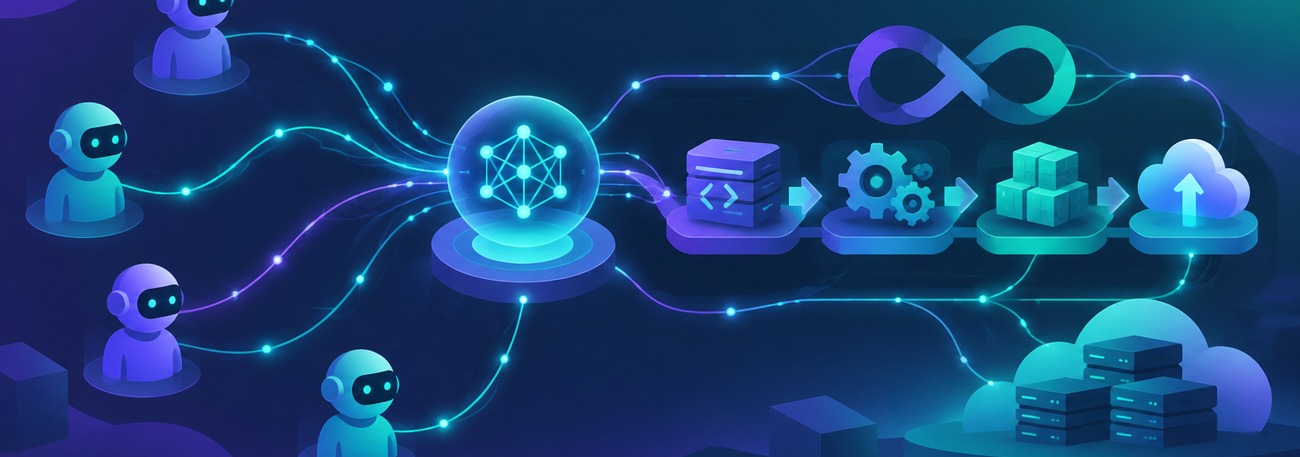
Akuity introduced its Agentic Control Plane and MCP Server, which give AI agents access to deployment history, cluster health, change lineage, and software delivery actions. Agent requests use the connected user’s identity and permissions, while a separate policy layer can further restrict what an agent may do in sensitive environments.
The company says agents can use this context to investigate incidents, bootstrap delivery configurations, evaluate whether a release is eligible for promotion, and initiate approved actions. Existing approval rules remain in force whether a person or an agent starts the request. For more information, read thefull announcement.
Analyst Take
AI coding tools can generate more software, but they do not automatically understand how an enterprise deploys it. Production environments contain approval rules, dependencies, cluster conditions, deployment histories, and exceptions that are rarely visible from the code alone. Akuity is trying to give agents that operational context without allowing them to bypass the controls already governing delivery.
This addresses a real gap in the AI development stack. An agent may be able to propose a code change while lacking the information needed to determine whether that change is safe to release. It may not know which version is running, why a previous deployment failed, whether an application is already degraded, or which approvals apply to the next environment. Giving the agent access to that information could make it more useful after code generation.
HyperFRAME Research Lens data shows the broader readiness problem. Only 14 percent of organizations describe their core data architecture as fully modernized for AI workloads. Software delivery presents a similar challenge. Agents are being introduced into environments built from existing tools, policies, identities, and operating practices. Connecting an agent to that environment is easier than giving it enough context to act reliably within it.
The important design choice is that Akuity does not give an agent separate credentials or unrestricted infrastructure access. Requests are authenticated as the user who connected the agent, and existing permissions continue to apply. Akuity also adds policies that can prevent an agent from taking sensitive actions the user could otherwise perform. That matters because an agent should not automatically inherit every action available to its human operator.
Using an existing identity framework also reduces the number of credentials an enterprise must issue and manage. But identity inheritance does not resolve every governance question. Customers still need to understand how sessions are established, how access is revoked, which actions appear in the audit trail, and whether the system records the context behind an agent’s recommendation or action.
The harder question is how this works in existing environments. Delivery policies are often spread across pipelines, scripts, identity systems, approval processes, and undocumented operating knowledge. Akuity can govern actions that pass through its platform, but customers will need to determine how much of their delivery environment it can see and control. The value will be lower if teams must recreate large portions of their operating model before an agent becomes useful.
The ability to promote a release from a chat interface is technically interesting, but we see most enterprises beginning with recommendations, troubleshooting, and lower-risk actions. Existing approval rules still apply, according to Akuity, but customers will also need clear human-approval thresholds, rollback procedures, and records showing why an agent initiated a change.
Akuity should be measured against practical delivery outcomes. Can it reduce the time required to identify and remediate incidents? Can it automate routine promotions without increasing failed deployments or policy exceptions? Can teams understand what context the agent used and why it recommended or initiated a change? Those results will matter more than the number of actions available through a chat interface.
What Was Announced
Akuity’s MCP Server allows AI assistants and coding agents such as Claude, Codex, and Cursor to interact with the Akuity Platform. These tools can access deployment history, cluster health, and the commit associated with a deployment. That context could help an agent investigate an active incident rather than reasoning only from the latest code change.
Every request passes through the Agentic Control Plane and is authenticated as the user who connected the agent. The user’s existing permissions carry across the Akuity instances and clusters the platform manages. An additional policy layer can restrict agent access to sensitive production actions even when the connected user has permission to perform them.
This approach avoids creating separate credentials for each agent connection. Enterprises should still evaluate how the platform handles tokens, session boundaries, revocation, and audit coverage. Reusing human permissions is a useful starting point, but organizations may eventually need more explicit distinctions between human and agent identities as agents take on more operational work.
Akuity also introduced workflows for service bootstrapping, release promotion, and troubleshooting. Developers can ask an agent to create delivery configurations for a new service, including environments and promotion rules. They can also ask whether a release is eligible for promotion and initiate that promotion without leaving the chat interface.
For incident response, an external agent can connect to Akuity’s On-Call Agent, which uses logs and recent infrastructure changes to diagnose a degraded application and recommend a fix. Akuity cited an early customer example in which the platform identified a systemic issue across degraded applications and traced it to a single project. That example is encouraging, but broader customer evidence will be needed to establish how consistently the approach works across complex environments.
Looking Ahead
Akuity’s announcement reflects a broader shift in developer tooling. AI agents are moving from generating code toward interacting with the systems that build, deploy, and operate it. That makes identity, permissions, approval, and auditability part of the agent architecture rather than controls added after deployment.
Akuity has an advantage because its platform already has access to deployment history, cluster state, promotion rules, and change lineage. The open question is how much useful context it can provide across the rest of an enterprise delivery environment. Most organizations use multiple development, security, observability, and infrastructure tools. An agent’s view will only be as complete as the systems connected to it.
Enterprises are also unlikely to delegate every production action at once. Adoption should begin with investigation, recommendations, service bootstrapping, and other bounded tasks where teams can compare the agent’s work with existing procedures. Broader autonomy will depend on demonstrated reliability, clear human-approval boundaries, and the ability to reconstruct why an action occurred.
Akuity’s opportunity is not simply to let developers operate delivery systems from a chat interface. It is to show that agents can use operational context to improve software delivery without creating a new path around enterprise controls.

Stephanie Walter | Practice Leader - AI Stack
Stephanie Walter is a results-driven technology executive and analyst in residence with over 20 years leading innovation in Cloud, SaaS, Middleware, Data, and AI. She has guided product life cycles from concept to go-to-market in both senior roles at IBM and fractional executive capacities, blending engineering expertise with business strategy and market insights. From software engineering and architecture to executive product management, Stephanie has driven large-scale transformations, developed technical talent, and solved complex challenges across startup, growth-stage, and enterprise environments.