















Research Finder
Find by Keyword
Nokia Cognitive Operations: Driving Edge AI and Wireless Resilience for Industrial Environments
Nokia Cognitive Operations integrates GPU-accelerated edge compute with multi-access wireless fabrics, enabling mission-critical sectors to run localized analytics and maintain operational autonomy during severe network disruptions.
9/18/2026
Key Highlights
- Nokia Cognitive Operations directly addresses low enterprise AIOps adoption rates by delivering a pre-integrated, edge-native platform that bypasses complex internal development.
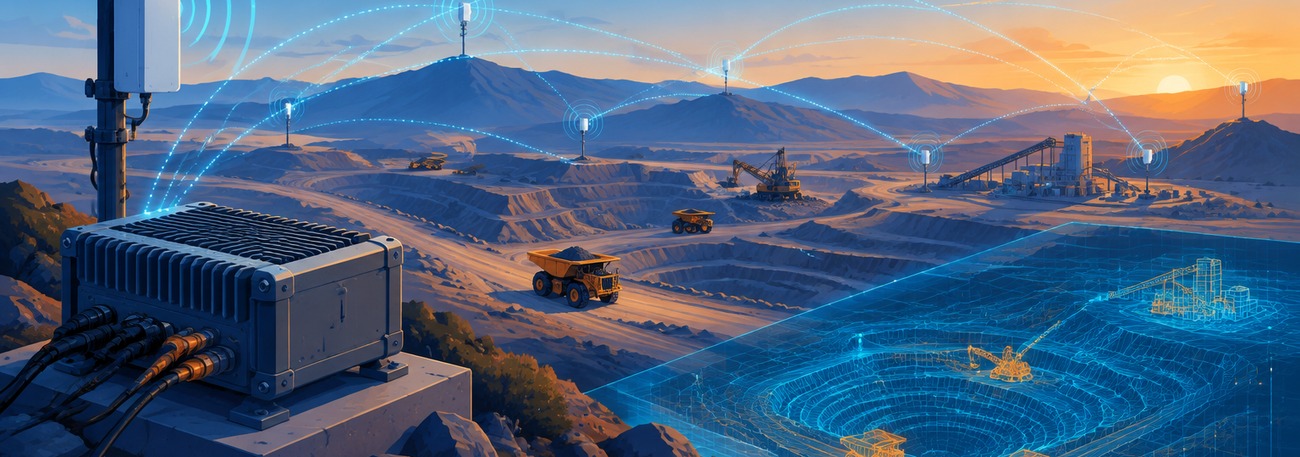
- The ruggedized Nokia Cognitive Edge Node (CEN) uses embedded, GPU-accelerated computing to process complex 3D digital twins and video analytics locally, eliminating cloud latency and reliance on backhaul connections.
- By integrating dynamic hybrid wireless fabrics—such as Rajant InstaMesh—the architecture prevents single points of access failure to maintain network survivability in extreme environments.
- The platform scales across mission-critical domains through customized deployment models, including Vehicle as a Node mesh networks for emergency fleets and self-organizing nodes for tactical defense.
- By marrying carrier-grade private wireless with localized edge compute, Nokia outperforms cloud hyperscalers and traditional telecom rivals through out-of-the-box operational autonomy and zero-downtime execution.
The News
Nokia launched Cognitive Operations (CO), a new platform built to unify mission-critical communications, accelerated edge computing, and operational AI for industries where failure in field operations is not an option. For more information, read the Nokia press release.
Analyst Take
Nokia has introduced Cognitive Operations (CO), an integrated technology platform targeting high-consequence industrial sectors, such as mining, public safety, and defense, where operational continuity is essential. By consolidating mission-critical communications, accelerated edge computing, and operational AI, the solution addresses the fundamental challenge of maintaining site visibility and system availability in harsh, remote environments. The architecture underpins this capability through a dynamic hybrid wireless network fabric designed to eliminate single points of access failure, thereby mitigating downtime risks and enhancing overall operational resilience.
At the core of the platform's capability layer is a combination of real-time situational awareness tools and autonomous monitoring systems. Through a live 3D digital twin framework, integrated video analytics, predictive maintenance modeling, and agentic AI assistance, field units gain continuous visibility into asset states and operational hazards. We see this as enabling organizations to transition from reactive troubleshooting to proactive safety management and streamlined field logistics, ensuring uninterrupted decision-making during critical incidents.
Hardware-level processing and platform adaptability are driven by the Nokia Cognitive Edge Node (CEN), a ruggedized compute and networking appliance deployed directly in vehicle fleets and remote sites. Featuring embedded, GPU-accelerated computing, the CEN processes complex AI workloads locally at the edge rather than relying on cloud infrastructure. Moreover, the system leverages a collaborative partner ecosystem to diversify connectivity; for instance, integrating Rajant’s InstaMesh technology into the CEN enables resilient multi-access networking capable of supporting Kinetic Mesh wireless topologies under demanding operational conditions.
HyperFRAME Lens State of the Enterprise I&O 1H 2026 research data highlights that only 21% of organizations have fully implemented AIOps for core IT functions due to high operational complexity and tool fragmentation, Nokia's CO platform directly addresses this implementation gap by packaging enterprise-grade AIOps into a pre-integrated, edge-native solution. Industrial and mission-critical enterprises often lag in AIOps adoption because traditional central-cloud AI systems cannot survive harsh, high-consequence environments without low-latency local execution and unified site visibility.
We find that Nokia bridges this maturity hurdle by deploying autonomous monitoring, predictive maintenance models, agentic AI assistance, and 3D digital twins directly onto the ruggedized Nokia CEN hardware. By embedding real-time AIOps directly into edge assets, such as vehicle fleets or remote mining equipment, Nokia enables field operations to instantly bypass internal implementation friction and transition straight from reactive troubleshooting to proactive, automated safety and logistics management.
Nokia Cognitive Operations: Sector-Specific Deployment Models and Edge Architectures for Industrial, Emergency, and Defense Environments
Nokia’s CO platform scales across targeted industrial verticals by deploying domain-specific applications tailored to high-stakes operational environments. In the sector of heavy industry, Cognitive Operations for Mining serves as the platform’s flagship solution, integrating the core artificial intelligence capabilities with resilient local connectivity powered by the CEN. To streamline adoption and infrastructure integration, Nokia offers dual deployment options: localized on-premises instances or rapid, cloud-based provisioning via the Microsoft Azure Marketplace, allowing mine operators to achieve functional deployment within days.
For public safety and tactical defense, the platform pivots to a decentralized mobility model centered on autonomous, self-organizing nodes. Cognitive Operations for Emergency Services introduces the Vehicle as a Node (VaaN) paradigm, transforming emergency response fleets, including police, fire, and medical units, into interconnected field intelligence hubs. At incident scenes, these vehicles automatically construct a localized mesh network to generate a unified 3D situational overview, execute edge-level video analytics, and sustain multi-channel communications across 5G, Wi-Fi, and satellite backhauls.
Similarly, Cognitive Operations for Defense adapts this architecture to electronic warfare and tactical military environments. By embedding secure, self-organizing nodes into battlefield vehicles and forward units, the platform maintains network survivability and operational command across contested domains. Frontline forces gain real-time tactical intelligence through on-device AI sensor fusion, local video analytics, and automated threat detection, ensuring resilient, continuous data exchange across tactical radios, 5G, and satellite links even when primary communication channels are disrupted.
Bridging the Execution Gap: The Architectural Advantages of Nokia’s Cognitive Edge Platform
We identify Nokia’s CO and CEN as facing competition from traditional telecom infrastructure rivals (Ericsson, Huawei), cloud-to-edge hyperscalers (AWS Outposts, Azure Stack), and industrial automation specialists (Siemens, Cisco). While hyperscalers struggle with continuous functionality during complete backhaul disconnects and standard network vendors often lack pre-integrated industrial AI models, Nokia bridges this gap by marrying carrier-grade private wireless with local, GPU-accelerated edge compute. The CEN hardware processes complex AI workloads, such as live 3D digital twins and real-time video analytics, directly at the vehicle or site level, insulating high-consequence operations from public cloud latency and network outages.
From our viewpoint, Nokia’s integration of dynamic multi-access mesh networking, such as Rajant InstaMesh, establishes a resilient, self-healing communications fabric that survives harsh and contested environments. Unlike AIOps platforms requiring extensive internal development, Nokia provides out-of-the-box, domain-specific applications tailored explicitly for mining, public safety, and tactical defense fleets. Consequently, Nokia CO/CEN delivers a distinct competitive advantage by delivering end-to-end operational autonomy, zero-trust network survivability, and rapid site deployment where failure is not an option.
Looking Ahead
We believe that the Nokia CO/CEN proposition is poised for success because it uniquely converges carrier-grade wireless connectivity, GPU-accelerated edge compute, and pre-packaged industrial AI into a single field-deployable solution. This eliminates the severe latency, connectivity loss, and operational fragmentation that routinely stall enterprise AI initiatives in harsh, high-consequence environments like mining, defense, and emergency services.
For prospective customers, considering this platform is essential to bridging the gap between cloud-based AI strategy and local, zero-downtime execution, enabling continuous, autonomous safety and decision-making directly at the operational edge even when central networks fail. Furthermore, ecosystem partners benefit from a highly scalable, flexible platform, supported by flexible options like on-premises or Microsoft Azure Marketplace deployments, that accelerates time-to-market for specialized edge applications without requiring complex, ground-up infrastructure integration.

Ron Westfall | VP and Practice Leader for Infrastructure and Networking
Ron Westfall is a prominent analyst figure in technology and business transformation. Recognized as a Top 20 Analyst by AR Insights and a Tech Target contributor, his insights are featured in major media such as CNBC, Schwab Network, and NMG Media.
His expertise covers transformative fields such as Hybrid Cloud, AI Networking, Security Infrastructure, Edge Cloud Computing, Wireline/Wireless Connectivity, and 5G-IoT. Ron bridges the gap between C-suite strategic goals and the practical needs of end users and partners, driving technology ROI for leading organizations.