









Research Finder
Find by Keyword
Amazon CloudWatch Omni: A New Observability Solution Designed To Track, Trace, and Debug Generative AI and Agents
AWS launches CloudWatch Omni, bringing off-console, AI-powered observability and evaluation to generative AI workloads and standard applications.
9/23/2026
Key Highlights
- AWS has introduced CloudWatch Omni to unify application and agentic AI observability in a single platform.
- The platform is architected to operate entirely outside the traditional AWS Management Console.
- Developers and operations teams can now share a single tracing and evaluation workflow using OpenTelemetry.
- Omni aims to deliver 17 built-in evaluators to score non-deterministic AI agent behavior reliably.
- The pricing model focuses on ingestion and storage with querying allowances to control operational costs.
The News
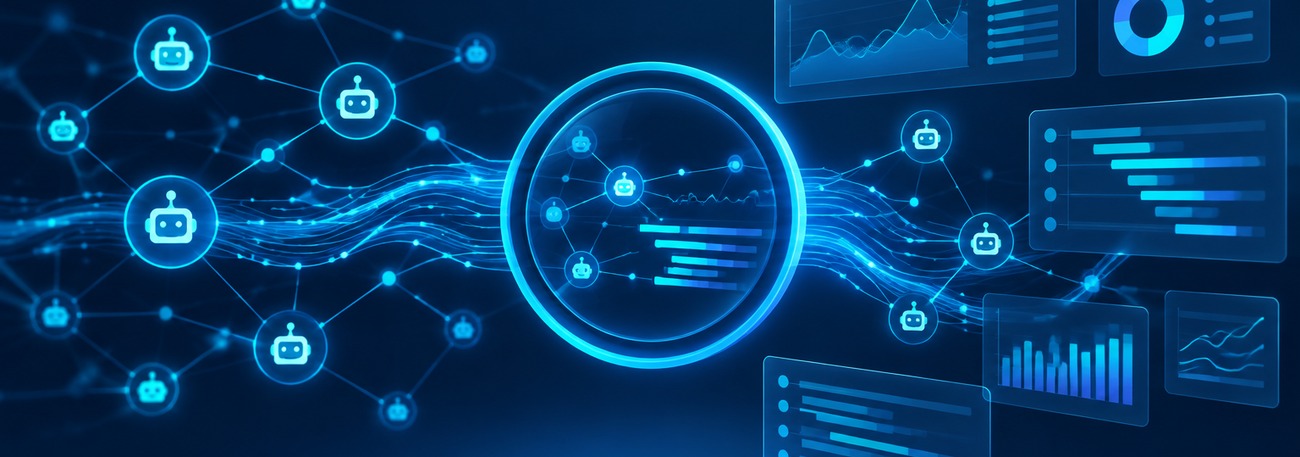
AWS announced the general availability of Amazon CloudWatch Omni, a unified observability solution for applications and AI agents. This new offering is designed to provide trace visibility, automated evaluations, and AI-guided investigations using open standards like OpenTelemetry. The platform exists outside the standard AWS console, offering both a standalone web experience and IDE extensions. You can find out more by reading the press release.
Analyst Take
Organizations are moving generative AI from isolated experiments into production environments. When they do, they hit an immediate operational wall. Standard observability tools monitor infrastructure health, network latency, and application uptime. These systems struggle to capture the reality of non-deterministic AI agents. An agent can return a perfectly valid HTTP 200 status code while delivering a completely hallucinated or harmful response to a customer.
Traditional dashboards measure whether the system is running; they do not measure if the system is reasoning correctly. AWS has recognized this operational gap. With the release of Amazon CloudWatch Omni, the cloud provider aims to deliver a unified observability experience that bridges the divide between standard application performance monitoring and agentic AI evaluation. We see this as a highly pragmatic move. Development teams currently spend hours manually reviewing raw logs to understand why a specific prompt chain failed or why an agent selected the wrong external tool. CloudWatch Omni is designed to eliminate this guesswork by providing structured trace visibility and automated quality evaluations directly within the existing engineering workflow. This eliminates tedious manual work.
What was Announced
Amazon CloudWatch Omni is a purpose-built observability and experimentation experience for AI agents and traditional applications. AWS positions it as the next evolution of CloudWatch, not a replacement for CloudWatch. The telemetry model is unchanged: applications and agents send data into CloudWatch, including existing CloudWatch logs and traces and new OpenTelemetry (OTel) traffic through an OTLP endpoint. Omni then presents that data through two main surfaces. First, developers receive a native extension for IDEs like VS Code, Kiro, and Cursor. Second, operations teams get a standalone web interface accessible via single sign-on, without needing the AWS Management Console for day-to-day work. Both environments share the exact same telemetry data. Enabling Omni, creating the domain and space, and assigning initial administrators still occurs in the CloudWatch console. The system relies heavily on OTel standards.
This means engineering teams can route data to Omni without a proprietary collection agent, integrating natively with frameworks like LangChain, LangGraph, CrewAI, and the Vercel AI SDK. CloudWatch Omni captures comprehensive traces of agent behavior. It records every large language model call, tool invocation, and reasoning step in a structured timeline.
To evaluate these traces, the platform includes 17 built-in evaluators. These tools automatically score AI responses across dimensions like coherence, helpfulness, faithfulness, and routing correctness. Developers can run these evaluations directly against production traffic or utilize curated test datasets. The platform also features a Trace Explorer with a comparison mode to analyze different prompt configurations side by side. A Session Explorer allows teams to review full, multi-turn conversation histories. Multi-agent architectures introduce massive complexity. When one agent delegates a task to another, tracking the context window and token usage across that boundary is notoriously difficult. Omni provides an Agent Topology view to address this directly. Engineers can click into any node on the graph to inspect latency bottlenecks or pinpoint exactly where a reasoning failure occurred in the chain.
The release also includes Prompt Management capabilities for versioning system prompts over time. The entire experience integrates with the AWS DevOps Agent, enabling developers to query traces in natural language. The decision to deliver Omni outside the traditional AWS console is highly significant. For years, the AWS console has been viewed as a strictly utilitarian interface. By providing a dedicated web experience and native IDE extensions, AWS is targeting the developer experience standards set by specialized observability players. This does not split Omni off from CloudWatch. It changes how teams interact with CloudWatch data. Meeting developers in their local environment accelerates the debugging loop considerably. Integrating evaluation natively into the tracing workflow solves a massive headache for AI engineering teams. Building custom evaluation pipelines is expensive and computationally intensive. By providing out-of-the-box evaluators, Omni allows teams to establish baseline quality scores almost immediately. When an agent degrades, engineers can pinpoint exactly which sub-call caused the failure. We find the ability to curate golden datasets directly from production traces particularly valuable. It allows teams to build robust regression tests based on actual user interactions rather than synthetic data.
The pricing structure is intentionally straightforward. Customers pay for the telemetry they ingest and store, while dashboards and alerts remain free. The platform includes a querying allowance up to five times the monthly ingestion volume. This approach provides a predictable cost model and removes the penalty for exploring data during an active incident investigation. Adopting Omni will require discipline. Development teams must commit to the OTel standard and instrument their code properly, even though existing CloudWatch telemetry can appear in Omni without reconfiguration. While AI code assistants can help automate this setup, the initial configuration still demands focused engineering effort. Organizations will also need to train their operations teams to interpret agent quality metrics alongside traditional performance data.
CloudWatch Omni represents a mature operational approach to scaling generative AI. It recognizes that building an agent is only the first step. Operating that agent reliably at scale requires a completely different toolset. By unifying infrastructure monitoring and AI evaluation into a single CloudWatch-backed experience delivered through an off-console UI and IDE extensions, AWS has provided a highly credible solution for the next phase of enterprise AI adoption.
Open Source and Competitive Landscape
The introduction of Amazon CloudWatch Omni represents a significant shift in the observability landscape, positioning AWS as a formidable direct competitor in the rapidly growing generative AI and agentic workload monitoring space. For established observability leaders like Splunk, Datadog, and Dynatrace, Omni introduces intense pressure by directly targeting the complex, non-deterministic nature of AI agents that these vendors are also aggressively rushing to support. By delivering observability directly where developers work, through native IDE extensions and a standalone web UI completely separate from the traditional AWS console, AWS is creating a frictionless experience that can bypass third-party dashboards. While these vendors will undoubtedly maintain their strategic multi-cloud and enterprise monitoring partnerships with AWS, the dynamic will increasingly skew toward "coopetition" as AWS attempts to capture high-value AI telemetry at the source.
Customers building on Amazon Bedrock or using frameworks like LangChain may find Omni's built-in evaluators, trace comparisons, and prompt playgrounds so compelling that it reduces their immediate reliance on the likes of Datadog or Dynatrace for AI-specific use cases. A critical driver of this shift is Omni's foundational reliance on open standards, specifically OpenTelemetry (OTel) and OpenInference, to capture complex execution traces and sub-calls. By heavily leaning on the AWS Distro for OpenTelemetry (ADOT), AWS is helping cement OTel as the undisputed industry standard for AI observability, effectively eroding the competitive moat of proprietary third-party collection agents. Paradoxically, this OTel standardization also ensures customers aren't entirely locked into CloudWatch Omni, as they can still route this standardized telemetry to Splunk or Datadog if they mandate a single pane of glass across a multi-cloud enterprise.
Furthermore, the sheer volume of complex, highly dimensional trace data, prompt iterations, and evaluations generated by agentic workflows has massive implications for search and log analytics backends. This flood of granular telemetry creates a natural synergy with Amazon OpenSearch Service, positioning it as an ideal, scalable engine for organizations wanting to perform deep, custom analytics or vector-based queries on their Omni trace data. Splunk and Datadog may consequently face an uphill battle convincing customers to pay premium ingest and retention fees for massive AI trace datasets when AWS offers a tightly integrated pipeline feeding directly into its own cost-effective storage and search layers. Ultimately, CloudWatch Omni signals that AWS is no longer just providing the underlying infrastructure for AI, but is actively aiming to own the end-to-end developer and operator observability experience for the next generation of agentic applications.
Looking Ahead
Based on what we are observing, the transition from deterministic software to probabilistic AI systems is forcing a complete redesign of enterprise operational practices. The key trend that we are going to be looking out for is how quickly organizations adopt continuous evaluation as a standard operational requirement. HyperFRAME Research Lens: State of I&O Strategy in the AI Era (2H 2026) found that strategic interest in AI for IT operations is high, but maturity remains low: only 21% of organizations have fully implemented AIOps for core IT functions. That finding sits alongside earlier HyperFRAME Research Lens data showing 78% of infrastructure and operations leaders consider AI strategically important, yet only 23% report production deployments delivering measurable ROI.
CloudWatch Omni operationalizes the missing piece of that gap: continuous evaluation and shared operational context. Our perspective is that the traditional boundary between software development and IT operations is blurring even further. Developers need production traces to tune their prompts, while operators need prompt context to resolve production incidents. CloudWatch Omni facilitates this shared context beautifully. By putting the same CloudWatch telemetry in the IDE and the web dashboard, it prevents the silos that typically plague incident response.
When you look at the market as a whole, the announcement places AWS in direct competition with specialized AI observability startups and established monitoring giants. Players like Datadog and New Relic will need to accelerate their own agentic evaluation capabilities to keep pace. Going forward, we are going to be closely monitoring how the company performs on user adoption, particularly among teams that historically avoided the AWS console. The success of this off-console strategy will dictate whether AWS can reclaim developer mindshare from third-party tools.
We expect to see further consolidation in the AI tooling market over the next 12 months. Organizations do not want separate tools for infrastructure logs, application traces, and LLM evaluations. They demand unified visibility. HyperFRAME will be tracking how the company does with expanding its evaluator library and third-party integrations in future quarters. The ability to monitor complex, multi-agent architectures reliably will become the defining characteristic of successful enterprise AI deployments.

Steven Dickens | CEO HyperFRAME Research
Regarded as a luminary at the intersection of technology and business transformation, Steven Dickens is the CEO and Principal Analyst at HyperFRAME Research.
Ranked consistently among the Top 10 Analysts by AR Insights and a contributor to Forbes, Steven's expert perspectives are sought after by tier one media outlets such as The Wall Street Journal and CNBC, and he is a regular on TV networks including the Schwab Network and Bloomberg.