










Research Finder
Find by Keyword
Can Dell Turn Its AI Data Platform Into the Context Layer for Enterprise Agents?
The Dell AI Data Platform (AIDP) is extending storage metadata and data orchestration with governed enterprise context, giving the Data Orchestration Engine a larger role between enterprise data, models, and agents.
10/07/2026
Key Highlights
- Dell is adding a Unified Semantic Layer, Enterprise Knowledge Graph, and Knowledge Agents to the AIDP, with availability planned for 1H 2027.
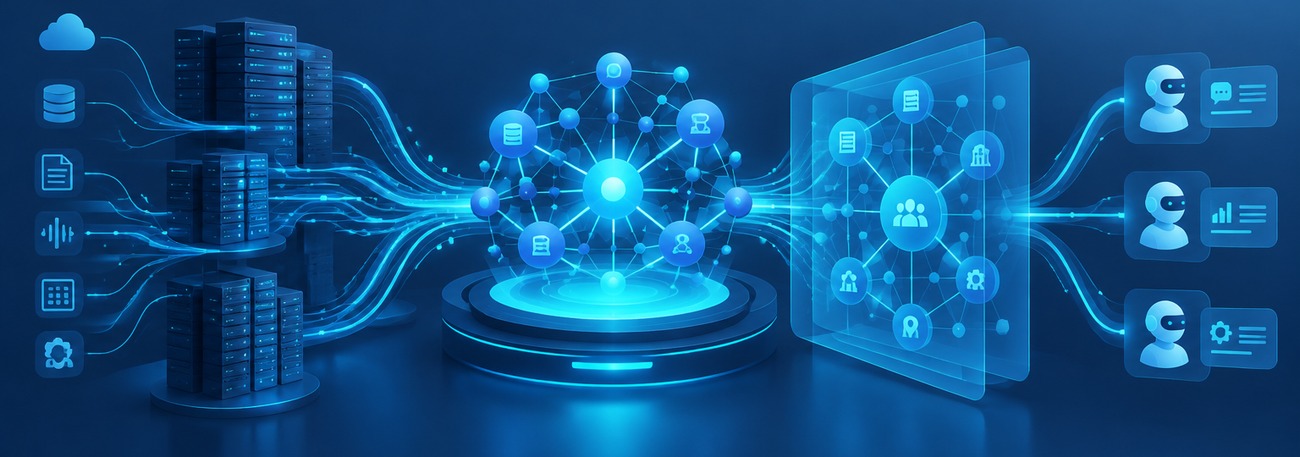
- The new context capabilities reside in the Data Orchestration Engine, where semantic definitions, graph relationships, permissions, agent identity, and scope govern what context agents can consume.
- AI models discover entities and relationships and propose incremental revisions as source data changes. Human approval determines what becomes authoritative context.
- Dell is also adding NVIDIA-accelerated data preparation, an open-source Storage Performance Tool, PowerScale security and multitenancy enhancements, and expanded professional services.
The News
Dell is expanding AIDP with new capabilities for enterprise context, accelerated data preparation, storage benchmarking, security, and services. The main additions are a Unified Semantic Layer, Enterprise Knowledge Graph, and Knowledge Agents inside the Data Orchestration Engine. Dell is also adding NVIDIA-accelerated data processing and search, an open-source Storage Performance Tool, and PowerScale security and multitenancy enhancements. Expanded AIDP professional services complete the release. For more information, read the official Dell press release.
Analyst Take
Dell’s latest AIDP release extends a strategy we have previously published on: connecting storage metadata, orchestration, and governed context inside a common AI data architecture. MetadataIQ and the Data Orchestration Engine established the metadata and coordination layers. The new semantic layer and knowledge graph add business meaning, relationships, permissions, and context that agents can consume under defined identity and scope. Together, those layers give Dell a clearer path from the data itself to the context an agent receives at inference time.
Enterprise AI requires retrieval, consistent business meaning, relationship awareness, source authority, and access controls. HyperFRAME Research Lens: State of the Enterprise AI Stack (Q3 2026) data illustrates this execution gap. Seventy-six percent of respondents say AI is strategically core to their business, while only 34% report a structured evaluation and deployment process, down from 37% in the prior wave. The share of projects that reached production and met their original objectives or return on investment moved from 23% to 27%. Enterprises continue to push more AI projects into production while formal deployment processes remain uneven, increasing the importance of architecture that can preserve context and governance beyond an individual implementation.
Model fluidity makes that requirement more acute. Sixty-six percent of Q3 2026 Lens respondents anticipate having multiple foundation models deployed concurrently, while 67% expect to add or replace foundation models every year. Enterprises gain more from semantic definitions, graph relationships, permissions, approved business definitions, and governance history when those assets remain stable as models change. Dell centralizes that context in the Data Orchestration Engine so multiple models and agents can consume a common set of approved meanings and relationships. Dell says the Unified Semantic Layer, Enterprise Knowledge Graph, and Knowledge Agents remain inside the platform in the customer’s data center, giving customers local control over the business context and sensitive information those components maintain. Dell supports model choice above the data layer, while cuDF, cuVS, Nemotron Retriever, and Auto-Ontology deepen NVIDIA's role in preparation, search, and context construction.
In our view, Dell can also draw advantage from its proximity to the storage layer. Storage systems generate metadata, access controls, and change events at the point where enterprise data originates. AIDP can use those signals to trigger context updates and constrain what agents see, giving Dell a direct architectural link between source data and permission-aware context. Catalog-first platforms often begin farther from the systems that originate the data and entitlements. Dell still has to prove that this advantage extends across non-Dell storage, external identity platforms, and heterogeneous data estates where neither metadata nor access policy begins inside Dell infrastructure.
What Was Announced
Dell’s main architectural addition is the new enterprise context capability. The Unified Semantic Layer defines business meaning, the Enterprise Knowledge Graph connects entities and relationships, and Knowledge Agents consume that governed context with the customer’s model of choice. The semantic layer can import existing ontologies and classification taxonomies, while NVIDIA Auto-Ontology can help build knowledge graphs from enterprise data. Dell says the graph uses metadata, lineage, and query history to refine relationships as activity evolves.
Storage and data-set events trigger incremental reevaluation when source data changes or new data appears. Models propose updates to the semantic layer and knowledge graph, while a user or administrator approves revisions before they become authoritative. Permissions also reside in the orchestration engine, and agents must present an identity and defined scope before Dell surfaces semantic results, entities, or relationships.
Dell maintains the semantic layer, knowledge graph, and Knowledge Agents inside the Data Orchestration Engine in the customer’s data center. External AI models hosted in the Dell AI Factory or elsewhere can create an initial semantic and graph state. Customers can define each Knowledge Agent’s guidance, accessible data, quality threshold, and spending limit, while NVIDIA Nemotron Retriever models provide reasoning and visual understanding. Dell plans to release these capabilities in 1H 2027.
Dell is also accelerating data preparation with NVIDIA cuDF and cuVS, Apache Arrow, and Spark. Dell says internal testing produced nearly 4x faster processing on average than CPU-only execution and up to 20x faster batch processing. The NVIDIA acceleration stack will be available in December 2026, with further Apache Arrow acceleration expected in 1H 2027.
The Dell Storage Performance Tool provides an open-source option for testing S3-compatible object storage across AI training, inference, and checkpointing workloads. Released under the MIT license, it measures throughput and latency, verifies persistent data, and records versions and provenance for repeatable testing. The tool is available now.
Dell is also expanding PowerScale security and multitenancy with support for up to 500 tenants per cluster, mTLS over NFS, and more granular role-based access control. These enhancements will be available in November 2026. Dell is also expanding professional services around data strategy, implementation, optimization, and managed operations, while channel partners can add services around data readiness, governance, legal requirements, integration, and lifecycle management. AI-ready data services are available now.
Looking Ahead
Enterprise context introduces a scaling constraint around semantic accuracy, permissions, and human review. Generative AI can reduce the manual work required to discover entities, relationships, and changes, while enterprises still need people with enough domain knowledge and authority to decide which proposed updates become trusted context. As agent counts, data sources, and semantic updates grow, that review workload can expand quickly. Substandard review reduces human approval to a procedural checkpoint; rigorous review can slow how quickly the context layer evolves.
The approval history may become an enterprise governance asset in its own right. Models can propose relationships and semantic changes, but enterprises retain the record of which definitions they accepted, who approved them, when they changed, and which policies governed those decisions. That history can provide continuity as organizations replace models, modify agents, and add new data sources, and it can support auditability when an agent relies on an approved definition or relationship.
We anticipate Dell will articulate how the Data Orchestration Engine synchronizes permissions with source systems and external identity platforms as entitlements change. Dell says the platform does not lock customers into a single model, data, or storage provider; the company should also clarify whether semantic definitions, graph state, approval history, and policy metadata remain portable outside the orchestration engine itself. Those answers will help determine whether AIDP preserves enterprise context as an independent governance asset or binds it tightly to Dell’s control layer.
The enterprise benefit is continuity. If Dell can keep approved business meaning, entitlements, graph relationships, and governance history current and portable across changing models, agents, and infrastructure, customers can scale AI without rebuilding context for every deployment. AIDP can then preserve institutional knowledge while reducing integration work and governance drift.

Don Gentile | Analyst-in-Residence, Data Platforms & Resiliency
Don Gentile analyzes the technologies, market dynamics, and enterprise priorities driving the AI-era data stack: the infrastructure that enables AI and the architectures that keep organizations running. His research helps technology vendors refine product strategy, strengthen market positioning, and communicate business value to enterprise customers.
Before joining HyperFRAME Research, Don held executive leadership roles at IBM and Hewlett Packard Enterprise, where he led product marketing, communications, external relations, and go-to-market strategy for enterprise infrastructure businesses. That experience informs his research, combining executive leadership with industry analysis to evaluate how technology decisions affect enterprise adoption, competitive differentiation, and long-term market direction.
Don's research practice focuses on AI infrastructure, enterprise data platforms, data architecture, control planes, enterprise storage, hybrid cloud, cyber resiliency, data protection, backup and recovery, and data governance. His work examines how these technologies enable production AI while improving governance and business outcomes.