














Research Finder
Find by Keyword
Dell Accelerates Enterprise AI via Brownfield Data Center Modernization
Dell helps enterprises bypass greenfield delays by auditing brownfield data centers, consolidating legacy workloads, and implementing hybrid liquid cooling and engineering services to transform existing facilities into high-density, AI-ready infrastructure.
10/20/2026
Key Highlights
- Dell emphasizes that economics, tokenomics, and data sovereignty are driving high-density AI workloads back on-premises, prompting enterprises to audit and consolidate legacy footprints into ready capacity for high-power infrastructure.
- To overcome severe thermal bottlenecks without overhauling facility plumbing, organizations are adopting workload-driven hybrid cooling models that combine air cooling for general compute, rear-door heat exchangers for mid-tier GPUs, and direct liquid cooling for racks scaling beyond 50kW.
- While internal server consolidation and localized cooling retrofits unlock immediate rack-level capacity, long-term viability depends on site-wide energy management—including microgrids, battery storage (BESS), and localized power generation—to insulate AI clusters from grid-interconnect delays.
- Dell's brownfield modernization blueprint transforms MEP engineering into a core competitive differentiator, allowing enterprises to avoid the high capital expenditures and multi-year delays of building greenfield data centers.
- By packaging hardware, targeted liquid cooling retrofits, and comprehensive MEP engineering services under the Dell AI Factory framework, Dell enables organizations to convert existing legacy facilities into permanent, high-margin AI execution hubs.
The News
Dell enables enterprises to modernize brownfield data centers for AI workloads through a phased approach that audits facility constraints, consolidates legacy infrastructure to free up power, and implements tailored cooling strategies ranging from air to direct liquid cooling. By matching cooling methods to specific rack densities, from rear-door heat exchangers for moderate GPUs to direct liquid cooling for high-density AI racks, organizations can rapidly adapt existing facilities to avoid the high costs and delays of new construction. For more information, read the Dell blog by Matt Leibowitz.
Analyst Take
Dell emphasizes that the enterprise AI market is following an accelerated adoption curve similar to early cloud computing, where tokenomics and data sovereignty drive heavy AI workloads back on-premises into brownfield facilities. Retrofitting these existing data centers offers a faster, less capital-intensive path that avoids regulatory hurdles, though legacy infrastructures struggle with AI servers drawing ten times the power of traditional hardware. To unlock necessary capacity, Dell assists organizations in auditing existing environments and applying server consolidation strategies to free up power, cooling, and rack space.
This freed-up capacity directly targets the primary operational bottleneck: transitioning air-cooled environments to advanced liquid cooling technologies capable of handling rack densities scaling beyond 120kW. To bypass complex facility replumbing, enterprises use retrofittable solutions such as rack-level coolant distribution units and rear-door heat exchangers to remove intense heat. A tailored hybrid cooling model balances these requirements by retaining air cooling for general compute, using rear-door exchangers for mid-tier GPU racks, and reserving direct liquid cooling for high-density AI infrastructure.
We find that Dell's strategic push to modernize brownfield data centers addresses a critical market reality where traditional enterprise IT facilities face imminent obsolescence due to unyielding high-density power demands. While server consolidation and hybrid liquid cooling bypass initial facility replumbing bottlenecks, the long-term viable operation of these retrofitted environments fundamentally hinges on total utility power availability and grid-tie capacity. Consequently, enterprises are increasingly compelled to integrate microgrids, battery energy storage systems (BESS), and localized power generation alongside liquid-cooling upgrades to insulate their high-density AI clusters from regional grid supply constraints.
This shift transforms mechanical, electrical, and plumbing (MEP) retrofits from simple heat-dissipation projects into holistic, site-wide energy management architectures. By pairing advanced thermal management with localized power resiliency, organizations can maximize compute density within their existing physical footprints while insulating themselves from skyrocketing utility costs and extended grid-interconnect delays. This comprehensive modernization framework positions brownfield facilities not merely as a temporary bridge to the cloud, but as permanent, high-margin hubs for enterprise AI execution.
Workload-Driven Hybrid Cooling: Modernizing Enterprise Data Centers for AI
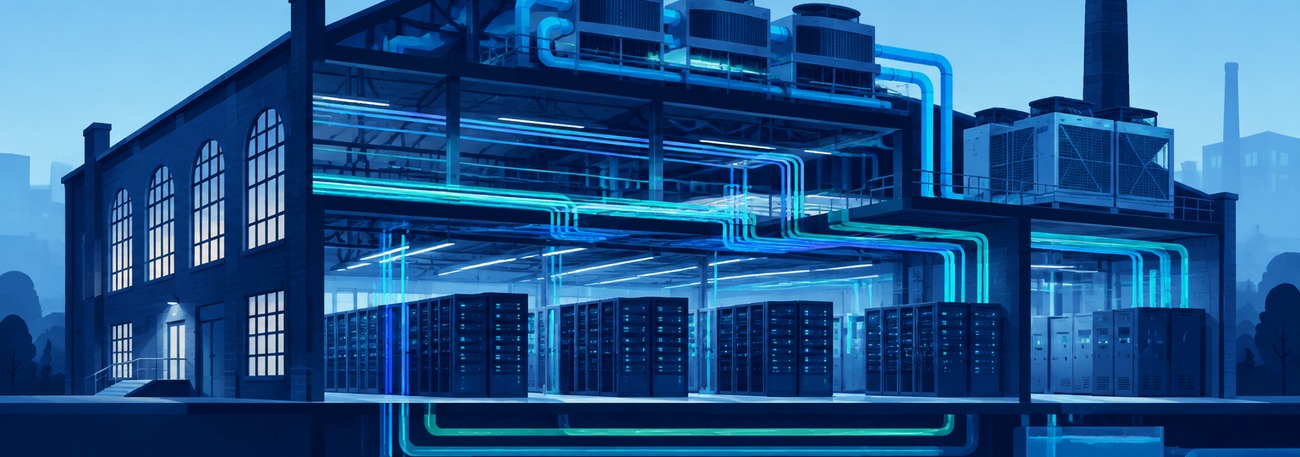
The transition toward high-density AI infrastructure requires enterprise data centers to abandon single-tier cooling models in favor of workload-driven, hybrid cooling architectures. Much like the architectural segmentation of multi-cloud environments, modern brownfield facilities must align thermal management strategies directly to rack power density. Standard enterprise compute workloads can remain on traditional air cooling (10-15kW per rack), while moderate GPU deployments (10-50kW per rack) benefit from transitional solutions such as rear-door heat exchangers. For next-generation AI clusters exceeding 50kW per rack, direct liquid cooling becomes essential to mitigate high thermal loads without requiring a total overhaul of facility plumbing.
When existing workload consolidation and localized rack-level cooling upgrades prove insufficient for ambitious AI deployments, organizations must evaluate retrofits, facility expansions, or new builds. Dell addresses this gap by offering comprehensive engineering services that deliver full MEP designs tailored for modern high-density environments. By conducting initial facility audits, rightsizing legacy server footprints, and deploying targeted cooling strategies, enterprises can rapidly modernize existing brownfield assets, avoiding the capital expenditure, regulatory hurdles, and community pushback associated with constructing new data centers from the ground up.
Dell’s Brownfield Blueprint: Accelerating Enterprise AI Through Data Center Modernization
From our perspective, Dell needed to spotlight its brownfield data center modernization strategy to capture a lucrative market of enterprises paralyzed by severe grid-interconnect delays, multi-year greenfield construction timelines, and soaring capital requirements associated with new facility builds. By offering a clear operational path to audit, consolidate, and retrofit existing footprints with high-density liquid cooling, Dell positioned itself to monetarily unlock immediate AI readiness for customers without forcing them to wait for new data center capacity. This strategic focus addresses the immediate enterprise pain point where public cloud tokenomics and strict data governance compel companies to execute intensive AI workloads on-premises.
Across the broader data center market, Dell's proposition accelerates the industry-wide shift from single-tier air cooling toward hybrid, workload-driven thermal management architectures. Furthermore, it elevates MEP engineering integration from a backend construction task into a primary differentiator for IT vendors competing in high-density infrastructure sales. Dell’s blueprint resets market expectations by demonstrating that existing legacy assets, rather than purely newly constructed mega-campuses, can serve as permanent, high-margin foundations for next-generation enterprise AI.
Looking Ahead
We believe that Dell's brownfield data center initiative can achieve success by directly solving the enterprise AI deployment bottleneck: bypassing multi-year greenfield construction timelines, extended utility grid-interconnect queues, and massive upfront capital expenditures. By packaging hardware, liquid cooling retrofits, and MEP engineering into a single-source solution under the Dell AI Factory framework, Dell drastically lowers execution risk for organizations seeking immediate on-premises AI readiness.
Moreover, to maximize its long-term market impact, Dell should evolve this initiative beyond internal rack retrofits to address external utility constraints through integrated microgrids, localized battery storage, and dynamic power management architectures. Furthermore, expanding standardized, modular cooling and power blocks can enable Dell to scale these brownfield upgrades reliably across highly constrained enterprise data centers without sacrificing operational continuity.

Ron Westfall | VP and Practice Leader for Infrastructure and Networking
Ron Westfall is a prominent analyst figure in technology and business transformation. Recognized as a Top 20 Analyst by AR Insights and a Tech Target contributor, his insights are featured in major media such as CNBC, Schwab Network, and NMG Media.
His expertise covers transformative fields such as Hybrid Cloud, AI Networking, Security Infrastructure, Edge Cloud Computing, Wireline/Wireless Connectivity, and 5G-IoT. Ron bridges the gap between C-suite strategic goals and the practical needs of end users and partners, driving technology ROI for leading organizations.