
















Research Finder
Find by Keyword
Equinix EPIC: Tackling High-Density AI Liquid Cooling Challenges
Equinix debuts EPIC testing sites across five global hubs to help enterprises de-risk high-density liquid cooling, GPU integration, and AI deployment.
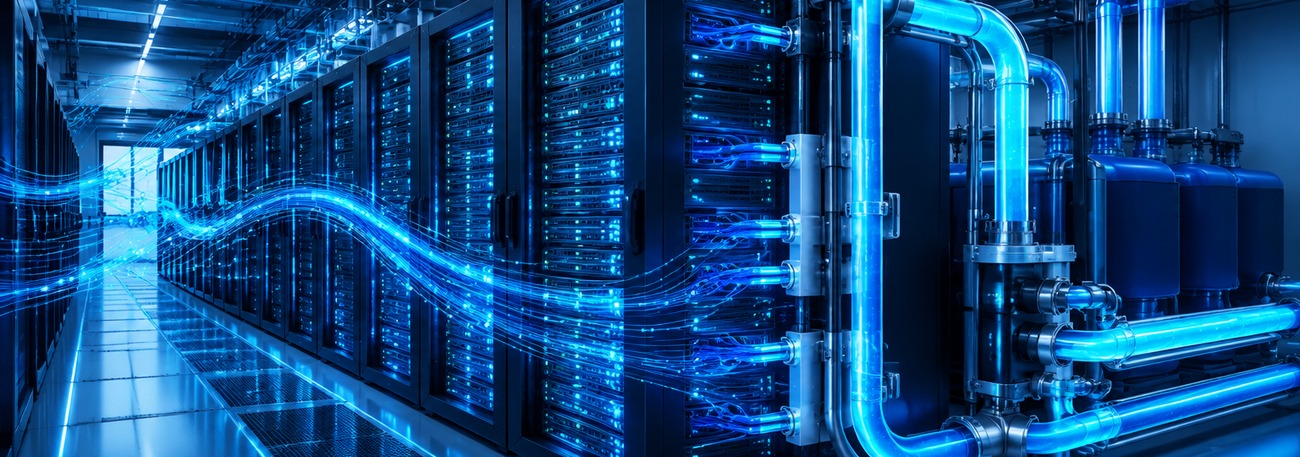
10/23/2026
Key Highlights
- Equinix has launched its Enhanced Performance Innovation Centers (EPIC) across five major global metropolitan markets to validate production-grade liquid-cooled artificial intelligence infrastructure.
- The initiative allows enterprise teams to stress-test high-density direct-to-chip cooling architectures inside operational data centers alongside original equipment manufacturers.
- Surging accelerator thermal requirements exceeding 100 kilowatts per rack are forcing enterprise operators to abandon traditional air cooling in favor of direct liquid circuits.
- Early enterprise participation from firms like Criteo demonstrates that physical, hands-on operational validation is necessary to overcome institutional reluctance toward liquid management.
- Colocation providers must rapidly evolve beyond simple space and power delivery into active thermal engineering partners to prevent enterprise workloads from retreating entirely to public clouds.
The News
Equinix has introduced its Equinix Enhanced Performance Innovation Centers across Frankfurt, London, Osaka, Paris, and Sydney to accelerate enterprise liquid cooling deployments. The global network provides production-ready colocation environments where organizations can benchmark high-density artificial intelligence hardware under genuine facility conditions. By collaborating with leading server manufacturers and on-site infrastructure specialists, enterprises can de-risk their cooling, power, and mechanical integration before committing capital to full-scale rollouts. Find out more by clicking here to read the press release (https://blog.equinix.com/blog/2026/10/21/inside-epic-where-enterprises-test-liquid-cooling-before-they-scale-ai/).
Analyst Take
Running AI workloads without boiling your silicon is rapidly becoming the single thorniest operational headache in the enterprise data center. Everyone is keen to talk about foundational models, token throughput, and parameter scale, yet practically nobody wants to discuss pipe fittings, pump cavitations, or fluid viscosity. The reality is quite simple: air cooling has reached its physical limits. When standard enterprise server racks sat comfortably at 10 to 15 kilowatts, massive air handlers and raised floors did the job nicely. Now, enterprise compute clusters running modern accelerator platforms easily demand 40 to 100 kilowatts per cabinet, with next-generation dense architectures pushing well beyond 120 kilowatts. Blowers and chilled air cannot cope with that heat density. Physics always wins.
Enterprises attempting to deploy these high-density clusters find themselves in a proper bind. Shifting from chilled air to circulating dielectric or treated fluid directly across bare silicon is not merely an equipment upgrade; it represents an entirely unfamiliar operational discipline. Most enterprise infrastructure teams have spent decades keeping liquids as far away from circuit boards as humanly possible. Suddenly, technology executives must ask their systems engineers to manage pressurized coolant loops, manifold balancing, and quick-disconnect fittings inside mission-critical facilities. If a coolant loop leaks or a distribution pump stutters, an entire cluster of scarce accelerator hardware faces thermal throttling or catastrophic shutdown. A recent McKinsey study highlighted that data center power demand could double by 2027, driven by high-density compute, with physical cooling bottlenecks emerging as a primary barrier to execution. That is precisely why enterprise pilots frequently stall right at the facility boundary.
While the launch of Equinix's EPIC initiative establishes crucial physical sandboxes for direct-to-chip liquid cooling, we find that it highlights a deeper shift in enterprise risk management from software integration to fluid-mechanical reliability. By embedding these environments directly within live operational IBX facilities, Equinix is effectively offering a standardized testing loop to help enterprise risk committees audit secondary cooling loops, quick-disconnect tolerances, and fluid maintenance protocols before committing capital. Ultimately, this strategy allows commercial colocation providers to defend their core customer base against public cloud migration by converting terrifying mechanical plumbing hazards into a repeatable, managed infrastructure service.
What was Announced
Equinix introduced its Equinix Enhanced Performance Innovation Centers, branded as EPIC. The initiative establishes a distributed network of production-grade, liquid-cooled testing environments located directly inside operational Equinix International Business Exchange data centers. At launch, EPIC facilities are operational across five primary metropolitan markets: Frankfurt, London, Osaka, Paris, and Sydney, with Equinix stating that additional global deployments are scheduled for 2027.
The technical architecture of EPIC is designed to provide dedicated physical infrastructure where enterprise engineering teams can benchmark, stress-test, and validate liquid-cooled hardware before making substantial capital commitments. Rather than evaluating hardware inside an isolated laboratory bench or a synthetic testbed, EPIC environments are architected to operate within live colocation halls. This configuration exposes customer workloads to genuine facility operating conditions, including real-world thermal loads, fluctuating electrical draw, and live secondary cooling loops.
On a functional level, the program is architected to support high-density direct-to-chip liquid cooling systems, accommodating high-thermal-design-power server chassis from major original equipment manufacturers. This includes testing configurations that incorporate cold plates mounted directly to compute dies, in-rack and in-row coolant distribution units, manifolds, and standardized dry-break quick-disconnect couplings. EPIC environments are engineered to test both training and inference workloads across mixed CPU and accelerator clusters, validating heat rejection efficiency and fluid dynamics under dynamic computing spikes.
Moreover, EPIC aims to deliver a collaborative testing framework alongside server manufacturers and thermal component vendors. Equinix is pairing this physical plant with on-site infrastructure specialists who help enterprise staff evaluate power delivery redundancy, facility-level heat exchange, leak detection mechanisms, and operational maintenance routines. The offering builds on Equinix's historical testing progression, following its 2022 Co-Innovation Facility focused on partner collaboration and its 2024 Solution Validation Centers designed for distributed enterprise architectures.
This structured validation approach addresses genuine enterprise anxiety. When an enterprise signs a purchase order for tens of millions of dollars in liquid-cooled server racks, the deployment cannot be treated like a casual experiment. Infrastructure teams must know how secondary fluid networks behave during peak compute jobs, how quickly coolant temperatures normalize after batch training runs, and whether facility staff can swap a failed server blade without draining an entire row. Criteo, an advertising technology firm running distributed machine learning models across multiple geographic regions, utilized Equinix to validate its liquid cooling operations prior to rolling out at scale. For Criteo, moving fluid through production racks shifted from an alarming unknown into an audited operating model.
We see this move as a pragmatic commercial play by Equinix to protect its enterprise colocation franchise. Hyperscalers have spent years designing custom, bespoke liquid loops for massive centralized server farms. But enterprise IT leaders do not build their own data centers; they rely on commercial colocation providers who can support hybrid cloud architectures and close network proximity to key business partners. If colocation facilities cannot support direct-to-chip cooling reliably, enterprise AI projects will stall or drift entirely into public cloud environments. By giving enterprises a controlled sandbox to test hardware alongside equipment vendors, Equinix removes the primary friction that delays high-density rack deployments. It turns an intimidating engineering hazard into a structured, manageable workflow.
Looking Ahead
We believe that the Equinix announcement signals a broader industrial transition where competitive advantage in digital infrastructure is dictated by thermodynamic competency rather than raw square footage. Wholesale operators such as Digital Realty and CyrusOne have pursued immense multi-megawatt campus reservations to capture hyperscale model training clusters; however, enterprise colocation demands distributed, localized density capable of serving low-latency inference near corporate data repositories. Our perspective is that colocation providers can no longer treat cooling as a passive facility utility. Liquid thermal management must now function as an actively managed, modular service layer integrated directly into customer server topologies.
Based on what we are observing across global enterprise deployments, the primary friction point will shift from thermal validation to standardized supply chain execution. Fluid chemistry, connector tolerances, and secondary loop maintenance vary wildly across original equipment manufacturers. A bespoke plumbing deployment that works swimmingly in Frankfurt might fail to achieve mechanical parity across APAC facilities if component availability falters. Going forward, we will be closely monitoring how the company performs on standardizing these liquid loops across disparate geographies without introducing excessive facility operational overhead.
The key trend that we are going to be looking out for is whether enterprise infrastructure leaders use these validation centers to accelerate internal private cloud deployments, or whether the sheer operational friction of liquid cooling pushes them right back toward hosted public cloud instances. HyperFRAME will be tracking how the company does in translating these EPIC testbeds into billable production deployments in future quarters.

Ron Westfall | VP and Practice Leader for Infrastructure and Networking
Ron Westfall is a prominent analyst figure in technology and business transformation. Recognized as a Top 20 Analyst by AR Insights and a Tech Target contributor, his insights are featured in major media such as CNBC, Schwab Network, and NMG Media.
His expertise covers transformative fields such as Hybrid Cloud, AI Networking, Security Infrastructure, Edge Cloud Computing, Wireline/Wireless Connectivity, and 5G-IoT. Ron bridges the gap between C-suite strategic goals and the practical needs of end users and partners, driving technology ROI for leading organizations.
Share

Steven Dickens | CEO HyperFRAME Research
Regarded as a luminary at the intersection of technology and business transformation, Steven Dickens is the CEO and Principal Analyst at HyperFRAME Research.
Ranked consistently among the Top 10 Analysts by AR Insights and a contributor to Forbes, Steven's expert perspectives are sought after by tier one media outlets such as The Wall Street Journal and CNBC, and he is a regular on TV networks including the Schwab Network and Bloomberg.