








Research Finder
Find by Keyword
Do You Really Need Bare Metal To Isolate AI Agents On Kubernetes?
AWS updates EKS and ECS with Nitro sandboxes, Karpenter static capacity, and Dynamic Resource Allocation for tight GPU clustering and multi-tenant safety.
11/18/2026
Key Highlights
- AWS introduced Nitro sandboxes for Amazon EKS and Amazon ECS to bring hardware-enforced isolation to standard EC2 instances without bare metal overhead.
- Teams enable these sandboxes through a single RuntimeClass setting, keeping applications unchanged and preserving full Kubernetes conformance.
- Confidential mode pairs Nitro attestation, AWS KMS, and Cedar policies to provide cryptographic proof of workload integrity for regulated industries and closed weight models.
- Karpenter now supports static capacity, On Demand Capacity Reservations, and placement groups alongside security groups for pods in EKS Auto Mode.
- Dynamic Resource Allocation in upstream Karpenter and EKS Auto Mode enables precise requests for GPUs and Elastic Fabric Adapters using EC2 topology awareness.
Analyst Take
I spent time with AWS last week at KubeCon, and the conversation centered around the evolution of Kubernetes in an era where AI deployments are accelerating. A key theme was that running untrusted code or multi-tenant AI agents on shared Kubernetes clusters usually forces an uncomfortable trade-off. Operations teams either pay the steep financial and operational tax of dedicated bare metal servers, or they accept the security anxieties of shared Linux kernels. At KubeCon last week, AWS laid out a clear engineering response to that dilemma. The announcements center on bringing hardware-level boundaries directly into standard virtualized environments while tightening how Kubernetes schedules high-performance silicon.
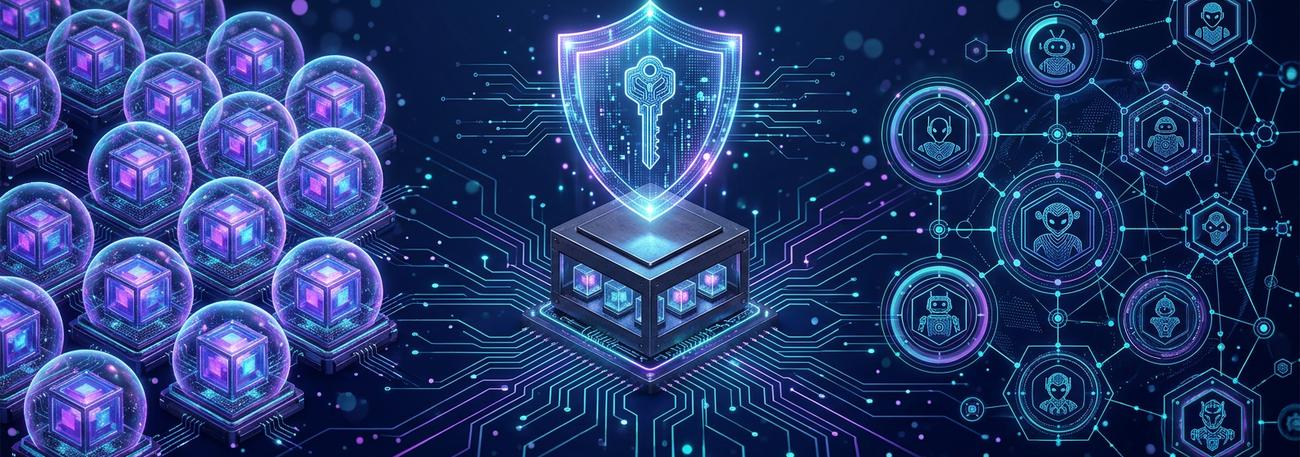
Let us start with Nitro sandboxes for Amazon EKS and Amazon ECS. For years, achieving true isolation meant giving each tenant or sensitive workload its own physical machine, or absorbing the performance penalties of nested virtualization. AWS is taking a different route. Each Kubernetes pod or ECS task runs inside its own Nitro-backed partition on a standard EC2 instance. Because each partition runs its own dedicated Linux kernel, a container breakout stays trapped within that boundary and cannot bleed into neighboring workloads on the same host.
That changes the math. From an adoption standpoint, AWS kept the operational friction remarkably low. Platform teams do not need to rewrite application code or maintain bespoke cluster forks. You turn the capability on with a single RuntimeClass setting, and EKS remains fully Kubernetes-conformant. Because it runs on standard EC2 instance types, organizations avoid the rigid capacity planning that typically accompanies bare-metal fleets.
We see two immediate beneficiaries here. First, independent software vendors running multiple customer tenants on shared infrastructure gain noisy neighbor controls and strict kernel separation without blowing up their cloud margins. Second, the timing lines up squarely with the rise of autonomous AI agents. Agents execute dynamic, unpredictable code on the fly. By aligning Nitro sandboxes with the CNCF Agent Sandbox project, AWS is giving platform architects a practical perimeter for agentic workflows that cannot be trusted with standard container boundaries.
Confidential mode pushes this architecture further into regulated territory. By combining Nitro attestation, AWS KMS, and Cedar-based policies, the platform is designed to deliver cryptographic proof that a workload is running exactly as defined, free from unauthorized access. For financial services firms, healthcare providers handling sensitive records, or organizations navigating strict digital sovereignty mandates and PCI DSS compliance, proving runtime integrity is often harder than achieving it. The same logic applies to enterprises deploying closed-weight AI models that represent core intellectual property. You want mathematical verification that neither an external attacker nor an internal operator can inspect the memory space during inference.
Of course, isolation means very little if your underlying compute scheduler cannot keep expensive accelerators fed. That brings us to the second pillar of the KubeCon news: Karpenter updates for AI and machine learning workloads. Historically, Karpenter earned its reputation by dynamically provisioning ephemeral compute in response to fluctuating traffic. AI training and large-scale inference behave very differently. They demand predictable, reserved silicon and tightly coupled networking.
AWS has expanded Karpenter to support static capacity, On-Demand Capacity Reservations, and placement groups. It is a pragmatic acknowledgment that modern clusters run mixed workloads. An enterprise might run bursty microservices alongside a massive, static reservation of GPU instances for model fine-tuning. Handling both through a single provisioning engine reduces toolchain sprawl. Furthermore, AWS folded enterprise guardrails like security groups for pods into EKS Auto Mode, where Karpenter runs as a fully managed capability. Operations teams get Karpenter automation without owning the control plane maintenance of the autoscaler itself.
Then there is Dynamic Resource Allocation, or DRA. Standard Kubernetes scheduling was built around CPU and memory, treating specialized hardware as simple countable integers. That abstraction breaks down quickly when you are wiring together complex GPU topologies and high-speed interconnects. AWS confirmed that DRA support is now available in upstream Karpenter, the AWS provider, and EKS Auto Mode.
By working alongside the NVIDIA and EFA DRA drivers, Kubernetes can now request GPUs, Elastic Fabric Adapter network adapters, and other specialized devices with surgical precision. More importantly, EC2 topology awareness lets the scheduler place GPUs physically close together, such as on the same network spine. When running distributed training jobs or large model inference, network hops kill performance. Making underlying hardware topology programmable through a standard Kubernetes API removes a massive amount of manual cluster tuning.
Skeptics will rightly point out that adding hardware partitions and granular device scheduling introduces new layers of architectural complexity to troubleshoot when things go sideways. Standardizing on RuntimeClass and upstream DRA mitigates much of that risk, yet teams will still need to rethink how they observe and debug workloads across isolated kernels. Even with those caveats, AWS has delivered a cohesive set of primitives that address the exact bottlenecks holding back enterprise AI and multi-tenant platform engineering.
Looking Ahead
The announcement by AWS signals a maturing phase for enterprise Kubernetes, where security boundaries and hardware topology matter just as much as developer velocity. Based on what we are observing across large enterprise deployments, the convergence of strict multi-tenant isolation and high-density AI scheduling is becoming the defining architectural challenge for platform engineering teams.
The key trend we are tracking is how quickly organizations move away from bare-metal workarounds in favor of hardware-partitioned virtual instances. Based on HyperFRAME's market analysis, standardizing isolation through a single Kubernetes RuntimeClass will accelerate adoption among risk-averse regulated industries far faster than bespoke security overlays ever could. At the same time, pushing DRA into upstream Karpenter prevents vendor lock-in while giving AWS a tight feedback loop with the broader cloud native community.
Going forward, we will track real-world latency and throughput benchmarks when Nitro sandboxes run alongside EFA-enabled GPU workloads. Competitors across the cloud and virtualization landscape are all chasing the confidential AI and multi-tenant agent opportunity, often relying on heavier hypervisor layers or specialized hardware enclaves. HyperFRAME will track how the company converts these architectural advantages into production wins across financial services and AI-native software vendors in future quarters.

Steven Dickens | CEO HyperFRAME Research
Regarded as a luminary at the intersection of technology and business transformation, Steven Dickens is the CEO and Principal Analyst at HyperFRAME Research.
Ranked consistently among the Top 10 Analysts by AR Insights and a contributor to Forbes, Steven's expert perspectives are sought after by tier one media outlets such as The Wall Street Journal and CNBC, and he is a regular on TV networks including the Schwab Network and Bloomberg.