













Research Finder
Find by Keyword
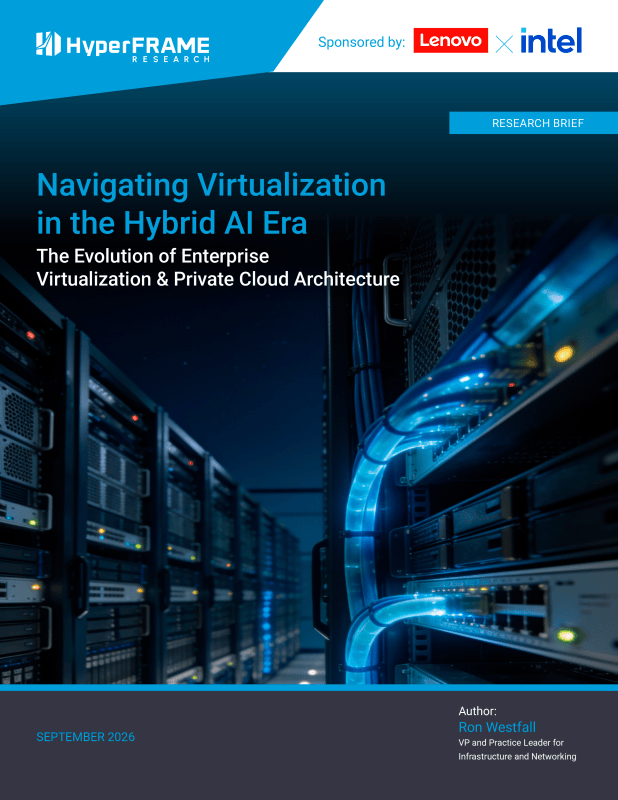
Navigating Virtualization in the Hybrid AI Era
The Evolution of Enterprise Virtualization & Private Cloud Architecture

To bridge the hybrid cloud operational maturity gap and scale Private AI securely, enterprises must transition to an automated private cloud control plane powered by high-density Lenovo ThinkSystem servers with Intel Xeon 6 processors, direct-to-chip Neptune liquid cooling, and TruScale consumption. Enterprise virtualization has evolved beyond hypervisor consolidation into a strategic, full-stack hybrid cloud infrastructure where virtual machines and containerized environments converge. However, a significant operational maturity gap persists according to HyperFRAME Lens primary data: while 55% of organizations report operating hybrid cloud models, only 23% of compute workloads actually execute within them. To close this divide, enterprises must abandon fragmented point-to-point topologies and embed AI operations within an orchestrated, automated private cloud control plane. By running Private AI and localized inference adjacent to existing on-premises enterprise data, organizations eliminate the bandwidth costs, high latency, and regulatory governance risks inherent to public cloud offloading.
Shifting virtualization licensing dynamics - led by VMware's transition to subscription bundling for the top 5,000 enterprises - are driving widespread infrastructure re-evaluations toward platforms like Red Hat OpenShift Virtualization, Nutanix AHV, and optimized VMware Cloud Foundation (VCF) deployments. Modernizing the underlying hardware substrate is critical to navigating this transition. Lenovo ThinkSystem servers powered by Intel Xeon 6 processors integrate Intel Advanced Matrix Extensions (AMX) to execute fine-tuned and small-to-medium AI inference models directly on host CPUs. This eliminates the necessity of deploying expensive, power-intensive discrete GPUs across every node while enabling organizations to compress physical host requirements and software licensing footprints by up to 40% without compromising baseline workload capacity.
Hardware-enforced confidential computing via Intel Trust Domain Extensions (TDX) and Software Guard Extensions (SGX) ensures that proprietary models and enterprise data remain isolated and encrypted in memory—shielded from hypervisors, host operating systems, and adjacent tenants. Concurrently, escalating compute densities demand modern thermal infrastructure. Integrating direct-to-chip Neptune liquid-cooling technology dissipates extreme thermal loads at the component level, preventing processor throttling and unlocking up to 51% in total cost of ownership (TCO) savings through dramatic reductions in data center floor space, power overhead, and facility cooling demands.
Operationalizing modern hybrid private clouds requires transforming traditional procurement and support workflows into agile, service-driven models. Transitioning to Lenovo TruScale Infrastructure-as-a-Service (IaaS) converts escalating capital expenditures into predictable, metered operating expenditures, preserving data sovereignty while absorbing expanding IT infrastructure budget allocations. At the management tier, integrating Lenovo xIQ telemetry with enterprise ServiceNow workflows automates hardware diagnostics, proactive threat detection, and self-healing remediations. This structural automation resolves up to 40% of infrastructure anomalies before end-user degradation occurs, slashes IT support operational costs by up to 30%, and accelerates employee onboarding time-to-productivity by up to 50%.
Key Research Brief Highlights
● Closing the Hybrid Maturity Gap: Resolves the operational imbalance where 55% of enterprises operate hybrid cloud models but only 23% of compute workloads run within them by establishing an automated private cloud control plane.
● CPU-Accelerated Private AI & Footprint Compression: High-density Lenovo ThinkSystem nodes powered by Intel Xeon 6 processors leverage built-in Intel AMX to run local inference, shrinking software licensing footprints and physical server counts by up to 40%.
● Silicon-Enforced Confidential Computing: Hardware-level isolation via Intel TDX and SGX secures proprietary AI models and sensitive data in memory across virtual machines and multi-tenant enclaves.
● Neptune Direct Liquid Cooling TCO Gains: Full rack-scale Neptune direct-to-chip liquid cooling manages extreme thermal densities, mitigating thermal throttling to drive up to 51% in multi-year TCO savings.
● Autonomous Operations & OpEx Transformation: Lenovo TruScale IaaS eliminates heavy upfront CapEx, while integrating xIQ telemetry with ServiceNow enables self-healing operations that auto-resolve up to 40% of system anomalies and reduce IT support costs by up to 30%.
Key Questions This Research Addresses
Why must enterprises transition from siloed virtualization setups to an automated private cloud control plane?
● Answer: While 55% of organizations deploy hybrid models, only 23% of compute workloads run on them; a unified control plane bridges this maturity gap by centralizing multi-model AI governance, dynamic inferencing routing, token monitoring, and security enforcement across heterogeneous environments.
How does on-premises enterprise virtualization serve as a strategic foundation for Private AI?
● Answer: Existing virtualized environments already house core enterprise data, business logic, and security workflows, making them the optimal bedrock for Local Enterprise Inference adjacent to data assets without incurring public cloud latency, egress costs, or regulatory compliance risks.
How do Intel Xeon 6 processors with Intel AMX optimize mixed-workload compute and lower licensing costs?
● Answer: Intel AMX provides built-in silicon matrix acceleration to execute smaller and fine-tuned AI inference models directly on CPUs, eliminating discrete GPU requirements for general AI tasks while consolidating workloads to reduce physical footprints and software licenses by up to 40%.
How do Intel TDX and SGX enforce confidential computing in hybrid private cloud environments?
● Answer: They deliver hardware-backed cryptographic isolation for memory enclaves and virtual machines, ensuring sensitive data and intellectual property remain protected against unauthorized access from underlying host OS layers, hypervisors, and neighboring tenants.
How does Lenovo Neptune direct-to-chip liquid cooling overcome physical data center constraints to lower TCO?
● Answer: By extracting heat directly from high-wattage components via liquid loops, Neptune prevents thermal throttling in extreme-density rack architectures, enabling denser VM allocations and delivering up to 51% in multi-year TCO savings through reduced power, space, and cooling overhead.
What market dynamics are driving the bifurcation of the virtualization migration ecosystem?
● Answer: VMware’s shift to subscription bundling targeted at the top 5,000 global enterprises has bifurcated the market into viable, modern migration paths (Nutanix AHV, Red Hat OpenShift Virtualization, KVM, and hyperscalers) versus legacy, stagnant alternatives (standalone Hyper-V) that lack an architectural runway for AI.
How does pre-validated ThinkAgile VX integration with VMware Cloud Foundation simplify operations?
● Answer: Factory-configured, co-engineered ThinkAgile VX appliances consolidate compute, vSAN storage, networking, and automated lifecycle operations into a single platform, eliminating Day-0 deployment errors and Day-2 maintenance friction.
How does Lenovo TruScale IaaS alleviate enterprise IT budget constraints?
● Answer: TruScale transforms upfront hardware CapEx into a flexible, metered pay-as-you-go OpEx model, enabling organizations to absorb expanding infrastructure budget demands while retaining full on-premises data sovereignty.
How does linking Lenovo xIQ telemetry with ServiceNow drive autonomous, self-healing infrastructure?
● Answer: Deep hardware diagnostics feed telemetry directly into ServiceNow workflows, automating ticket routing and auto-resolving up to 40% of infrastructure anomalies proactively before service degradation occurs.
What measurable business and workforce productivity gains result from Lenovo automated deployment and managed services?
Answer: Predictive analytics and automated workflows reduce overall enterprise IT support costs by up to 30% while streamlining device provisioning to improve employee time-to-productivity by up to 50%.

Ron Westfall | VP and Practice Leader for Infrastructure and Networking
Ron Westfall is a prominent analyst figure in technology and business transformation. Recognized as a Top 20 Analyst by AR Insights and a Tech Target contributor, his insights are featured in major media such as CNBC, Schwab Network, and NMG Media.
His expertise covers transformative fields such as Hybrid Cloud, AI Networking, Security Infrastructure, Edge Cloud Computing, Wireline/Wireless Connectivity, and 5G-IoT. Ron bridges the gap between C-suite strategic goals and the practical needs of end users and partners, driving technology ROI for leading organizations.