


















Research Finder
Find by Keyword
Computex 2026: Can Qualcomm's Solutions Template Drive an Agent-centered Vision??
The Dragonwing IQ10 blueprint shows Qualcomm delivering complete solutions to partners, milliwatt to megawatt; conversion will be the test of the Compute Continuum Vision.

6/23/2026
Key Highlights
- The centerpiece of Qualcomm's Computex slate, the Dragonwing IQ10 Robotics Reference Design (RRD), is a complete, production-ready system for partner manufacturers, built on the Dragonwing IQ10 processor (18 Oryon CPU cores, multicore NPUs, GPU, up to 700 TOPS) and designed to remove the integration work that slows robots from prototype to production.
- On the PC tier, Qualcomm showcased the premium Snapdragon X2 Elite and launched the entry-level Snapdragon C at roughly $300, with an ASUS-built Ascent QN10 mini PC, just as NVIDIA used its own keynote to enter Windows on Arm with the Grace-based N1 and N1X, entering (potentially expanding) a category Qualcomm has carried for years.
- Automotive is the vision's proven case, built over years of co-development behind a design-win pipeline that now exceeds $45 billion, which is why it anchors the favorable read even though the robotics reference design is a newer, less-tested go-to-market.
- Qualcomm's orchestration posture is deliberately partner-friendly, framing its silicon as one coordinated layer from device to cloud while leaving the agent logic to the open ecosystem and partners, a choice that avoids lock-in but also cedes the value-rich orchestration layer.
- Dragonfly extends the model toward the megawatt tier, a new brand over the named AI200 and AI250 accelerators with an early anchor in Humain's 200-megawatt deployment, though the roadmap and additional names wait for the June 24 investor day.
- The favorable case is real, a path to operationalize Amon's continuum, but its payoff turns on unsettled questions: does a reference design convert to volume, will large manufacturers accept a turnkey platform, and whether Qualcomm captures the value it creates rather than risking commoditization of its own silicon.
The News
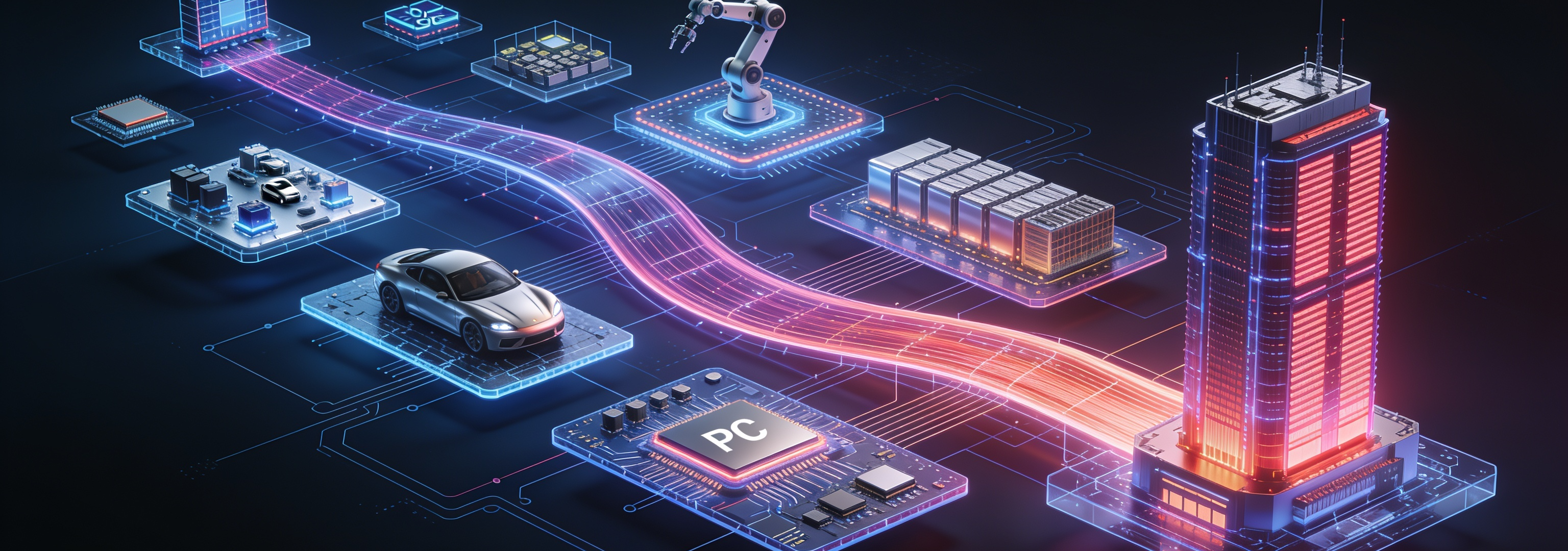
At Computex Taipei 2026, Qualcomm paired Cristiano Amon's agent-centric keynote with a product slate that turns the compute continuum into a concrete go-to-market. Announcements spanned the PC, edge, robotics, and data center tiers, from the milliwatt edge to the megawatt data center. The headline for us at the show was the Dragonwing IQ10 Robotics Reference Design, a complete, production-ready system that consolidates compute, sensing, networking, safety, and software into one package. The company aims this package at partner manufacturers building autonomous mobile robots, industrial machinery, and humanoids. Alongside it, Qualcomm showcased the premium Snapdragon X2 Elite and launched the entry-level Snapdragon C for PCs, and teased Dragonfly as a new brand for its data center silicon. The full product roundup is detailed in media coverage from the show.
Analyst Take
Attending Amon's keynote, I emerged looking for the products that will drive where the continuum stops being a slide and becomes a business model, and the model is a genuinely interesting one. The keynote sold a continuum from the milliwatt edge to the megawatt data center, and our prior note argued it was a vision delivered as category redefinition rather than a product pitch. This note builds on that read, picking up where the keynote piece left off, to ask how the cathedral actually gets built and whether the method holds. In that frame, the interesting thing about the Dragonwing IQ10 reference design is not that it is a complete solution, the name gives that away. The interest comes from Qualcomm is staking its diversification on a go-to-market most chipmakers avoid: selling the integration, not just the silicon. Done well, that bet is defensible, because the integration burden, not raw TOPS, is what actually stalls partners between prototype and production. Players removing that hurdle earn the design and the revenue that trails it. Done poorly, the same move risks commoditizing Qualcomm's own value and invites the margin compression that has punished system-level plays before. So the question is not whether the template is clever. It is whether it converts, and whether Qualcomm captures the value it creates. This reminds us of a design-build firm that sells the finished building rather than the materials piece by piece. That is an approach that earns trust and stickiness when it works, and erodes margin when it does not. That tension is the test we hold every tier against.
What Was Announced
The Dragonwing IQ10 Robotics Reference Design merits the closest look, because it is where Qualcomm's go-to-market thesis is most explicit. The company’s argument is that building a production robot today means stitching together separate compute units, sensor bridge boards, networking, safety, real-time control, and a software stack. This integration work, not raw compute, is what stretches development cycles by months. Addressing that gap, the RRD offers partners a complete, validated system built on the premium Dragonwing IQ10 processor, with native ingestion of up to 12 GMSL2 cameras alongside LiDAR, Time-of-Flight, and inertial sensors. The package also includes on-device AI runtimes, ROS2 support, and cloud-connected fleet management through the Qualcomm AI Hub. While a new release, the RRD builds on the legacy of validated functional safety architectures and integration know-how honed over the company’s decade in automotive production programs. That more than anything else gives downstream partner manufacturers a creditable argument during the certification and reliability hurdles that often derail robotics timelines.
The early-access bench is deep, spanning NEURA Robotics, Advantech, APLUX, Booster, Innodisk, MeiG, NEXCOM, Radxa, Thundercomm, and VinMotion. The open question is conversion. Reference designs are not unusual in this industry, and a launch roster is easier to assemble than a shipping fleet. The figure that will matter is not the partner count today, but how many of those names reach volume on Qualcomm silicon. Also, whether larger manufacturers adopt the platform rather than studying it and building their own.
On the PC tier, Qualcomm gave its continuum more shipping substance, showcasing the premium Snapdragon X2 Elite, the third-generation Oryon-based Windows platform first shown at its 2025 Snapdragon Summit. The company also launched the entry-level Snapdragon C at roughly $300 for budget-conscious buyers, with an ASUS-built Ascent QN10 AI mini PC extending the lineup. The PC tier also produced the show's sharpest competitive subplot, even if Qualcomm did not stage it. NVIDIA used its own Computex keynote to launch the N1 and N1X, the Grace-based Arm superchip branded RTX Spark for Windows PCs, its most serious push yet into the laptop processor market. Over lunch, I put the obvious question to Qualcomm CMO Don McGuire: Qualcomm has carried the Windows-on-Arm, all-day-battery-life argument for years, largely alone, so what does it mean when the most influential name in AI silicon validates that thesis by entering it? The honest framing seems to be ‘welcome to the party.’ At HyperFRAME, we see NVIDIA's arrival as the strongest endorsement yet of a category Qualcomm helped create. It remains to be seen whether a bigger market with a marquee entrant tends to reward the company that proved the recipe, even if NVIDIA is largely targeting the extreme high end of the space.
On how all of that intelligence is coordinated, Qualcomm's posture is deliberately architectural and partner-friendly. It frames its silicon as one coordinated layer across devices, edge, and infrastructure, and supplies the connective software through on-device runtimes, the Qualcomm AI Hub, and a data center inference suite. This approach leaves the agent logic to the open ecosystem, the company’s own commentary has pointed to local-first frameworks such as OpenClaw, and to partners like ThunderSoft, whose AquaDrive operating system runs multi-agent orchestration on Snapdragon automotive platforms. That openness is genuinely attractive to partners wary of lock-in. It also means the orchestration layer, where much of the long-run value in an agentic world may accrue, is one Qualcomm is choosing to cede, for now. The substrate is Qualcomm's. The mesh, by design, is shared, and that is a strategic choice with two edges.
Automotive is the part of the story that earns the favorable read, and it is worth being precise about why. Qualcomm did not win automotive with a reference design handed to partners; it won through years of deep co-development and design wins, behind a pipeline that now exceeds $45 billion and relationships with Mercedes-Benz, BMW, Volkswagen Group, Toyota, and a widening set of Chinese automakers including a recent Chery agreement. The substantive automotive news landed earlier in the spring at Auto China rather than at Computex, where the keynote used the car mainly as a reference point for physical AI, with Qualcomm framing a vehicle as essentially a robot you drive. The Snapdragon Digital Chassis, spanning the Cockpit and Ride platforms, is the most complete expression of the integrated-platform model, with a fifth-generation version targeted for commercial shipments by the end of fiscal 2026. Partners are already building agentic software on top, as ThunderSoft demonstrated on-device inference of a large mixture-of-experts model and a multi-agent cockpit architecture on Snapdragon silicon. The honest read is that automotive shows the model can work, not that robotics will replicate it on the same timeline, because the automotive win took the better part of a decade and rested on relationships a reference design alone does not buy.
At the megawatt end of the continuum, Qualcomm teased Dragonfly, a new third brand tier alongside Snapdragon and Dragonwing, applying the same integrated-solution logic to the data center. The tier is more real than a brand launch alone implies, with the named AI200 inference accelerator shipping in 2026 and the AI250 due in 2027. The company can boast an early anchor customer in Humain's planned 200-megawatt deployment, and an unnamed hyperscaler with custom shipments targeted for late 2026. It is also the least proven tier, and the one where Qualcomm named no new products at Computex, routing the roadmap and additional customer names to its June 24 investor day in New York. The generous reading is a sequenced reveal; the skeptic could be forgiven seeing this as an unfinished story. Both can be true, and which one prevails is what June 24 has to settle, in the most contested tier of the continuum against the most entrenched incumbents.
Market Analysis
The throughline across the slate is a single delivery model, selling the integrated solution rather than the component, and the favorable case for it is straightforward. At each tier the binding constraint on adoption is integration, not peak performance. The chipmaker absorbing that burden can win the design and the multi-year revenue that follows, which is what Qualcomm already demonstrates in automotive. The harder case is the one a rigorous read has to weigh against it. NVIDIA's Jetson platform and CUDA developer base remain the gravitational center of robot compute, and a complete solution competes against incumbency and habit, not just specifications. Reference designs have a long history of impressive launch rosters and modest conversion. And the integrated model carries an internal tension, because the more Qualcomm sells the whole solution, the more it risks commoditizing its own silicon and inviting the margin pressure that has dogged system-level strategies elsewhere. None of this refutes the thesis, but it does boundary the case. The model is most likely to pay off where Qualcomm already holds relationships and a power-efficiency edge that is hard to match (i.e. automotive and at the battery-constrained edge) with the least certainty where it is newest and most contested, in volume robotics and the megawatt data center. The most durable question is value capture, whether selling complete solutions builds a moat or simply presents a head start. That will only show up in margins and conversion in the coming quarters.
Looking Ahead
The key trend we will be monitoring is conversion, because that is where this thesis rises or falls. For robotics, that means watching whether the Dragonwing IQ10 reference design turns its early-access roster into named, deployed AMRs and humanoids at volume. Also, a crucial data point will be whether any large manufacturer adopts it rather than treating it as a reference to learn from and then leave. For automotive, it means tracking the fifth-generation Snapdragon Digital Chassis into production and watching whether the agentic cockpit convergence reaches shipping vehicles, because for Qualcomm, automotive is where the model has already earned the benefit of the doubt. And it means June 24, Dragonfly has to follow the tease with an integrated model headroom into the megawatt tier with named customers, dates, and a credible answer on margin. Amon described a continuum from the milliwatt edge to the megawatt data center. Computex made the favorable case that Qualcomm has a coherent method for building it. The next several quarters will show whether the method becomes a durable moat.

Stephen Sopko | Analyst-in-Residence – Semiconductors & Deep Tech
Stephen Sopko is an Analyst-in-Residence specializing in semiconductors and the deep technologies powering today’s innovation ecosystem. With decades of executive experience spanning Fortune 100, government, and startups, he provides actionable insights by connecting market trends and cutting-edge technologies to business outcomes.
Stephen’s expertise in analyzing the entire buyer’s journey, from technology acquisition to implementation, was refined during his tenure as co-founder and COO of Palisade Compliance, where he helped Fortune 500 clients optimize technology investments. His ability to identify opportunities at the intersection of semiconductors, emerging technologies, and enterprise needs makes him a sought-after advisor to stakeholders navigating complex decisions.